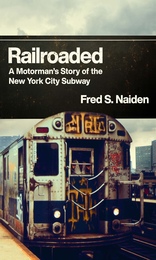
front cover of Railroaded
Railroaded
A Motorman's Story of the New York City Subway
Fred S. Naiden
Rutgers University Press

“A fascinating insider’s view of a vital and dangerous profession.” —The Wall Street Journal
“An instant classic of labor and transportation history.” —Library Journal, starred review

The New York City subway system is one of the largest and oldest in the world, still carrying traces of the transport systems that came before it. Some of its elevated tracks are remnants of steam railroads, and some tunnels run where canoes served as ferries. For passengers, riding the subway can feel like stepping into another world, dark and dank and sometimes dangerous. Now just imagine what it’s like to work there every day.

One of the few subway workers who went on to earn a PhD from Harvard, historian Fred Naiden gives readers a firsthand look at what it was like to work as a subway porter, a motorman, and a locomotive engineer during the 1980s. He recounts the labor activism of his fellow MTA employees, who advocated for better conditions, higher pay, and less institutional racism. He also shares wild stories about the riders he encountered, from a homeless former realtor who worked as a mob frontman to an angry passenger who pulled a gun on him while the train was stuck at a stop signal. Above all, Railroaded will answer many questions about the New York subway system, including how it could be improved.

[more]

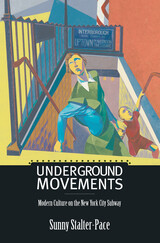
front cover of Underground Movements
Underground Movements
Modern Culture on the New York City Subway
Sunny Stalter-Pace
University of Massachusetts Press, 2013
For more than a century the New York City subway system has been a vital part of the city's identity, even as judgments of its value have varied. It has been celebrated as the technological embodiment of the American melting pot and reviled as a blighted urban netherworld. Underground Movements explores the many meanings of the subway by looking back at the era when it first ascended to cultural prominence, from its opening in 1904 through the mid-1960s. Sunny Stalter-Pace analyzes a broad range of texts written during this period—news articles, modernist poetry, ethnic plays, migration narratives, as well as canonical works by authors such as Hart Crane, William Carlos Williams, and Ralph Ellison—to illustrate the subway's central importance as a site of abstract connection, both between different parts of the city and between city dwellers who ride the train together.

Writers and artists took up questions that originated in the sphere of urban planning to explore how underground movement changed the ways people understand the city. Modern poets envisioned the subway as a space of literary innovation; playwrights and fiction writers used it to gauge the consequences of migration and immigration; and essayists found that it underscored the fragile relationship between urban development and memory. Even today, the symbolic associations forged by these early texts continue to influence understanding of the cultural significance of the subway and the city it connects.
[more]


Send via email Share on Facebook Share on Twitter