
 A SCHOLARLY BOOK REPOSITORY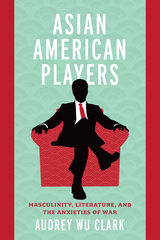
The player is a womanizer, a trickster, a gambler—but can Asian American men fully participate in this kind of masculinity? In Asian American Players, Audrey Wu Clark showcases how the literary figure of the Asian American player unsettles the hegemony of white American masculinity through mimicry, even as that masculinity socially and politically alienates him. She examines gendered and racialized US militarism through works written during major postmodern American wars, investigating how books by John Okada, David Henry Hwang, Chang-rae Lee, Frances Khirallah Noble, and Viet Thanh Nguyen (re)fashion Asian American masculinity in ways that ultimately mimic masculinist American foreign policy and military strategies during corresponding wars. She unearths a dual picture of Asian American players: as traces of the anxiety of America’s quest for empowerment and continued military and industrial dominance in the international arena and as those tarred as inferior and disloyal outsiders within this mirrored global dominance. She thus finds new inroads into understanding US imperialism and militarism and identifies ways that key literary figures have written against insidious tropes.
Finalist, National Book Critics Circle Award
Finalist, National Book Award in Nonfiction
A New York Times Book Review “The Year in Reading” Selection
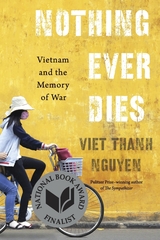
All wars are fought twice, the first time on the battlefield, the second time in memory. From the author of the Pulitzer Prize–winning novel The Sympathizer comes a searching exploration of the conflict Americans call the Vietnam War and Vietnamese call the American War—a conflict that lives on in the collective memory of both nations.
“[A] gorgeous, multifaceted examination of the war Americans call the Vietnam War—and which Vietnamese call the American War…As a writer, [Nguyen] brings every conceivable gift—wisdom, wit, compassion, curiosity—to the impossible yet crucial work of arriving at what he calls ‘a just memory’ of this war.”
—Kate Tuttle, Los Angeles Times
“In Nothing Ever Dies, his unusually thoughtful consideration of war, self-deception and forgiveness, Viet Thanh Nguyen penetrates deeply into memories of the Vietnamese war…[An] important book, which hits hard at self-serving myths.”
—Jonathan Mirsky, Literary Review
“Ultimately, Nguyen’s lucid, arresting, and richly sourced inquiry, in the mode of Susan Sontag and W. G. Sebald, is a call for true and just stories of war and its perpetual legacy.”
—Donna Seaman, Booklist (starred review)
“A wondrously limpid testament to the pleasures of reading.” —Steven Poole, The Guardian
Six incandescent lectures on literature from the patron saint of mirrors, metafiction, and infinite libraries.
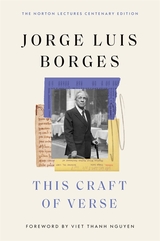
For more than thirty years, Jorge Luis Borges’s Norton Lectures went unpublished. Recorded at Harvard in 1967 and 1968, the tapes gathered dust in a library vault until their discovery after his death. It was a twist that the author of Labyrinths would have relished. This volume assembles the recovered materials, offering a priceless window into the Argentinian master’s lifelong love affair with the English language.
This Craft of Verse captures the cadences, candor, wit, and erudition of one of the twentieth century’s enduring literary voices. Though his avowed topic is poetry, Borges explores subjects ranging from prose forms—especially the novel—to literary history, translation theory, and philosophical aspects of communication writ large. Borges here draws on a wide range of literary examples—modern and medieval English, Spanish, French, Italian, German, Greek, Latin, Arabic, Hebrew, and Chinese. He brings characteristic eloquence and inexhaustible enthusiasm to readings of Plato, the Old Norse kenningar, Byron, Poe, Chesterton, Joyce, and Frost, as well as translations of Homer, the Bible, and the Rubáiyát of Omar Khayyám.
Whether discussing metaphor, the origins of verse, or his own “poetic creed,” Borges gives a performance as entertaining as it is intellectually engaging. A lesson in the love of literature and the making of a unique artistic sensibility, This Craft of Verse is a sustained encounter with one of the writers whose place in the twentieth century will be forever remembered.

From the Pulitzer Prize–winning author of The Sympathizer (now an HBO series) comes a moving and unflinchingly personal meditation on the literary forms of otherness and a bold call for expansive political solidarity.
Born in war-ravaged Vietnam, Viet Nguyen arrived in the United States as a child refugee in 1975. The Nguyen family would soon move to San Jose, California, where the author grew up, attending UC Berkeley in the aftermath of the shocking murder of Vincent Chin, which shaped the political sensibilities of a new generation of Asian Americans.
The essays here, delivered originally as the prestigious Norton Lectures, proffer a new answer to a classic literary question: What does the outsider mean to literary writing? Over the course of six captivating and moving chapters, Nguyen explores the idea of being an outsider through lenses that are, by turns, literary, historical, political, and familial.
Each piece moves between writers who influenced Nguyen’s craft and weaves in the haunting story of his late mother’s mental illness. Nguyen unfolds the novels and nonfiction of Herman Melville, F. Scott Fitzgerald, Ralph Ellison, William Carlos Williams, and Maxine Hong Kingston, until aesthetic theories give way to pressing concerns raised by war and politics. What is a writer’s responsibility in a time of violence? Should we celebrate fiction that gives voice to the voiceless—or do we confront the forces that render millions voiceless in the first place? What are the burdens and pleasures of the “minor” writer in any society? Unsatisfied with the modest inclusion accorded to “model minorities” such as Asian Americans, Nguyen sets the agenda for a more radical and disquieting solidarity with those whose lives have been devastated by imperialism and forever wars.
READERS
Browse our collection.
PUBLISHERS
See BiblioVault's publisher services.
STUDENT SERVICES
Files for college accessibility offices.
RECENTLY PUBLISHED


UChicago Accessibility Resources
home | accessibility | search | about | contact us
BiblioVault ® 2001 - 2025
The University of Chicago Press