
 A SCHOLARLY BOOK REPOSITORY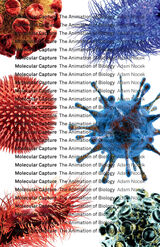
How computer animation technologies became vital visualization tools in the life sciences
Who would have thought that computer animation technologies developed in the second half of the twentieth century would become essential visualization tools in today’s biosciences? This book is the first to examine this phenomenon. Molecular Capture reveals how popular media consumption and biological knowledge production have converged in molecular animations—computer simulations of molecular and cellular processes that immerse viewers in the temporal unfolding of molecular worlds—to produce new regimes of seeing and knowing.
Situating the development of this technology within an evolving field of historical, epistemological, and political negotiations, Adam Nocek argues that molecular animations not only represent a key transformation in the visual knowledge practices of life scientists but also bring into sharp focus fundamental mutations in power within neoliberal capitalism. In particular, he reveals how the convergence of the visual economies of science and entertainment in molecular animations extends neoliberal modes of governance to the perceptual practices of scientific subjects. Drawing on Alfred North Whitehead’s speculative metaphysics and Michel Foucault’s genealogy of governmentality, Nocek builds a media philosophy well equipped to examine the unique coordination of media cultures in this undertheorized form of scientific media. More specifically, he demonstrates how governmentality operates across visual practices in the biosciences and the popular mediasphere to shape a molecular animation apparatus that unites scientific knowledge and entertainment culture.
Ultimately, Molecular Capture proposes that molecular animation is an achievement of governmental design. It weaves together speculative media philosophy, science and technology studies, and design theory to investigate how scientific knowledge practices are designed through media apparatuses.
A bold reimagining of life that bridges science, philosophy, cybernetics, and the complexities of biological existence
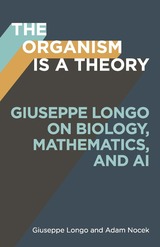
The Organism Is a Theory is an intriguing synthesis of decades of interdisciplinary research by eminent mathematician and biological scientist Giuseppe Longo. A unique collaboration between Longo and philosopher of technology Adam Nocek, the volume confronts foundational issues in the history of mathematics, computer science, physics, and theoretical biology.
Challenging conventional approaches that apply computational and formalist models to the biological world, Longo reveals how the limitations of these models hinder the understanding of organismic complexity, development, and evolution. Through a critique of dominant scientific paradigms, he emphasizes the need for a new biological theory that accounts for the temporal and spatial intricacies of life. Enhanced by Nocek’s comprehensive introduction and a fascinating three-part interview with Longo, The Organism Is a Theory offers a bold rethinking of the biosciences, integrating the work of Alan Turing, Bernhard Riemann, Henri Poincaré, Kurt Gödel, and others into Longo’s vision of critical biology.
Bridging scientific and philosophical discourses, this book creatively applies insights from mathematics, physics, and computing into the study of the organism to present a new theoretical approach to understanding biological complexity that resists reductive mechanistic and informatic explanations.
Retail e-book files for this title are screen-reader friendly with image accompanied by short alt text and/or extended description.
READERS
Browse our collection.
PUBLISHERS
See BiblioVault's publisher services.
STUDENT SERVICES
Files for college accessibility offices.
RECENTLY PUBLISHED






UChicago Accessibility Resources
home | accessibility | search | about | contact us
BiblioVault ® 2001 - 2025
The University of Chicago Press