
 A SCHOLARLY BOOK REPOSITORY
Results by Title
2 books about Nomadism
2 books about Nomadism
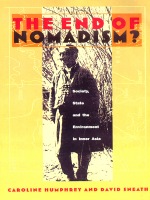
The End of Nomadism?
Society, State, and the Environment in Inner Asia
Caroline Humphrey and David Sneath
Duke University Press, 1999
Those who herd in the vast grassland region of Inner Asia face a precarious situation as they struggle to respond to the momentous political and economic changes of recent years. In The End of Nomadism? Caroline Humphrey and David Sneath confront the romantic, ahistorical myth of the wandering nomad by revealing the complex lives and the significant impact on Asian culture of these modern “mobile pastoralists.” In their examination of the present and future of pastoralism, the authors recount the extensive and quite sudden social, political, environmental, and economic changes of recent years that have forced these peoples to respond and evolve in order to maintain their centuries-old way of life.
Using extensive and detailed case studies comparing pastoralism in Siberian Russia, Mongolia, and Northwest China, Humphrey and Sneath explore the different paths taken by nomads in these countries in reaction to a changing world. In examining how each culture is facing not only different prospects for sustainability but also different environmental problems, the authors come to the surprising conclusion that mobility can, in fact, be compatible with a modern and urbanized world. While placing emphasis on the social and cultural traditions of Inner Asia and their fate in the post-Socialist economies of the present, The End of Nomadism? investigates the changing nature of pastoralism by focusing on key areas under environmental threat and relating the ongoing problems to distinctive socioeconomic policies and practices in Russia and China. It also provides lively contemporary commentary on current economic dilemmas by revealing in telling detail, for instance, the struggle of one extended family to make a living.
This book will interest Central Asian, Russian, and Chinese specialists, as well as those studying the environment, anthropology, sociology, peasant studies, and ecology.
Using extensive and detailed case studies comparing pastoralism in Siberian Russia, Mongolia, and Northwest China, Humphrey and Sneath explore the different paths taken by nomads in these countries in reaction to a changing world. In examining how each culture is facing not only different prospects for sustainability but also different environmental problems, the authors come to the surprising conclusion that mobility can, in fact, be compatible with a modern and urbanized world. While placing emphasis on the social and cultural traditions of Inner Asia and their fate in the post-Socialist economies of the present, The End of Nomadism? investigates the changing nature of pastoralism by focusing on key areas under environmental threat and relating the ongoing problems to distinctive socioeconomic policies and practices in Russia and China. It also provides lively contemporary commentary on current economic dilemmas by revealing in telling detail, for instance, the struggle of one extended family to make a living.
This book will interest Central Asian, Russian, and Chinese specialists, as well as those studying the environment, anthropology, sociology, peasant studies, and ecology.
[more]
Nomad Properties
Political Anthropologies of Nomadism from the 18th Century until Today
Edited by Anna Möllers, Dirk Schuck, and Bernhard Kleeberg
Campus Verlag, 2024
Perspectives on nomadism in political and theoretical contexts.
What is the discourse about nomadism telling us about anthropological concepts of Western societies? This edited volume relates historical instances of nomadism to the role of “the nomad” in political discourses and recent theoretical debates. The figure of the nomad was and still is constructed as an antagonist within a (neo-)liberal frame of narratives about sedentarism, productivity, and improvement. Whereas the discourse about nomadism in the eighteenth and nineteenth centuries was entangled with colonial contexts and ideas about so-called primitive societies, it became even more multifaceted in the twentieth century, considering ideas about “nomadic thinking” of Deleuze and Guattari, and different forms of “modern nomadism” on the rise: from traveling day laborers to refugees of war, from scientists to a global managerial class.
What is the discourse about nomadism telling us about anthropological concepts of Western societies? This edited volume relates historical instances of nomadism to the role of “the nomad” in political discourses and recent theoretical debates. The figure of the nomad was and still is constructed as an antagonist within a (neo-)liberal frame of narratives about sedentarism, productivity, and improvement. Whereas the discourse about nomadism in the eighteenth and nineteenth centuries was entangled with colonial contexts and ideas about so-called primitive societies, it became even more multifaceted in the twentieth century, considering ideas about “nomadic thinking” of Deleuze and Guattari, and different forms of “modern nomadism” on the rise: from traveling day laborers to refugees of war, from scientists to a global managerial class.
[more]
READERS
Browse our collection.
PUBLISHERS
See BiblioVault's publisher services.
STUDENT SERVICES
Files for college accessibility offices.
RECENTLY PUBLISHED



UChicago Accessibility Resources
home | accessibility | search | about | contact us
BiblioVault ® 2001 - 2026
The University of Chicago Press