
 A SCHOLARLY BOOK REPOSITORY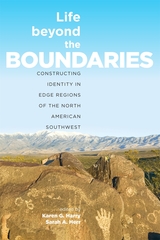
Life beyond the Boundaries explores identity formation on the edges of the ancient Southwest. Focusing on some of the more poorly understood regions, including the Jornada Mogollon, the Gallina, and the Pimería Alta, the authors use methods drawn from material culture science, anthropology, and history to investigate themes related to the construction of social identity along the perimeters of the American Southwest.
Through an archaeological lens, the volume examines the social experiences of people who lived in edge regions. Through mobility and the development of extensive social networks, people living in these areas were introduced to the ideas and practices of other cultural groups. As their spatial distances from core areas increased, the degree to which they participated in the economic, social, political, and ritual practices of ancestral core areas increasingly varied. As a result, the social identities of people living in edge zones were often—though not always—fluid and situational.
Drawing on an increase of available information and bringing new attention to understudied areas, the book will be of interest to scholars of Southwestern archaeology and other researchers interested in the archaeology of low-populated and decentralized regions and identity formation. Life beyond the Boundaries considers the various roles that edge regions played in local and regional trajectories of the prehistoric and protohistoric Southwest and how place influenced the development of social identity.
Contributors: Lewis Borck, Dale S. Brenneman, Jeffery J. Clark, Severin Fowles, Patricia A. Gilman, Lauren E. Jelinek, Myles R. Miller, Barbara J. Mills, Matthew A. Peeples, Kellam Throgmorton, James T. Watson
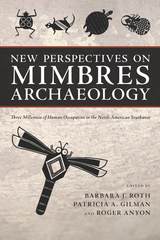
New Perspectives on Mimbres Archaeology brings together these experts in a single volume for the first time. The contributors discuss current knowledge of the people who lived in the Mimbres region of the southwestern United States and how our knowledge has changed since the Mimbres Foundation, directed by Steven A. LeBlanc, began the first modern archaeological investigations in the region. Many of these authors have spent decades conducting the fieldwork that has allowed for a broader understanding of Mimbres society.
Focusing on a variety of important research topics of interest to archaeologists—including the social contexts of people and communities, the role of ritual and ideology in Mimbres society, evidence of continuities and cultural change through time, and the varying impacts of external influences throughout the region—New Perspectives on Mimbres Archaeology presents recent data on and interpretations of the entire pre-Hispanic sequence of occupation. Additional contributions include a history of nonprofit archaeology by William H. Doelle and a concluding chapter by Steven A. LeBlanc reflecting on his decades-long work in Mimbres archaeology and outlining important areas for the next wave of research.
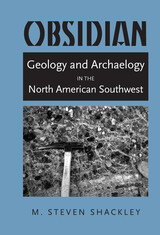
Archaeological obsidian studies in the American Southwest and beyond have significantly matured in the last two decades. Like ceramic analysis, obsidian artifact analysis has become a key factor in many archaeological projects because obsidian used to produce chipped stone tools is common across time periods in the Southwest—from Paleoindian through colonial periods. Even today, making stone tools from obsidian is used in teaching.
In the last twenty years, not only have the ways archaeologists use obsidian provenance to address twenty-first-century issues changed, but we now also see geologists and paleontologists using obsidian in ways never before imagined.
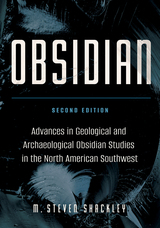
In the second edition of Obsidian, author M. Steven Shackley examines the newly discovered sources of archaeological obsidian and other volcanic rocks on both sides of the U.S.-Mexico border. This work has aided in building new inferences concerning exchange, group interaction, and social networks: subjects that were only emerging twenty years ago in obsidian studies.
The field of obsidian provenance studies is truly international, linking archaeologists and geologists in the United States like never before. While the obsidian sources covered in this volume are regionally specific, the applications and methods used in the understanding of source recording, composition issues, and provenance are relevant worldwide.
READERS
Browse our collection.
PUBLISHERS
See BiblioVault's publisher services.
STUDENT SERVICES
Files for college accessibility offices.
RECENTLY PUBLISHED



UChicago Accessibility Resources
home | accessibility | search | about | contact us
BiblioVault ® 2001 - 2026
The University of Chicago Press