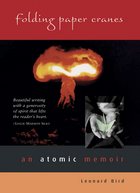
Between 1951 and 1962 the Atomic Energy Commission triggered some one hundred atmospheric detonations of nuclear weapons at the Nevada Test Site. U.S. military troops who participated in these tests were exposed to high doses of radiation. Among them was a young Marine named Leonard Bird. In Folding Paper Cranes Bird juxtaposes his devastating experience of those atomic exercises with three visits over his lifetime—one in the 1950s before his Nevada assignment, one in 1981, and one in the early 1990s—to the International Park for World Peace in Hiroshima.
Among the monuments to tragedy and hope in Hiroshima’s Peace Park stands a statue of Sadako Sasaki holding a crane in her outstretched arms. Sadako was two years old when the atomic bomb was dropped on her city; she was diagnosed with leukemia ten years later. According to popular Japanese belief, folding a thousand paper cranes brings good fortune. Sadako spent the last months of her young life folding hundreds of paper cranes. She folded 644 before she died.
As he journeys from the Geiger counters, radioactive dust, and mushroom clouds of the Nevada desert to the bronze and ivory memorials for the dead in Japan, Bird—himself a survivor of radiation-induced cancer—seeks to make peace with his past and with a future shadowed by nuclear proliferation. His paper cranes are the poetry and prose of this haunting memoir.