
 A SCHOLARLY BOOK REPOSITORY
Results by Title
2 books about Orderliness
2 books about Orderliness

More Than Pretty Boxes
How the Rise of Professional Organizing Shows Us the Way We Work Isn’t Working
Carrie M. Lane
University of Chicago Press, 2024
This study of organizing and decluttering professionals helps us understand—and perhaps alleviate—the overwhelming demands society places on our time and energy.
For a widely dreaded, often mundane task, organizing one’s possessions has taken a surprising hold on our cultural imagination. Today, those with the means can hire professionals to help sort and declutter their homes. In More Than Pretty Boxes, Carrie M. Lane introduces us to this world of professional organizers and offers new insight into the domains of work and home, which are forever entangled—especially for women.
The female-dominated organizing profession didn’t have a name until the 1980s, but it is now the subject of countless reality shows, podcasts, and magazines. Lane draws on interviews with organizers, including many of the field’s founders, to trace the profession’s history and uncover its enduring appeal to those seeking meaningful, flexible, self-directed work. Taking readers behind the scenes of real-life organizing sessions, More Than Pretty Boxes details the strategies organizers use to help people part with their belongings, and it also explores the intimate, empathetic relationships that can form between clients and organizers.
But perhaps most importantly, More Than Pretty Boxes helps us think through an interconnected set of questions around neoliberal work arrangements, overconsumption, emotional connection, and the deeply gendered nature of paid and unpaid work. Ultimately, Lane situates organizing at the center of contemporary conversations around how work isn’t working anymore and makes a case for organizing’s radical potential to push back against the overwhelming demands of work and the home, too often placed on women’s shoulders. Organizers aren’t the sole answer to this crisis, but their work can help us better understand both the nature of the problem and the sorts of solace, support, and solutions that might help ease it.
For a widely dreaded, often mundane task, organizing one’s possessions has taken a surprising hold on our cultural imagination. Today, those with the means can hire professionals to help sort and declutter their homes. In More Than Pretty Boxes, Carrie M. Lane introduces us to this world of professional organizers and offers new insight into the domains of work and home, which are forever entangled—especially for women.
The female-dominated organizing profession didn’t have a name until the 1980s, but it is now the subject of countless reality shows, podcasts, and magazines. Lane draws on interviews with organizers, including many of the field’s founders, to trace the profession’s history and uncover its enduring appeal to those seeking meaningful, flexible, self-directed work. Taking readers behind the scenes of real-life organizing sessions, More Than Pretty Boxes details the strategies organizers use to help people part with their belongings, and it also explores the intimate, empathetic relationships that can form between clients and organizers.
But perhaps most importantly, More Than Pretty Boxes helps us think through an interconnected set of questions around neoliberal work arrangements, overconsumption, emotional connection, and the deeply gendered nature of paid and unpaid work. Ultimately, Lane situates organizing at the center of contemporary conversations around how work isn’t working anymore and makes a case for organizing’s radical potential to push back against the overwhelming demands of work and the home, too often placed on women’s shoulders. Organizers aren’t the sole answer to this crisis, but their work can help us better understand both the nature of the problem and the sorts of solace, support, and solutions that might help ease it.
[more]
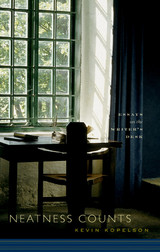
Neatness Counts
Essays on the Writer’s Desk
Kevin Kopelson Kopelson
University of Minnesota Press, 2006
In Neatness Counts, Kevin Kopelson reflects on the poetics of the desk—rolltop or bureau-plat, cluttered or bare, the nestlike desk, the schematic desk, the dramatic desk, the dramatic lack of any such furniture. Exploring the topography of literary creation by way of the topography of work space, Kopelson, one of today’s most important critics, offers a series of meditations on how orderliness, chaos, and other physical states correspond with both the exhilaration of production and the desperation of writer's block.Focusing on the poet Elizabeth Bishop, the novelist Marcel Proust, the critic Roland Barthes, the playwright Tom Stoppard, and the travel writer Bruce Chatwin, Neatness Counts is at once critical and creative, examining how various writers' work habits relate to their published work. Kopelson also considers desks of his own—one that had belonged to an older brother, one he borrowed from a messy friend, one now shared with a partner. And by pursuing these two lines of inquiry to their unlikely but enlightening conclusions, Kopelson both fabricates a virtual library of literary insight and commemorates an era in which the term “desktop” didn’t denote one’s computer screen.Kevin Kopelson is professor of English at the University of Iowa. His books include, most recently, The Queer Afterlife of Vaslav Nijinsky.
[more]
READERS
Browse our collection.
PUBLISHERS
See BiblioVault's publisher services.
STUDENT SERVICES
Files for college accessibility offices.
RECENTLY PUBLISHED





UChicago Accessibility Resources
home | accessibility | search | about | contact us
BiblioVault ® 2001 - 2025
The University of Chicago Press