
 A SCHOLARLY BOOK REPOSITORY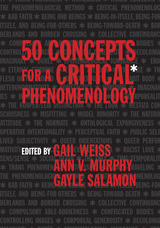
Phenomenology, the philosophical method that seeks to uncover the taken-for-granted presuppositions, habits, and norms that structure everyday experience, is increasingly framed by ethical and political concerns. Critical phenomenology foregrounds experiences of marginalization, oppression, and power in order to identify and transform common experiences of injustice that render “the familiar” a site of oppression for many. In Fifty Concepts for a Critical Phenomenology, leading scholars present fresh readings of classic phenomenological topics and introduce newer concepts developed by feminist theorists, critical race theorists, disability theorists, and queer and trans theorists that capture aspects of lived experience that have traditionally been neglected. By centering historically marginalized perspectives, the chapters in this book breathe new life into the phenomenological tradition and reveal its ethical, social, and political promise. This volume will be an invaluable resource for teaching and research in continental philosophy; feminist, gender, and sexuality studies; critical race theory; disability studies; cultural studies; and critical theory more generally.
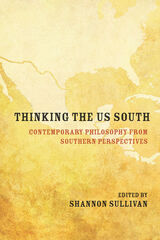
Knowledge emerges from contexts, which are shaped by people’s experiences. The varied essays in Thinking the US South: Contemporary Philosophy from Southern Perspectives demonstrate that Southern identities, borders, and practices play an important but unacknowledged role in ethical, political, emotional, and global issues connected to knowledge production. Not merely one geographical region among others, the US South is sometimes a fantasy and other times a nightmare, but it is always a prominent component of the American national imaginary. In connection with the Global North and Global South, the US South provides a valuable perspective from which to explore race, class, gender, and other inter- and intra-American differences. The result is a fresh look at how identity is constituted; the role of place, ancestors, and belonging in identity formation; the impact of regional differences on what counts as political resistance; the ways that affect and emotional labor circulate; practices of boundary policing, deportation, and mourning; issues of disability and slowness; racial and other forms of suffering; and above all, the question of whether and how doing philosophy changes when done from Southern standpoints. Examining racist tropes, Indigenous land claims, Black Southern philosophical perspectives, migrant labor, and more, this incisive anthology makes clear that roots matter.
READERS
Browse our collection.
PUBLISHERS
See BiblioVault's publisher services.
STUDENT SERVICES
Files for college accessibility offices.
RECENTLY PUBLISHED







UChicago Accessibility Resources
home | accessibility | search | about | contact us
BiblioVault ® 2001 - 2025
The University of Chicago Press