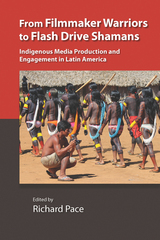
From Filmmaker Warriors to Flash Drive Shamans
Indigenous Media Production and Engagement in Latin America
Richard Pace
Vanderbilt University Press, 2018
From Filmmaker Warriors to Flash Drive Shamans broadens the base of research on Indigenous media in Latin America through thirteen chapters that explore groups such as the Kayapó of Brazil, the Mapuche of Chile, the Kichwa of Ecuador, and the Ayuuk of Mexico, among others, as they engage video, DVDs, photography, television, radio, and the internet.
The authors cover a range of topics such as the prospects of collaborative film production, the complications of archiving materials, and the contrasting meanings of and even conflict over "embedded aesthetics" in media production—i.e., how media reflects in some fashion the ownership, authorship, and/or cultural sensibilities of its community of origin. Other topics include active audiences engaging television programming in unanticipated ways, philosophical ruminations about the voices of the dead captured on digital recorders, the innovative uses of digital platforms on the internet to connect across generations and even across cultures, and the overall challenges to obtaining media sovereignty in all manner of media production.
The book opens with contributions from the founders of Indigenous Media Studies, with an overview of global Indigenous media by Faye Ginsburg and an interview with Terence Turner that took place shortly before his death.
[more]