
 A SCHOLARLY BOOK REPOSITORY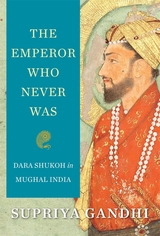
The definitive biography of the eldest son of Emperor Shah Jahan, whose death at the hands of his younger brother Aurangzeb changed the course of South Asian history.
Dara Shukoh was the eldest son of Shah Jahan, the fifth Mughal emperor, best known for commissioning the Taj Mahal as a mausoleum for his beloved wife Mumtaz Mahal. Although the Mughals did not practice primogeniture, Dara, a Sufi who studied Hindu thought, was the presumed heir to the throne and prepared himself to be India’s next ruler. In this exquisite narrative biography, the most comprehensive ever written, Supriya Gandhi draws on archival sources to tell the story of the four brothers—Dara, Shuja, Murad, and Aurangzeb—who with their older sister Jahanara Begum clashed during a war of succession. Emerging victorious, Aurangzeb executed his brothers, jailed his father, and became the sixth and last great Mughal. After Aurangzeb’s reign, the Mughal Empire began to disintegrate. Endless battles with rival rulers depleted the royal coffers, until by the end of the seventeenth century Europeans would start gaining a foothold along the edges of the subcontinent.
Historians have long wondered whether the Mughal Empire would have crumbled when it did, allowing European traders to seize control of India, if Dara Shukoh had ascended the throne. To many in South Asia, Aurangzeb is the scholastic bigot who imposed a strict form of Islam and alienated his non-Muslim subjects. Dara, by contrast, is mythologized as a poet and mystic. Gandhi’s nuanced biography gives us a more complex and revealing portrait of this Mughal prince than we have ever had.

What is the best possible society? How would its rulers govern and its citizens behave? Such questions are sometimes dismissed as distractions from genuine political problems, but in an era when political idealism seems a relic of the past, says Jonny Thakkar, they are more urgent than ever. A daring experiment in using ancient philosophy to breathe life into our political present, Plato as Critical Theorist takes seriously one of Plato’s central claims: that philosophers should rule. What many accounts miss is the intimate connection between Plato’s politics and his metaphysics, Thakkar argues. Philosophy is the activity of articulating how parts and wholes best fit together, while ruling is the activity that shapes the parts of society into a coherent whole conducive to the good life. Plato’s ideal society is thus one in which ideal theory itself plays a leading role.
Today’s liberal democracies require not philosopher-kings legislating from above but philosopher-citizens willing to work toward a vision of the best society in their daily lives. Against the claim that such idealism is inherently illiberal, Thakkar shows that it is fully compatible with the liberal theories of both Popper and Rawls while nevertheless pushing beyond them in providing a new vantage point for the Marxian critique of capitalism.
READERS
Browse our collection.
PUBLISHERS
See BiblioVault's publisher services.
STUDENT SERVICES
Files for college accessibility offices.
RECENTLY PUBLISHED




UChicago Accessibility Resources
home | accessibility | search | about | contact us
BiblioVault ® 2001 - 2025
The University of Chicago Press