
 A SCHOLARLY BOOK REPOSITORY
Results by Title
2 books about Pizzato, Mark
2 books about Pizzato, Mark
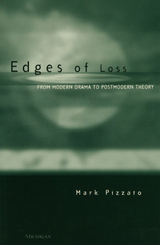
Edges of Loss
From Modern Drama to Postmodern Theory
Mark Pizzato
University of Michigan Press, 1998
One of the curious characteristics of much postmodern theory is the attention it has paid to theater, an art form seemingly more in danger of extinction today than perhaps ever in its history. Mark Pizzato interrogates this curiosity, revealing it as an obsession with the destruction of social institutions and the "universal truths" of modernism. Edges of Loss explores the theatrics of loss in the minds of authors, performers, spectators, and the conflicting social orders of perversion, taboo, and the sacred. Theater as a marginal form reveals the unstable edges of community and the ways such community is imagined and staged. The author initiates his approach to the question of loss through an investigation of the psychohistory of modern and postmodern stages: the return to ritual chorus and the belief in poetry in Eliot's modern poetic drama, the nostalgia for a lost ritual "womb" in Nietzsche's proto-postmodern views of ancient tragedy. Building on this approach, Pizzato employs the techniques of psychobiography wth modern, avant-garde playwrights Antonin Artaud, Bertolt Brecht, and Jean Genet to diagnose the significance of their work in relation to various postmdern theorists. In doing so, he reveals a common concern among both modernists and postmodernists for the stage edge as a border, a gap, an ambiguous juncture between the artist as a self and the artist as a voice of the community. In the end, Edges of Loss establishes this concern as a concern for the lost mother and a lost symbiosis with something deeper and more true. Through its initial focus on literary theory, its subsequent investigation of theatre history and performance history, and its persistent use of various psychoanalytic views, especially regarding spectatorship and cultural studies, Edges of Loss becomes increasingly interdisciplinary. For the aesthetics of loss within modern drama reaches beyond New Critical wholeness toward theatrical elements in many disciplines and various epistemologies of loss. Such differing perspectives show the potential of theater today to display new relationships and to unearth forgotten horizons."An extraordinary and original study. . . a book that wrestles with many current issues in theater and theory without submitting to the common vagaries of those fields of study." --Anthony Kubiak
[more]
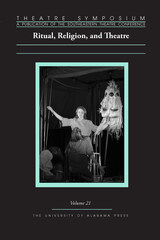
Theatre Symposium, Vol. 21
Ritual, Religion, and Theatre
Edited by E. Bert Wallace
University of Alabama Press, 2013
Volume 21 of Theatre Symposium presents essays that explore the intricate and vital relationships between theatre, religion, and ritual.
Whether or not theatre arose from ritual and/or religion, from prehistory to the present there have been clear and vital connections among the three. Ritual, Religion, and Theatre, volume 21 of the annual journal Theatre Symposium, presents a series of essays that explore the intricate and vital relationships that exist, historically and today, between these various modes of expression and performance.
The essays in this volume discuss the stage presence of the spiritual meme; ritual performance and spirituality in The Living Theatre; theatricality, themes, and theology in James Weldon Johnson’s God’s Trombones; Jordan Harrison’s Act a Lady and the ritual of queerness; Gerpla and national identity in Iceland; confession in Hamlet and Measure for Measure; Christian liturgical drama; Muslim theatre and performance; cave rituals and the Brain’s Theatre; and other, more general issues.
Edited by E. Bert Wallace, this latest publication by the largest regional theatre organization in the United States collects the most current scholarship on theatre history and theory.
CONTRIBUTORS
Cohen Ambrose / David Callaghan / Gregory S. Carr
Matt DiCintio / William Doan / Tom F. Driver / Steve Earnest
Jennifer Flaherty / Charles A. Gillespie / Thomas L. King
Justin Kosec / Mark Pizzato / Kate Stratton
Whether or not theatre arose from ritual and/or religion, from prehistory to the present there have been clear and vital connections among the three. Ritual, Religion, and Theatre, volume 21 of the annual journal Theatre Symposium, presents a series of essays that explore the intricate and vital relationships that exist, historically and today, between these various modes of expression and performance.
The essays in this volume discuss the stage presence of the spiritual meme; ritual performance and spirituality in The Living Theatre; theatricality, themes, and theology in James Weldon Johnson’s God’s Trombones; Jordan Harrison’s Act a Lady and the ritual of queerness; Gerpla and national identity in Iceland; confession in Hamlet and Measure for Measure; Christian liturgical drama; Muslim theatre and performance; cave rituals and the Brain’s Theatre; and other, more general issues.
Edited by E. Bert Wallace, this latest publication by the largest regional theatre organization in the United States collects the most current scholarship on theatre history and theory.
CONTRIBUTORS
Cohen Ambrose / David Callaghan / Gregory S. Carr
Matt DiCintio / William Doan / Tom F. Driver / Steve Earnest
Jennifer Flaherty / Charles A. Gillespie / Thomas L. King
Justin Kosec / Mark Pizzato / Kate Stratton
[more]
READERS
Browse our collection.
PUBLISHERS
See BiblioVault's publisher services.
STUDENT SERVICES
Files for college accessibility offices.
RECENTLY PUBLISHED



UChicago Accessibility Resources
home | accessibility | search | about | contact us
BiblioVault ® 2001 - 2025
The University of Chicago Press