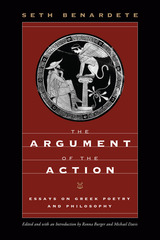
This volume brings together Seth Benardete’s studies of Hesiod, Homer, and Greek tragedy, eleven Platonic dialogues, and Aristotle’s Metaphysics.
The Argument of the Action spans four decades of Seth Benardete’s work, documenting its impressive range. Benardete’s philosophic reading of the poets and his poetic reading of the philosophers share a common ground, guided by the key he found in the Platonic dialogue: probing the meaning of speeches embedded in deeds, he uncovers the unifying intention of the work by tracing the way it unfolds through a movement of its own. Benardete’s original interpretations of the classics are the fruit of this discovery of the “argument of the action.”
Beginning with Plato was first published in 1944. Minnesota Archive Editions uses digital technology to make long-unavailable books once again accessible, and are published unaltered from the original University of Minnesota Press editions.
These selected poems of Joseph Warren Beach range in time from the present year to the age of Pericles; in place from California to Shangri-La, from Paris to the Middle West; in theme from current political issues to the timeless problems of Greek philosophy; in mood from tender love to trenchant satire. In these fifty-odd poems is a rich variety—Anthony Eden and Cordell Hull, the French capital in the summer preceding the first World War, the skylines of the American West, the skylines of Minneapolis, soldier and swan maiden, and the inner life of man wherever lived. Mr. Beach can tell home truths without bitterness, and handle nostalgic emotion without sentimentality.
A comprehensive study of “one of the most elusive and subtle” of all the Platonic dialogues.
The Gorgias begins with a discussion of the nature and value of rhetoric and develops into an impassioned argument for the primacy of absolute right (as expressed by conscience) in the regulation of both public and private life. Plochmann and Robinson closely analyze this great dialogue in the first two-thirds of their book, turning in the final four chapters to a broader discussion of its unity, sweep, and philosophic implications.
In Gorgias and the New Sophistic Rhetoric, Bruce McComiskey achieves three rhetorical goals: he treats a single sophist's rhetorical technê (art) in the context of the intellectual upheavals of fifth-century bce Greece, thus avoiding the problem of generalizing about a disparate group of individuals; he argues that we must abandon Platonic assumptions regarding the sophists in general and Gorgias in particular, opting instead for a holistic reading of the Gorgianic fragments; and he reexamines the practice of appropriating sophistic doctrines, particularly those of Gorgias, in light of the new interpretation of Gorgianic rhetoric offered in this book.
In the first two chapters, McComiskey deals with a misconception based on selective and Platonic readings of the extant fragments: that Gorgias's rhetorical technê involves the deceptive practice of manipulating public opinion. This popular and ultimately misleading interpretation of Gorgianic doctrines has been the basis for many neosophistic appropriations. The final three chapters deal with the nature and scope of neosophistic rhetoric in light of the non-Platonic and holistic interpretation of Gorgianic rhetoric McComiskey postulates in his opening chapters. He concludes by examining the future of communication studies to discover what roles neosophistic doctrines might play in the twenty-first century.
McComiskey also provides a selective bibliography of scholarship on sophistic rhetoric and philosophy in English since 1900.
Walter T. Schmid offers the first original interpretation of the Laches since Hermann Bonitz in the nineteenth century in the only full-length commentary on the Laches available in English.
Schmid divides the book into five main discussions: the historical background of the dialogue; the relation of form and content in a Platonic dialogue and specific structural and aesthetic features of the Laches; the first half of the dialogue, which introduces the characters and considers the theme of the education of young men; the inquiry with Laches, which examines the traditional Greek conception of military courage; and the inquiry with Nicias in which two nontraditional conceptions of courage are mooted, one closely associated with the sophistic movement in Athens, the other with Socrates himself. Furnishing a detailed paragraph-by-paragraph reading that traces Socrates’ ongoing quest for virtue and wisdom—a wisdom founded in the action of a whole human life—Schmid conclusively shows how and why the Laches fills an important niche in Plato’s moral theory.
In this interpretive commentary on Theaetetus, Gregory Kirk makes a major contribution to scholarship on Plato by emphasizing the relevance of the interpersonal dynamics between the interlocutors for the interpretation of the dialogue’s central arguments about knowledge. Kirk attends closely to the personalities of the participants in the dialogue, focusing especially on the unique demands faced by a student—in this case, Theaetetus—and the ways in which one can embrace or deflect the responsibilities of learning. Kirk’s approach gives equal consideration to the dual demands of dramatic interpretation and philosophical argument that constitute the unique character of the Platonic text, and he develops an original interpretation of the Theaetetus, concluding that the uncertainty that characterizes wisdom supersedes the certainty of knowledge.
“If only every introductory course were as engaging as Philosophy 101 by Peter Kreeft! Kreeft offers a marvelous way of using Plato’s Apology both to introduce the whole scope of philosopher and to evoke a personal response. Even the diffident freshman, prone to keeping a new subject like philosopher as arm’s length, will feel the enchantment of love-for-wisdom that philosophy is supposed to be.” – Joseph W. Koterski, S.J., chair, Department of Philosophy, Fordham University
“A terrific introduction to philosophy through this not uncontroversial commentary on Plato’s Apology. Not everyone will agree that Socrates provided the best possible defense for himself nor that he intended to. But Kreeft’s is an eminently defensible reading of the Apology and will awaken many a student to the delights of Plato and Philosophy. The comparisons of Socrates with Christ are fascinating. This book will go a long way to consoling those who are not privileged to have Socrates or Kreeft as teachers in the flesh.” – Janet Smith, Sacred Heart Major Seminary, Detroit
In Philosophy as Agôn: A Study of Plato's Gorgias and Related Texts, Robert Metcalf offers a fresh interpretation of Plato's dialogues as dramatic texts whose philosophy is not so much a matter of doctrine as it is a dynamic, nondogmatic, and open-ended practice of engaging others in agonistic dialogue.
Metcalf challenges prevailing interpretations according to which the agôn (contest or struggle) between the interlocutors in the dialogues is inessential to Plato's philosophical purpose, or simply a reflection of the cultural background of ancient Greek life. Instead, he argues that Plato understands philosophy as essentially agonistic—involving the adversarial engagement of others in dialogue such that one's integrity is put to the test through this engagement, and where the agôn is structured so as to draw adversaries together in agreement about the matters at issue, though that agreement is always open to future contest.
Based on a careful reading of the Gorgias and related Socratic dialogues, such as Apology and Theaetetus, Metcalf contends that agôn is indispensable to the critique of prevailing opinions, to the transformation of the interlocutor through shame-inducing refutation, and to philosophy as a lifelong training (askêsis) of oneself in relation to others.
Once again available in paperback, Plato is the first half of Eric Voegelin's Plato and Aristotle, the third volume of his five-volume Order and History, which has been hailed throughout the Western world as a monumental accomplishment of modern scholarship.
Plato’s dialogues are some of the most widely read texts in Western philosophy, and one would imagine them fully mined for elemental material. Yet, in Plato and Tradition, Patricia Fagan reveals the dialogues to be continuing sources of fresh insight. She recovers from them an underappreciated depth of cultural reference that is crucial to understanding their central philosophical concerns. Through careful readings of six dialogues, Fagan demonstrates that Plato’s presentation of Socrates highlights the centrality of tradition in political, erotic, and philosophic life. Plato embeds Socrates’s arguments and ideas in traditional references that would have been familiar to contemporaries of Socrates or Plato but that today’s reader typically passes over. Fagan’s book unpacks this cultural and literary context for the proper and full understanding of the philosophical argument of the Platonic dialogues. She concludes that, as Socrates demonstrates in word and deed, tradition is essential to successful living. But we must take up tradition with a critical openness to questioning its significance and future. Her original and compelling analyses may change the views of many readers who think themselves already well versed in the dialogues.
Winner, Mina P. Shaughnessy Prize
Achieving the remarkable feat of linking composition theory, deconstruction, and classical rhetoric, this book has been admirably summarized by the theorist G. Douglas Atkins, who writes: "This lively and engaging, informed and informative book constitutes an important contribution. Though its ‘field’ is most obviously composition, composition theory, and pedagogy, part of its importance derives from the way it transcends disciplinary boundaries to bear on writing in general. . . I know of no book that so fully and well discusses, and evaluates, the implications of deconstruction for composition and pedagogy. That [it] goes ‘beyond deconstruction,’ rather than merely ‘applying’ it, increases its importance and signals a clear contribution to the understanding of writing."
Jasper Neel analyzes the emerging field of composition studies within the epistemological and ontological debate over writing precipitated by Plato, who would have us abandon writing entirely, and continued by Derrida, who argues that all human beings are written. This book offers a three-part exploration of that debate. In the first part, a deconstructive reading of Plato’s Phaedrus, Neel shows the elaborate sleight-of-hand that Plato must employ as he uses writing to engage in a semblance of spoken dialogue.
The second part describes Derrida’s theory of writing and presents his famous argument that "the history of truth, of the truth of truth, has always been. . .the debasement of writing, and its repression outside full speech." A lexicon of nine Derridean terms, the key to his theory of writing, is also included. At the end of this section, Neel turns deconstruction against itself, demonstrating that Derridean analysis collapses of its own weight.
The concluding section of the book juxtaposes the implications of Platonic and Derridean views of writing, warning that Derrida’s approach may lock writing inside philosophy. The conclusion suggests that writing may be liberated from philosophical judgment by turning to Derrida’s predecessors, the sophists, particularly Protagoras and Gorgias. Drawing on Protagoras’s idea of strong discourse, Neel shows that sophistry is the foundation of democracy: "Strong discourse is public discourse, which, though based on probability and not truth, remains persuasive over a long period of time to a great number of people. This publicly tested discourse exists only among competitors, never alone, but its ability to remain persuasive even when surrounded by other discourses enables the ideas of democracy to emerge and then keeps democracy alive."
An insightful commentary on Plato’s Laws, his complex final work.
The Laws was Plato’s last work, his longest, and one of his most difficult. In contrast to the Republic, which presents an abstract ideal, the Laws appears to provide practical guidelines for the establishment and maintenance of political order in the real world. Classicist Seth Benardete offers a rich analysis of each of the twelve books of the Laws, which illuminates Plato’s major themes and arguments concerning theology, the soul, justice, and education.
Most importantly, Benardete shows how music in a broad sense, including drama, epic poetry, and even puppetry, mediates between reason and the city in Plato’s philosophy of law. Benardete also uncovers the work’s concealed ontological dimension, explaining why it is hidden and how it can be brought to light. In establishing the coherence and underlying organization of Plato’s last dialogue, Benardete makes a significant contribution to Platonic studies.
Faced with the difficult task of discerning Plato’s true ideas from the contradictory voices he used to express them, scholars have never fully made sense of the many incompatibilities within and between the dialogues. In the magisterial Plato’s Philosophers, Catherine Zuckert explains for the first time how these prose dramas cohere to reveal a comprehensive Platonic understanding of philosophy.
To expose this coherence, Zuckert examines the dialogues not in their supposed order of composition but according to the dramatic order in which Plato indicates they took place. This unconventional arrangement lays bare a narrative of the rise, development, and limitations of Socratic philosophy. In the drama’s earliest dialogues, for example, non-Socratic philosophers introduce the political and philosophical problems to which Socrates tries to respond. A second dramatic group shows how Socrates develops his distinctive philosophical style. And, finally, the later dialogues feature interlocutors who reveal his philosophy’s limitations. Despite these limitations, Zuckert concludes, Plato made Socrates the dialogues’ central figure because Socrates raises the fundamental human question: what is the best way to live?
Plato’s dramatization of Socratic imperfections suggests, moreover, that he recognized the apparently unbridgeable gap between our understandings of human life and the nonhuman world. At a time when this gap continues to raise questions—about the division between sciences and the humanities and the potentially dehumanizing effects of scientific progress—Zuckert’s brilliant interpretation of the entire Platonic corpus offers genuinely new insights into worlds past and present.
Guiding the reader through the key arguments of the classic figures of Western political philosophy, from Plato through to the modern era, this revised edition includes new essays on Aristotle's 'Politics', Confucianism, Islamic social philosophy and Nazism, as well as additional material on 'Roman Law', Anarchism and 'anti-capitalism'.
Cohen moves chronologically through the development of political philosophy. He presents key texts in their own terms, before offering short, precise analyses of their strengths, weaknesses and influence. The book finishes with a discussion of modern liberalism and conservatism.
Providing both a broad overview and precise summaries of key ideas, this is an invaluable guide for all students of political thought.
The leading scholars represented in Politics, Philosophy, Writing examine six key Platonic dialogues and the most important of the epistles, moving from Plato's most public or political writings to his most philosophical. The collection is intended to demonstrate the unity of Plato's concerns, the literary quality of his writing, and the integral relation of form and content in his work. Taken together, these essays show the consistency of Plato's understanding of the political art, the art of writing, and the philosophical life.
Studies emphasizing the unity of Plato's lifework have given way in recent scholarship to specialized and overspecialized examinations of individual dialogues. While each of the contributors to Politics, Philosophy, Writing studies one text, his or her work is oriented toward illuminating the whole of Plato's project. Each of the essays is an innovative contribution to scholarship on its topic; as a collection, they constitute a unique reading of Plato's political philosophy.
Plato scholars have generally divided themselves into two camps: those who concentrate on the analytic or logical aspects of the dialogues, and those who concentrate on the literary-critical features. In one camp are the philologists and classicists, and in the other, the writers of inventive interpretive commentaries. By avoiding distinctions between Plato the poet and Plato the philosopher, Politics, Philosophy, Writing allows a deeper exploration of the comprehensiveness of Plato's theoretical vision and illuminates the lasting challenge of his understanding of the human condition.
An oracle was reported to have said, "No one is wiser than Socrates." And in fact it was Socrates’ life’s work to interpret these words, which demanded and defined the practice of philosophy. Each of these original essays attends carefully to the specifics of the Apology, looking to its dramatic details, its philosophic teaching, and its complexity as a work of writing to bring into focus the "Socrates" of the Apology.
Overall, the contributors, distinguished scholars of ancient philosophy, share a belief in the unity of the letter and the spirit of Platonic philosophy: the conviction that the Platonic text cannot be reached except through reading and cannot be read except through thinking. In this way, the readings in this volume mirror Socrates’ own hermeneutical practice of uniting the demands of the mind and the demands of the text—the Socratic "examination." The result, true to the Socratic injunction that the unexamined life is not worth living, continues that practice of examination, here offering a reexamination of Socrates in the Apology.
The Rhetoric of Morality and Philosophy, one of the most groundbreaking works of twentieth-century Platonic studies, is now back in print for a new generation of students and scholars to discover. In this volume, distinguished classicist Seth Benardete interprets and pairs two important Platonic dialogues, the Gorgias and the Phaedrus, illuminating Socrates’ notion of rhetoric and Plato’s conception of morality and eros in the human soul.
Following his discussion of the Gorgias as a dialogue about the rhetoric of morality, Benardete turns to the Phaedrus as a discourse about genuine rhetoric, namely the science of eros, or true philosophy. This novel interpretation addresses numerous issues in Plato studies: the relation between the structure of the Gorgias and the image of soul/city in the Republic, the relation between the structure of Phaedrus and the concept of eros, and Socrates’ notion of ignorance, among others.
When Athenians suffered the shame of having lost a war from their own greed and foolishness, around 404 BCE the public’s blame was directed at Socrates, a man whose unique appearance and behavior, as well as his disapproval of the democracy, made him a ready target. Socrates was subsequently put on trial and sentenced to death. However, as René Girard has pointed out, no individual can be held responsible for a communal crisis. Plato’s Apology depicts Socrates as both the bane and the cure of Greek society, while his Crito shows a sacrificial Socrates, what some might consider a pharmakos figure, the human drug through whom Plato can dispense his philosophical remedies. With tremendous insight and satisfying complexity, this book analyzes classical texts through the lens of Girard’s mimetic mechanism.
Platonic discourses concerning the soul are incredibly rich and multitiered. Plato's own diverse and disparate arguments and images offer competing accounts of how we are to understand the nature of the soul. Consequently, it should come as no surprise that the accounts of Platonists who engage Plato’s dialogues are often riddled with questions. This volume takes up the theories of well-known philosophers and theologians, including Plato, Plotinus, Proclus, the emperor Julian, and Origen, as well as lesser-known but equally important figures in a collection of essays on topics such as transmigration of the soul, the nature of the Platonist enlightenment experience, soul and gender, pagan ritual practices, Christian and pagan differences about the soul, mental health and illness, and many other topics. Contributors include Crystal Addey, Sara Ahbel-Rappe, Dirk Baltzly, Robert Berchman, Jay Bregman, Luc Brisson, Kevin Corrigan, John Dillon, John F. Finamore, Lloyd P. Gerson, Dorian Gieseler Greenbaum, Elizabeth Hill, Sarah Klitenic Wear, Danielle A. Layne, Ilaria L. E. Ramelli, Gregory Shaw, Svetla Slaveva-Griffine, Suzanne Stern-Gillet, Harold Tarrant, Van Tu, and John D. Turner.
"Exceptionally illuminating and philosophically sophisticated."
---Ted Cohen, Professor of Philosophy, University of Chicago
"In this audacious and long-awaited book, Joel Rudinow takes seriously a range of interrelated issues that most music theorizing is embarrassed to tackle. People often ask me about music and spirituality. With Soul Music, I can finally recommend a book that offers genuine philosophical insight into the topic."
---Theodore Gracyk, Professor of Philosophy, Minnesota State University Moorhead
The idea is as strange as it is commonplace---that the "soul" in soul music is more than just a name, that somehow the music truly taps into something essential rooted in the spiritual notion of the soul itself. Or is it strange? From the civil rights movement and beyond, soul music has played a key, indisputable role in moments of national healing. Of course, American popular music has long been embroiled in controversies over its spiritual purity (or lack thereof). But why? However easy it might seem to dismiss these ideas and debates as quaint and merely symbolic, they persist.
In Soul Music: Tracking the Spiritual Roots of Pop from Plato to Motown, Joel Rudinow, a philosopher of music, takes these peculiar notions and exposes them to serious scrutiny. How, Rudinow asks, does music truly work upon the soul, individually and collectively? And what does it mean to say that music can be spiritually therapeutic or toxic? This illuminating, meditative exploration leads from the metaphysical idea of the soul to the legend of Robert Johnson to the philosophies of Plato and Leo Strauss to the history of race and racism in American popular culture to current clinical practices of music therapy.
Joel Rudinow teaches in the Philosophy and Humanities Departments at Santa Rosa Junior College and is the coauthor of Invitation to Critical Thinking and the coeditor of Ethics and Values in the Information Age.
Marquez shows how this impasse is the key to understanding the ambiguous reevaluation of the rule of law that is the most striking feature of the political philosophy of the Statesman. The law appears here as a mere approximation of the expertise of the inevitably absent statesman, dim images and static snapshots of the clear and dynamic expertise required to steer the ship of state across the storms of the political world. Yet such laws, even when they are not created by genuine statesmen, can often provide the city with a limited form of cognitive capital that enables it to preserve itself in the long run, so long as citizens, and especially leaders, retain a “philosophical” attitude towards them. It is only when rulers know that they do not know better than the laws what is just or good (and yet want to know what is just and good) that the city can be preserved. The dialogue is thus, in a sense, the vindication of the philosopher-king in the absence of genuine political knowledge.
Duhem's 1908 essay questions the relation between physical theory and metaphysics and, more specifically, between astronomy and physics–an issue still of importance today. He critiques the answers given by Greek thought, Arabic science, medieval Christian scholasticism, and, finally, the astronomers of the Renaissance.
In The Tragedy and Comedy of Life, Seth Benardete focuses on the idea of the good in what is widely regarded as one of Plato's most challenging and complex dialogues, the Philebus. Traditionally the Philebus is interpreted as affirming the doctrine that the good resides in thought and mind rather than in pleasure or the body. Benardete challenges this view, arguing that Socrates vindicates the life of the mind over the life of pleasure not by separating the two and advocating a strict asceticism, but by mixing pleasure and pain with mind in such a way that the philosophic life emerges as the only possible human life.
Benardete combines a probing and challenging commentary that subtly mirrors and illuminates the complexities of this dialogue with the finest English translation of the Philebus yet available. The result is a work that will be of great value to classicists, philosophers, and political theorists alike.
The Verge of Philosophy is both an exploration of the limits of philosophy and a memorial for John Sallis’s longtime friend and interlocutor Jacques Derrida. The centerpiece of the book is an extended examination of three sites in Derrida’s thought: his interpretation of Heidegger regarding the privileging of the question; his account of the Platonic figure of the good; and his interpretation of Plato’s discourse on the crucial notion of the chora, the originating space of the universe.
Sallis’s reflections are given added weight—even poignancy—by his discussion of his many public and private philosophical conversations with Derrida over the decades of their friendship. This volume thus simultaneously serves to mourn and remember a friend and to push forward the deeply searching discussions that lie at the very heart of that friendship.
“All of John Sallis’s work is essential, but [this book] in particular is remarkable. . . . Sallis shows better than anyone I have ever read what it means to practice philosophy on the verge.”—Walter Brogan, Villanova University
READERS
Browse our collection.
PUBLISHERS
See BiblioVault's publisher services.
STUDENT SERVICES
Files for college accessibility offices.
UChicago Accessibility Resources
home | accessibility | search | about | contact us
BiblioVault ® 2001 - 2026
The University of Chicago Press