
 A SCHOLARLY BOOK REPOSITORY
The Best Narrative & Biography Books of 2024, Selected by Porchlight
When a progressive college professor runs for the Pennsylvania House of Representatives in a deeply conservative rural district, he loses. That’s no surprise. But the story of how Ferrence loses and, more importantly, how American political narratives refuse to recognize the existence and value of nonconservative rural Americans offers insight into the political morass of our nation.
In essays focused on showing goats at the county fair, planting native grasses in the front lawn, the political power of poetry, and getting wiped out in an election, Ferrence offers a counter-narrative to stereotypes of monolithic rural American voters and emphasizes the way stories told about rural America are a source for the bitter divide between Red America and Blue America.
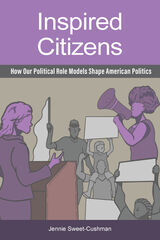
Sweet-Cushman develops Inspired Citizenship Theory to show that political role models can have motivating effects on one’s political citizenship and may, in some case, insulate those who have been traditionally marginalized in American politics. Moreover, she asserts that citizens who have political role models possess very different political behaviors and attitudes than those who do not.
Inspired Citizens also considers the often-conflicting pressures and messages political role models project to citizens. Sweet-Cushman posits that role models inspire political action most effectively when they fulfill highly individualized expectations for role model identity, spurring deeper connection and a desire to emulate.
Inspired Citizens strengthens our understanding of what we should (and should not) look to political figures for in guiding democratic behaviors and inspiring productive citizenship.

A data-rich, eye-opening look at how, when, and why political fundraising is consequential.
Over the last two decades, the number of competitive congressional races has declined precipitously. Yet candidates and officeholders dial for more and more dollars each election, and they do so earlier and earlier in the campaign cycle.
In The Money Signal, Danielle M. Thomsen offers a new perspective on the role of money in politics. She shows that fundraising matters because it is widely used as an indicator of a candidate’s viability and strength, which shapes subsequent donations, dropout decisions, media attention, and rewards in office. Put simply, money is a focal point that candidates, donors, journalists, and party leaders rally around. For candidates, fundraising is a highly public form of self-presentation that pays dividends long before the election and well after the votes are cast.
Thomsen draws on comprehensive fundraising data that spans more than four decades, in addition to interviews, surveys of candidates and donors, newspaper coverage, committee assignments, and analysis of legislative success. The Money Signal highlights the numerous ways that dollars influence the perceptions and behavior of key actors and observers throughout the election cycle.
Navigating Gendered Terrain addresses how gender is used to shape how campaigns are waged by influencing insider perceptions of and decisions about effective campaign messages, images, and tactics within party and political contexts. Dittmar uses survey information and interviews with candidates, political consultants, and other campaign professionals to reveal how gender-informed advertising, websites, and overall presentation to voters respond to stereotypes and perceptions of female and male candidates.
She closes her book by offering a feminist interpretation of women as candidates and explaining how the unintended outcomes of political campaigns reinforce prevailing ideas about gender and candidacy.
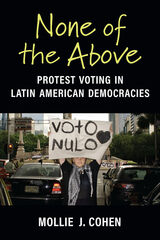
Contrary to received wisdom, this book shows that most citizens cast blank or spoiled votes in presidential elections on purpose. By participating in invalid vote campaigns, citizens can voice their concerns about low-quality candidates while also expressing a preference for high-quality democracy. Campaigns promoting blank and spoiled votes come about more often, and succeed at higher rates, when incumbent politicians undermine the quality of elections. Surprisingly, invalid vote campaigns can shore up the quality of democracy in the short term. None of the Above shows that swings in blank and spoiled vote rates can serve as a warning about the trajectory of a country’s democracy.

Andrew B. Hall argues that we have missed one of the most important reasons for this ideological gulf: the increasing reluctance of moderate citizens to run for office. While political scientists, journalists, and pundits have largely focused on voters, worried that they may be too partisan, too uninformed to vote for moderate candidates, or simply too extreme in their own political views, Hall argues that our political system discourages moderate candidates from seeking office in the first place. Running for office has rarely been harder than it is in America today, and the costs dissuade moderates more than extremists. Candidates have to wage ceaseless campaigns, dialing for dollars for most of their waking hours while enduring relentless news and social media coverage. When moderate candidates are unwilling to run, voters do not even have the opportunity to send them to office. To understand what is wrong with our legislatures, then, we need to ask ourselves the question: who wants to run? If we want more moderate legislators, we need to make them a better job offer.
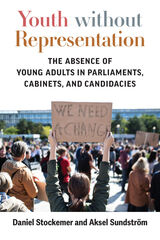
Officeholders in contemporary parliaments and cabinets are more likely than not to be male, wealthy, middle-aged or older, and from the dominant ethnicity, whereas young adults have an insufficient presence in political office. Young adults—those aged 35 years or under—comprise a mere ten percent of all parliamentarians globally, and three percent of all cabinet members. Compared to their presence in the world’s population, this age group faces an underrepresentation of one to three in parliament and one to ten in cabinet. In this book, Stockemer and Sundström provide a holistic account of youths’ marginalization in legislatures, cabinets, and candidacies for office through a comparative lens. They argue that youths’ underrepresentation in political office constitutes a democratic deficit and provide ample evidence for why they think that youth must be present in politics at much higher rates. They further embed this book within what they label a vicious cycle of political alienation, which involves the declining political sophistication of the young, their waning electoral participation, and their insufficient of representation in office. Empirically, the authors combine a global focus with in-depth studies, discussing the country-level, party-level, and individual-level factors that bar young adults’ entry to positions of political power. This is the first comprehensive book on youth representation and it has relevance for those broadly interested in issues of representation, democracy, inequality, and comparative politics.
READERS
Browse our collection.
PUBLISHERS
See BiblioVault's publisher services.
STUDENT SERVICES
Files for college accessibility offices.
RECENTLY PUBLISHED





UChicago Accessibility Resources
home | accessibility | search | about | contact us
BiblioVault ® 2001 - 2026
The University of Chicago Press