
 A SCHOLARLY BOOK REPOSITORY
Results by Title
2 books about Porter, James I.
2 books about Porter, James I.
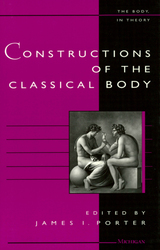
Constructions of the Classical Body
James I. Porter, Editor
University of Michigan Press, 2002
Classical scholarship has traditionally neglected the prominence of the body in antiquity. Constructions of the Classical Body theorizes that the study of antiquity is necessarily a study of the body, and that attention to this fact can lead to a much-needed shift in the way in which classical studies are approached today. This volume aims to reestablish the relevance of the problem of the body at the perimeters of several different kinds of inquiry, and, in this way, to help open up a field of possibilities for future study. The range covered by the essays in this volume is sweeping: from Corinthian vaseware to Athenian and Roman politics, poetry from Homer to Ovid, medical writers from the Hippocratic corpus to the diary of Aelius Aristides (second century c.e.), philosophy (Seneca, Porphyry), the Greek novel, Christian apocrypha, Ovid's medieval reception, and twentieth century film. This range is a consequence of the multidisciplinarity that any study of the body requires, and it attests to the particular richness of the body in classical antiquity and as an object for study today. The volume illustrates that body is located between traditional borders, not within them; the body dissolves traditional objects of study and joins areas usually kept apart. Retracing the fate of the body is thus a way of rendering antiquity truly strange again -- it allows us to see the past afresh, with open eyes.This volume includes essays by Carlin A. Barton, Anne Carlson, Eric Downing, Catherine Edwards, Maud W. Gleason, John Henderson, Ralph Hexter, S. C. Humphreys, Helen King, Leslie Kurke, Robert Lamberton, David S. Potter, Amy Richlin, Giulia Sissa, Maria Wyke, and Froma I. Zeitlin, along with an introduction by James I. Porter. ". . . a superb collection, one that I know will be most welcome not only in the field of classical studies, but in the libraries of all those interested in the history and historicity of the body." --Page duBois, University of California, San Diego
[more]
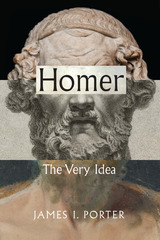
Homer
The Very Idea
James I. Porter
University of Chicago Press, 2021
The story of our ongoing fascination with Homer, the man and the myth.
Homer, the great poet of the Iliad and the Odyssey, is revered as a cultural icon of antiquity and a figure of lasting influence. But his identity is shrouded in questions about who he was, when he lived, and whether he was an actual person, a myth, or merely a shared idea. Rather than attempting to solve the mystery of this character, James I. Porter explores the sources of Homer’s mystique and their impact since the first recorded mentions of Homer in ancient Greece.
Homer: The Very Idea considers Homer not as a man, but as a cultural invention nearly as distinctive and important as the poems attributed to him, following the cultural history of an idea and of the obsession that is reborn every time Homer is imagined. Offering novel readings of texts and objects, the book follows the very idea of Homer from his earliest mentions to his most recent imaginings in literature, criticism, philosophy, visual art, and classical archaeology.
Homer, the great poet of the Iliad and the Odyssey, is revered as a cultural icon of antiquity and a figure of lasting influence. But his identity is shrouded in questions about who he was, when he lived, and whether he was an actual person, a myth, or merely a shared idea. Rather than attempting to solve the mystery of this character, James I. Porter explores the sources of Homer’s mystique and their impact since the first recorded mentions of Homer in ancient Greece.
Homer: The Very Idea considers Homer not as a man, but as a cultural invention nearly as distinctive and important as the poems attributed to him, following the cultural history of an idea and of the obsession that is reborn every time Homer is imagined. Offering novel readings of texts and objects, the book follows the very idea of Homer from his earliest mentions to his most recent imaginings in literature, criticism, philosophy, visual art, and classical archaeology.
[more]
READERS
Browse our collection.
PUBLISHERS
See BiblioVault's publisher services.
STUDENT SERVICES
Files for college accessibility offices.
RECENTLY PUBLISHED




UChicago Accessibility Resources
home | accessibility | search | about | contact us
BiblioVault ® 2001 - 2026
The University of Chicago Press