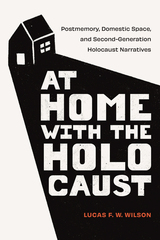
front cover of At Home with the Holocaust
At Home with the Holocaust
Postmemory, Domestic Space, and Second-Generation Holocaust Narratives
Lucas F. W. Wilson
Rutgers University Press, 2025
At Home with the Holocaust examines the relationship between intergenerational trauma and domestic space, focusing on how Holocaust survivors’ homes became extensions of their traumatized psyches that their children “inhabited.” Analyzing second- and third-generation Holocaust literature—such as Art Spiegelman's Maus, Jonathan Safran Foer's Everything Is Illuminated, Sonia Pilcer's The Holocaust Kid, and Elizabeth Rosner's The Speed of Light—as well as oral histories of children of survivors, Lucas F. W. Wilson's study reveals how the material conditions of survivor-family homes, along with household practices and belongings, rendered these homes as spaces of traumatic transference. As survivors’ traumas became imbued in the very space of the domestic, their homes functioned as material archives of their Holocaust pasts, creating environments that, not uncommonly, second-handedly wounded their children. As survivor-family homes were imaginatively transformed by survivors’ children into the sites of their parents’ traumas, like concentration camps and ghettos, their homes catalyzed the transmission of these traumas.
[more]


logo for Harvard University Press
Family Frames
Photography, Narrative, and Postmemory
Marianne Hirsch
Harvard University Press, 1997

Family photographs--snapshots and portraits, affixed to the refrigerator or displayed in gilded frames, crammed into shoeboxes or cataloged in albums--preserve ancestral history and perpetuate memories. Indeed, photography has become the family's primary means of self-representation. In Family Frames Marianne Hirsch uncovers both the deception and the power behind this visual record.

Hirsch provocatively explores the photographic conventions for constructing family relationships and discusses artistic strategies for challenging those constructions. When we capture our family photographically, we are often responding to an idealized image. Contemporary artists and writers, Hirsch shows, have exposed the gap between lived reality and a perceived ideal to witness contradictions that shape visual representations of parents and children, siblings, lovers, or extended families. Exploring fiction, "imagetexts," and photographic essays, she elucidates their subversive devices, giving particular attention to literal and metaphorical masks. While permitting false impressions and misreadings, family photos have also proved a powerful means for shaping personal and cultural memory. Hirsch highlights a striking example: the wide variety of family pictures surviving the Holocaust and the wrenching displacements of late-twentieth-century history. Whether personal treasures, artistic constructions, or museum installations, these images link private memory to collective history.

[more]


Send via email Share on Facebook Share on Twitter