
 A SCHOLARLY BOOK REPOSITORY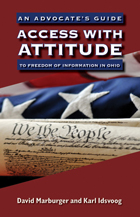
For those who find themselves in a battle for public records, Access with Attitude: An Advocate’s Guide to Freedom of Information in Ohio is an indispensable weapon. First Amendment lawyer David Marburger and investigative journalist Karl Idsvoog have written a simply worded, practical guide on how to take full advantage of Ohio’s so-called Sunshine Laws.
Journalists, law firms, labor unions, private investigators, genealogists, realty companies, banks, insurers—anyone who regularly needs access to publicly held information—will find this comprehensive and contentious guide to be invaluable. Marburger, who drafted many of the provisions that Ohio adopted in its open records law, and coauthor Idsvoog have been fighting for broader access to public records their entire careers. They offer field-tested tips on how to avoid “no,” and advise readers on legal strategies if their requests for information go unmet. Step by step, they show how to avoid delays and make the law work.
Whether you’re a citizen, a nonprofit organization, a journalist, or an attorney going after public records, Access with Attitude is an essential resource.
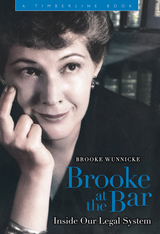
Brooke shares vignettes of her early life—California in the Great Depression, college at Stanford, law school in Colorado during World War II, and the 1946 opening of her Cheyenne law office, a precedent for women in law. She vividly describes memorable and amusing experiences with clients, witnesses, lawyers, juries, and judges and explains some significant cases. She recounts important and dynamic events from her twelve years as Denver’s chief appellate deputy district attorney, an era during which she was an inestimable mentor to many young lawyers who became prominent in the private and public sectors.
Brooke passionately believed “the law has been and will continue to be civilization’s hope.” In her book’s final part, she demystifies many legal terms and procedures and describes the parts of a civil jury trial—including information for jurors and witnesses—and provides an enthusiastic and clear refresher on the US Constitution and Bill of Rights.
Brooke at the Bar is a unique and historically important contribution that will be of interest to general readers, scholars, and students interested in US law, political science, government, women’s history, twentieth-century western history, civil rights, and legal communities, including those in Wyoming and Colorado, where Brooke was “at the Bar.”
From reviews of earlier editions:
“Young people get into legal trouble for two reasons: they do not know what the law is, and they do not stop to think about the consequences of their actions. This book would make a good text for a preparation for life class. . . . The book is written in plain language, unencumbered by a lot of legal citations, and with no expectation that the reader will have any working knowledge of the law.”
—Texas Bar Journal
“A book any parent should consider giving their child. . . . But before you do, take a look at it yourself. No matter the title, Wallace’s book . . . contains information everyone . . . should know.”
—Austin American-Statesman
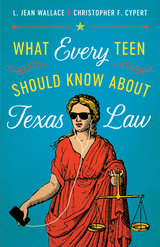
What Every Teen Should Know about Texas Law is the only single-source guide for accurate, easy-to-understand information about most areas of civil law in Texas. L. Jean Wallace drew on years of experience as a students’ attorney at Texas Tech University to inform young adults about the areas of law that affect them most: driving and car ownership, pranks and crimes (including alcohol and drug offenses), personal relationships, employment and consumer concerns, and living on their own. She illustrated her points with true, sometimes humorous, stories of young adults’ encounters with the law.
For this new edition, municipal judge Christopher F. Cypert has completely updated the book to reflect the current state of the law. He covers specific topics that are now mandated to be taught in schools, including the proper way to interact with peace officers during traffic stops and other in-person encounters, as well as internet-era misbehaviors such as sexting and cyberbullying. Like Wallace, Cypert has helped many young people navigate the sometimes confusing processes of the legal world, often loaning earlier editions of this book to young offenders in his court. Both authors’ real-world experience and legal expertise ensure that What Every Teen Should Know about Texas Law is indeed a complete and practical guide for assuming the responsibilities of adulthood—as well as a good refresher course for all legal-age Texans.
READERS
Browse our collection.
PUBLISHERS
See BiblioVault's publisher services.
STUDENT SERVICES
Files for college accessibility offices.
RECENTLY PUBLISHED





UChicago Accessibility Resources
home | accessibility | search | about | contact us
BiblioVault ® 2001 - 2026
The University of Chicago Press