
 A SCHOLARLY BOOK REPOSITORY
Results by Title
2 books about Prasad, Monica
2 books about Prasad, Monica
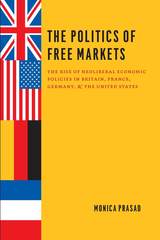
The Politics of Free Markets
The Rise of Neoliberal Economic Policies in Britain, France, Germany, and the United States
Monica Prasad
University of Chicago Press, 2006
The attempt to reduce the role of the state in the market through tax cuts, decreases in social spending, deregulation, and privatization—“neoliberalism”—took root in the United States under Ronald Reagan and in Britain under Margaret Thatcher. But why did neoliberal policies gain such prominence in these two countries and not in similarly industrialized Western countries such as France and Germany?
In The Politics of Free Markets, a comparative-historical analysis of the development of neoliberal policies in these four countries,Monica Prasad argues that neoliberalism was made possible in the United States and Britain not because the Left in these countries was too weak, but because it was in some respects too strong. At the time of the oil crisis in the 1970s, American and British tax policies were more punitive to business and the wealthy than the tax policies of France and West Germany; American and British industrial policies were more adversarial to business in key domains; and while the British welfare state was the most redistributive of the four, the French welfare state was the least redistributive. Prasad shows that these adversarial structures in the United States and Britain created opportunities for politicians to find and mobilize dissatisfaction with the status quo, while the more progrowth policies of France and West Germany prevented politicians of the Right from anchoring neoliberalism in electoral dissatisfaction.
In The Politics of Free Markets, a comparative-historical analysis of the development of neoliberal policies in these four countries,Monica Prasad argues that neoliberalism was made possible in the United States and Britain not because the Left in these countries was too weak, but because it was in some respects too strong. At the time of the oil crisis in the 1970s, American and British tax policies were more punitive to business and the wealthy than the tax policies of France and West Germany; American and British industrial policies were more adversarial to business in key domains; and while the British welfare state was the most redistributive of the four, the French welfare state was the least redistributive. Prasad shows that these adversarial structures in the United States and Britain created opportunities for politicians to find and mobilize dissatisfaction with the status quo, while the more progrowth policies of France and West Germany prevented politicians of the Right from anchoring neoliberalism in electoral dissatisfaction.
[more]
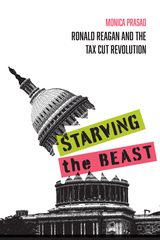
Starving the Beast
Ronald Reagan and the Tax Cut Revolution
Monica Prasad
Russell Sage Foundation, 2018
Since the Reagan Revolution of the early 1980s, Republicans have consistently championed tax cuts for individuals and businesses, regardless of whether the economy is booming or in recession or whether the federal budget is in surplus or deficit. In Starving the Beast, sociologist Monica Prasad uncovers the origins of the GOP’s relentless focus on tax cuts and shows how this is a uniquely American phenomenon.
Drawing on never-before seen archival documents, Prasad traces the history of the 1981 tax cut—the famous “supply side” tax cut, which became the cornerstone for the next several decades of Republican domestic economic policy. She demonstrates that the main impetus behind this tax cut was not business group pressure, racial animus, or a belief that tax cuts would pay for themselves.
Rather, the tax cut emerged because in America--unlike in the rest of the advanced industrial world—progressive policies are not embedded within a larger political economy that is favorable to business. Since the end of World War II, many European nations have combined strong social protections with policies to stimulate economic growth such as lower taxes on capital and less regulation on businesses than in the United State. Meanwhile, the United States emerged from World War II with high taxes on capital and some of the strongest regulations on business in the advanced industrial world. This adversarial political economy could not survive the economic crisis of the 1970s.
Starving the Beast suggests that taking inspiration from the European model of progressive policies embedded in market-promoting political economy could serve to build an American economy that works better for all.
Drawing on never-before seen archival documents, Prasad traces the history of the 1981 tax cut—the famous “supply side” tax cut, which became the cornerstone for the next several decades of Republican domestic economic policy. She demonstrates that the main impetus behind this tax cut was not business group pressure, racial animus, or a belief that tax cuts would pay for themselves.
Rather, the tax cut emerged because in America--unlike in the rest of the advanced industrial world—progressive policies are not embedded within a larger political economy that is favorable to business. Since the end of World War II, many European nations have combined strong social protections with policies to stimulate economic growth such as lower taxes on capital and less regulation on businesses than in the United State. Meanwhile, the United States emerged from World War II with high taxes on capital and some of the strongest regulations on business in the advanced industrial world. This adversarial political economy could not survive the economic crisis of the 1970s.
Starving the Beast suggests that taking inspiration from the European model of progressive policies embedded in market-promoting political economy could serve to build an American economy that works better for all.
[more]
READERS
Browse our collection.
PUBLISHERS
See BiblioVault's publisher services.
STUDENT SERVICES
Files for college accessibility offices.
RECENTLY PUBLISHED






UChicago Accessibility Resources
home | accessibility | search | about | contact us
BiblioVault ® 2001 - 2026
The University of Chicago Press