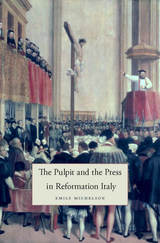
front cover of The Pulpit and the Press in Reformation Italy
The Pulpit and the Press in Reformation Italy
Emily Michelson
Harvard University Press, 2013

Italian preachers during the Reformation era found themselves in the trenches of a more desperate war than anything they had ever imagined. This war—the splintering of western Christendom into conflicting sects—was physically but also spiritually violent. In an era of tremendous religious convolution, fluidity, and danger, preachers of all kinds spoke from the pulpit daily, weekly, or seasonally to confront the hottest controversies of their time. Preachers also turned to the printing press in unprecedented numbers to spread their messages.

Emily Michelson challenges the stereotype that Protestants succeeded in converting Catholics through superior preaching and printing. Catholic preachers were not simply reactionary and uncreative mouthpieces of a monolithic church. Rather, they deftly and imaginatively grappled with the question of how to preserve the orthodoxy of their flock and maintain the authority of the Roman church while also confronting new, undeniable lay demands for inclusion and participation.

These sermons—almost unknown in English until now—tell a new story of the Reformation that credits preachers with keeping Italy Catholic when the region’s religious future seemed uncertain, and with fashioning the post-Reformation Catholicism that thrived into the modern era. By deploying the pulpit, pen, and printing press, preachers in Italy created a new religious culture that would survive in an unprecedented atmosphere of competition and religious choice.

[more]

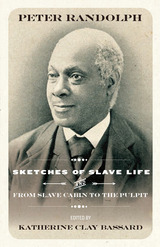
front cover of Sketches of Slave Life and From and From Slave Cabin to the Pulpit
Sketches of Slave Life and From and From Slave Cabin to the Pulpit
Peter Randolph
West Virginia University Press, 2016

This book is the first anthology of the autobiographical writings of Peter Randolph, a prominent nineteenth-century former slave who became a black abolitionist, pastor, and community leader.

Randolph’s story is unique because he was freed and relocated from Virginia to Boston, along with his entire plantation cohort. A lawsuit launched by Randolph against his former master’s estate left legal documents that corroborate his autobiographies.

Randolph's writings give us a window into a different experience of slavery and freedom than other narratives currently available and will be of interest to students and scholars of African American literature, history, and religious studies, as well as those with an interest in Virginia history and mid-Atlantic slavery. 

 
[more]

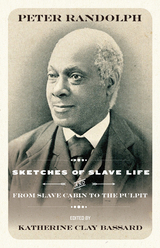
front cover of Sketches of Slave Life and From Slave Cabin to Pulpit
Sketches of Slave Life and From Slave Cabin to Pulpit
Katherine Clay Bassard
University of Delaware Press

This book is the first anthology of the autobiographical writings of Peter Randolph, a prominent nineteenth-century former slave who became a Black abolitionist, pastor, and community leader. Randolph’s story is unique because he was freed and relocated from Virginia to Boston, along with his entire plantation cohort. A lawsuit launched by Randolph against his former master’s estate left legal documents that corroborate his autobiographies.

Randolph's writings give us a window into a different experience of slavery and freedom than other narratives currently available and will be of interest to students and scholars of African American literature, history, and religious studies, as well as those with an interest in Virginia history and mid-Atlantic slavery.


[more]


Send via email Share on Facebook Share on Twitter