
 A SCHOLARLY BOOK REPOSITORY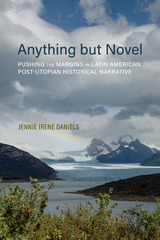
The first in-depth study in English to analyze post-utopian historical novels written during and in the wake of brutal Latin American dictatorships and authoritarian regimes
During neoliberal reforms in the 1980s and 1990s, murder, repression, and exile had reduced the number of intellectuals and Leftists, and many succumbed to or were coopted by market forces and ideologies. The opposition to the economic violence of neoliberal projects lacked a united front, and feasible alternatives to the contemporary order no longer seemed to exist. In this context, some Latin American literary intellectuals penned post-utopian historical novels as a means to reconstruct memory of significant moments in national history. Through the distortion and superimposition of distinct genres within the narratives, authors of post-utopian historical novels incorporated literary, cultural, and political traditions to expose contemporary challenges that were rooted in unresolved past conflicts.
In Anything but Novel, Jennie Irene Daniels closely examines four post-utopian novels—César Aira’s Ema, la cautiva, Rubem Fonseca’s O Selvagem da Ópera, José Miguel Varas’s El correo de Bagdad, and Santiago Páez’s Crónicas del Breve Reino—to make their contributions more accessible and to synthesize and highlight the literary and social interventions they make. Although the countries the novels focus on (Argentina, Brazil, Chile, and Ecuador) differ widely in politics, regime changes, historical precedents, geography, and demographics, the development of a shared subgenre among the literary elite suggests a common experience and interpretation of contemporary events across Latin America. These novels complement one another, extending shared themes and critiques.
Daniels argues the novels demonstrate that alternatives exist to neoliberalism even in times when it appears there are none. Another contribution of these novels is their repositioning of the Latin American literary intellectuals who have advocated for the marginalized in their societies. Their work has opened new avenues and developed previous lines of research in feminist, queer, and ethnic studies and for nonwhite, nonmale writers.
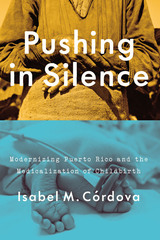
As Puerto Rico rapidly industrialized from the late 1940s until the 1970s, the social, political, and economic landscape changed profoundly. In the realm of heath care, the development of medical education, new medical technologies, and a new faith in science radically redefined childbirth and its practice. What had traditionally been a home-based, family-oriented process, assisted by women and midwives and “accomplished” by mothers, became a medicalized, hospital-based procedure, “accomplished” and directed by biomedical, predominantly male, practitioners, and, ultimately reconfigured, after the 1980s, into a technocratic model of childbirth, driven by doctors’ fears of malpractice suits and hospitals’ corporate concerns.
Pushing in Silence charts the medicalization of childbirth in Puerto Rico and demonstrates how biomedicine is culturally constructed within regional and historical contexts. Prior to 1950, registered midwives on the island outnumbered registered doctors by two to one, and they attended well over half of all deliveries. Isabel M. Córdova traces how, over the next quarter-century, midwifery almost completely disappeared as state programs led by scientifically trained experts and organized by bureaucratic institutions restructured and formalized birthing practices. Only after cesarean rates skyrocketed in the 1980s and 1990s did midwifery make a modest return through the practices of five newly trained midwives. This history, which mirrors similar patterns in the United States and elsewhere, adds an important new chapter to the development of medicine and technology in Latin America.
READERS
Browse our collection.
PUBLISHERS
See BiblioVault's publisher services.
STUDENT SERVICES
Files for college accessibility offices.
RECENTLY PUBLISHED




UChicago Accessibility Resources
home | accessibility | search | about | contact us
BiblioVault ® 2001 - 2025
The University of Chicago Press