
 A SCHOLARLY BOOK REPOSITORY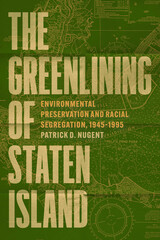
Illuminates how borough residents, urban planners, and politicians used environmental policy to cement a racially restrictive landscape.
Though it was once home to the world’s largest landfill, today Staten Island boasts thousands of acres of parklands, dozens of public-private conservation arrangements, and four ecological zoning districts. In this book, Patrick D. Nugent details the political forces that gave rise to this wealth of greenery in a famously dense city. He demonstrates how postwar economic and political trajectories intersected in the 1960s with the rising consciousness of environmentalism to create a distinctive laboratory in Staten Island, where white communities and politicians heeded the rising call for the preservation of green space—but often as a tool to maintain racial segregation. Ecological zoning, public-private park management, conservation easement, environmental litigation, and other strategies created a lush, discriminatory landscape. Nugent refers to these policies as greenlining.
The Greenlining of Staten Island shows that the political and environmental history of Staten Island is key to understanding how environmentalism has been used to reinforce racial discrimination, not just in New York City, but nationwide. By the mid-1970s, conservationists had embraced urban planning that preserved low-density housing districts and bolstered the sprawling and segregated landscape that took shape in metropolitan America over the coming decades. In exploring the gap between the modern environmental movement’s ambitious goals and its tangible outcomes, Nugent excavates important lessons for contemporary city dwellers debating zoning reform and planning for climate change’s impending effects.
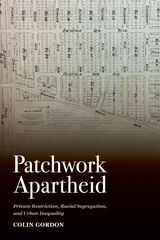
Gordon also explores the role of other policies and practices in sustaining segregation. Enforcement of private racial restrictions was held unconstitutional in 1948, and such agreements were prohibited outright in 1968. But their premises and assumptions, and the segregation they had accomplished, were accommodated by local zoning and federal housing policies. Explicit racial restrictions were replaced by the deceptive business practices of real estate agents and developers, who characterized certain neighborhoods as white and desirable and others as black and undesirable, thereby hiding segregation behind the promotion of sound property investments, safe neighborhoods, and good schools. These practices were in turn replaced by local zoning, which systematically protected white neighborhoods while targeting “blighted” black neighborhoods for commercial and industrial redevelopment, and by a tangle of federal policies that reliably deferred to local and private interests with deep investments in local segregation. Private race restriction was thus a key element in the original segregation of American cities and a source of durable inequalities in housing wealth, housing opportunity, and economic mobility.
Patchwork Apartheid exhaustively documents the history of private restriction in urban settings and demonstrates its crucial role in the ideas and assumptions that have sustained racial segregation in the United States into the twenty-first century.
READERS
Browse our collection.
PUBLISHERS
See BiblioVault's publisher services.
STUDENT SERVICES
Files for college accessibility offices.
RECENTLY PUBLISHED






UChicago Accessibility Resources
home | accessibility | search | about | contact us
BiblioVault ® 2001 - 2026
The University of Chicago Press