
 A SCHOLARLY BOOK REPOSITORY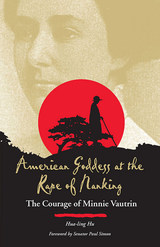
The Japanese army’s brutal four-month occupation of the city of Nanking during the 1937 Sino-Japanese War is known, for good reason, as “the rape of Nanking.” As they slaughtered an estimated three hundred thousand people, the invading soldiers raped more than twenty thousand women—some estimates run as high as eighty thousand. Hua-ling Hu presents here the amazing untold story of the American missionary Minnie Vautrin, whose unswerving defiance of the Japanese protected ten thousand Chinese women and children and made her a legend among the Chinese people she served.
Vautrin, who came to be known in China as the “Living Goddess” or the “Goddess of Mercy,” joined the Foreign Christian Missionary Society and went to China during the Chinese Nationalist Revolution in 1912. As dean of studies at Ginling College in Nanking, she devoted her life to promoting Chinese women’s education and to helping the poor.
At the outbreak of the war in July 1937, Vautrin defied the American embassy’s order to evacuate the city. After the fall of Nanking in December, Japanese soldiers went on a rampage of killing, burning, looting, rape, and torture, rapidly reducing the city to a hell on earth. On the fourth day of the occupation, Minnie Vautrin wrote in her diary: “There probably is no crime that has not been committed in this city today. . . . Oh, God, control the cruel beastliness of the soldiers in Nanking.”
When the Japanese soldiers ordered Vautrin to leave the campus, she replied: “This is my home. I cannot leave.” Facing down the blood-stained bayonets constantly waved in her face, Vautrin shielded the desperate Chinese who sought asylum behind the gates of the college. Vautrin exhausted herself defying the Japanese army and caring for the refugees after the siege ended in March 1938. She even helped the women locate husbands and sons who had been taken away by the Japanese soldiers. She taught destitute widows the skills required to make a meager living and provided the best education her limited sources would allow to the children in desecrated Nanking.
Finally suffering a nervous breakdown in 1940, Vautrin returned to the United States for medical treatment. One year later, she ended her own life. She considered herself a failure.
Hu bases her biography on Vautrin’s correspondence between 1919 and 1941 and on her diary, maintained during the entire siege, as well as on Chinese, Japanese, and American eyewitness accounts, government documents, and interviews with Vautrin’s family.
The minuscule motion of a butterfly’s wings can trigger a tornado half a world away, according to chaos theory. Under the right conditions, small simple actions can produce large complex effects. In this timely and provocative book, Catharine A. MacKinnon argues that the right seemingly minor interventions in the legal realm can have a butterfly effect that generates major social and cultural transformations.
Butterfly Politics brings this incisive understanding of social causality to a wide-ranging exploration of gender relations. The pieces collected here—many published for the first time—provide a new perspective on MacKinnon’s career as a pioneer of legal theory and practice and an activist for women’s rights. Its central concerns of gender inequality, sexual harassment, rape, pornography, and prostitution have defined MacKinnon’s intellectual, legal, and political pursuits for over forty years. Though differing in style and approach, the selections all share the same motivation: to end inequality, including abuse, in women’s lives. Several mark the first time ideas that are now staples of legal and political discourse appeared in public—for example, the analysis of substantive equality. Others urge changes that have yet to be realized.
The butterfly effect can animate political activism and advance equality socially and legally. Seemingly insignificant actions, through collective recursion, can intervene in unstable systems to produce systemic change. A powerful critique of the legal and institutional denial of reality that perpetuates practices of gender inequality, Butterfly Politics provides a model of what principled, effective, socially conscious engagement with law looks like.
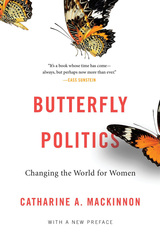
“Sometimes ideas change the world. This astonishing, miraculous, shattering, inspiring book captures the origins and the arc of the movement for sex equality. It’s a book whose time has come—always, but perhaps now more than ever.”
—Cass Sunstein, coauthor of Nudge
Under certain conditions, small simple actions can produce large and complex “butterfly effects.” Butterfly Politics shows how Catharine A. MacKinnon turned discrimination law into an effective tool against sexual abuse—grounding and predicting the worldwide #MeToo movement—and proposes concrete steps that could have further butterfly effects on women’s rights. Thirty years after she won the U.S. Supreme Court case establishing sexual harassment as illegal, this timely collection of her previously unpublished interventions on consent, rape, and the politics of gender equality captures in action the creative and transformative activism of an icon.
“MacKinnon adapts a concept from chaos theory in which the tiny motion of a butterfly’s wings can trigger a tornado half a world away. Under the right conditions, she posits, small actions can produce major social transformations.”
—New York Times
“MacKinnon [is] radical, passionate, incorruptible and a beautiful literary stylist… Butterfly Politics is a devastating salvo fired in the gender wars… This book has a single overriding aim: to effect global change in the pursuit of equality.”
—The Australian
“Sexual Harassment of Working Women was a revelation. It showed how this anti-discrimination law—Title VII—could be used as a tool… It was the beginning of a field that didn’t exist until then.”
—U.S. Supreme Court Justice Ruth Bader Ginsburg

This collection of essays addresses a number of questions regarding the role of consent in marriage and in sexual relations outside of marriage in ancient and medieval societies. Ranging from ancient Greece and Rome to the Byzantine Empire and Western Medieval Europe, the contributors examine rape, seduction, and the role of consent in establishing the punishment of one or both parties; the issue of marital debt and spousal rape; and the central question of what is perceived as coercion and what may be the validity or value of coerced consent. Other concepts, such as honor and shame, are also investigated.
Because of the wide range--in time and place--of societies studied, the reader is able to see many different approaches to the question of consent and coercion as well as a certain evolution, in which Christianity plays an important role.

Other books have dealt with how police and prosecutors bend and break the law in their zeal to prevail. This one focuses instead on how the gravest injustice can be committed with the best of intentions, and how one woman’s bravery and persistence finally triumphed.

Part 1, "The Records," includes two sources written as the Rape was underway. The first is a long set of documents produced by the International Committee for the Nanking Safety Zone, a group of foreigners who strove to protect the Chinese residents. The second is a series of letters that American surgeon Dr. Robert Wilson wrote for his family during the same period. These letters are published here for the first time.
The evidence compiled by the International Committee and its members would be decisive for the indictments against Japanese leaders at the International Military Tribunal for the Far East in Tokyo. Part 2, "The Judgments," reprints portions of the tribunal's 1948 judgment dealing with the Rape of Nanking, its judicial consequences, and sections of the dissenting judgment of Justice Radhabinod Pal.
These contemporary records and judgments create an intimate firsthand account of the Rape of Nanking. Together they are intended to stimulate deeper reflection than previously possible on how and why we assess and assign the burden of war guilt.
Timothy Brook is Professor of Chinese History and Associate Director of the Joint Centre for Asia Pacific Studies, University of Toronto, and is coeditor of Nation Work: Asian Elites and National Identities and Cultureand Economy: The Shaping of Capitalism in Eastern Asia, both published by the University of Michigan Press.

Popular media depict miners as a rough-and-tumble lot who diligently worked the placers along scenic rushing rivers while living in roaring mining camps in the foothills of the Sierra Nevada Mountains. Trafzer and Hyer destroy this mythic image by offering a collection of original newspaper articles that describe in detail the murder, rape, and enslavement perpetrated by those who participated in the infamous gold rush. "It is a mercy to the Red Devils," wrote an editor of the Chico Courier, "to exterminate them." Newspaper accounts of the era depict both the barbarity and the nobility in human nature, but while some protested the inhumane treatment of Native Americans, they were not able to end the violence. Native Americans fought back, resisting the invasion, but they could not stop the tide of white miners and settlers. They became "strangers in a stolen land."
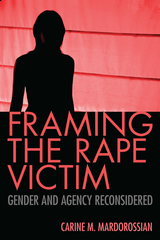
In recent years, members of legal, law enforcement, media and academic circles have portrayed rape as a special kind of crime distinct from other forms of violence. In Framing the Rape Victim, Carine M. Mardorossian argues that this differential treatment of rape has exacerbated the ghettoizing of sexual violence along gendered lines and has repeatedly led to women’s being accused of triggering, if not causing, rape through immodest behavior, comportment, passivity, or weakness.
Contesting the notion that rape is the result of deviant behaviors of victims or perpetrators, Mardorossian argues that rape saturates our culture and defines masculinity’s relation to femininity, both of which are structural positions rather than biologically derived ones. Using diverse examples throughout, Mardorossian draws from Hollywood film and popular culture to contemporary women’s fiction and hospitalized birth emphasizing that the position of dominant masculinity can be occupied by men, women, or institutions, while structural femininity is a position that may define and subordinate men, minorities, and other marginalized groups just as effectively as it does women. Highlighting the legacies of the politically correct debates of the 1990s and the terrorist attacks of 9/11, the book illustrates how the framing of the term “victim” has played a fundamental role in constructing notions of agency that valorize autonomy and support exclusionary, especially masculine, models of American selfhood.
The gendering of rape, including by well-meaning, sometimes feminist, voices that claim to have victims’ best interests at heart, ultimately obscures its true role in our culture. Both a critical analysis and a call to action, Framing the Rape Victim shows that rape is not a special interest issue that pertains just to women but a pervasive one that affects our society as a whole.
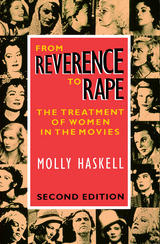
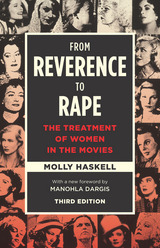
"An incisive, exceedingly thoughtful look at the distorted lens through which Hollywood has historically viewed women. It is a valuable contribution not just of film criticism but to a society in which the vital role of women is just beginning to emerge."—Christian Science Monitor
"Haskell is interested in women—how they are used in movies, how they use movies, and how the parts they play function as projections and verifications of our myths about women's lot and woman's psyche and even, lately, women's lib."—Jane Kramer, Village Voice
"In examining the goddesses worshipped by an entire nation, Molly Haskell reveals a good deal about our national character and our most cherished sexual myths. . . . Concerned with the deeply ingrained belief of women's inferiority, she analyzes movies as a social product as well as a social arbiter, and she effectively demonstrates how women are encouraged to impose limitations on themselves by fashioning those selves after flickering shadows in a darkened auditorium—sexual creatures who possess neither ability nor ambition beyond their bodies. . . . Both as an examination of film and as sociology, From Reverence to Rape is excellent."—Harriet Kriegel, The Nation

In 1806 an anxious crowd of thousands descended upon Lenox, Massachusetts, for the public hanging of Ephraim Wheeler, condemned for the rape of his thirteen-year-old daughter, Betsy. Not all witnesses believed justice had triumphed. The death penalty had become controversial; no one had been executed for rape in Massachusetts in more than a quarter century. Wheeler maintained his innocence. Over one hundred local citizens petitioned for his pardon--including, most remarkably, Betsy and her mother.
Impoverished, illiterate, a failed farmer who married into a mixed-race family and clashed routinely with his wife, Wheeler existed on the margins of society. Using the trial report to reconstruct the tragic crime and drawing on Wheeler's jailhouse autobiography to unravel his troubled family history, Irene Quenzler Brown and Richard D. Brown illuminate a rarely seen slice of early America. They imaginatively and sensitively explore issues of family violence, poverty, gender, race and class, religion, and capital punishment, revealing similarities between death penalty politics in America today and two hundred years ago.
Beautifully crafted, engagingly written, this unforgettable story probes deeply held beliefs about morality and about the nature of justice.
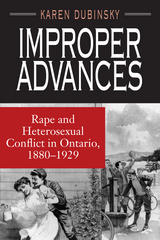
Karen Dubinsky relies on criminal case files, a revealing but largely untapped source for social historians, to retell individual stories of sexual danger—crimes such as rape, abortion, seduction, murder, and infanticide. Her research supports many feminist analyses of sexual violence: that crimes are expressions of power, that courts are prejudiced by the victim's background, and that most assaults occur within the victims' homes and communities.
Dubinsky distinguishes herself from most feminist scholars, however, by refusing to view women solely as victims and sex as a tool of oppression. She finds that these women actively sought and took pleasure in sexuality, but they distinguished between wanted and unwanted sexual encounters and attempted to punish coercive sex despite obstacles in the court system and the community.
Confronting a number of key theoretical and historiographic controversies, including recent debates over sexuality in feminist theory and politics, she challenges current thinking on the history of women, gender, and sexuality.

At once deeply intimate and terrifyingly universal, One Hour in Paris weaves together Freedman’s personal experience with the latest philosophical, neuroscientific, and psychological insights on what it means to live in a body that has been traumatized. Using her background as a philosopher, she looks at the history of psychological trauma and draws on recent theories of posttraumatic stress disorder and neuroplasticity to show how recovery from horrific experiences is possible. Through frank discussions of sex and intimacy, she explores the consequences of sexual violence for love and relationships, and she illustrates the steep personal cost of sexual violence and the obstacles faced by individual survivors in its aftermath. Freedman’s book is an urgent call to face this fundamental social problem head-on, arguing that we cannot continue to ignore the fact that sexual violence against women is rooted in gender inequalities that exist worldwide—and must be addressed.
One Hour in Paris is essential reading for survivors of sexual violence as well as an invaluable resource for therapists, mental health professionals, and family members and friends of victims.
Published by University of Delaware Press. Distributed worldwide by Rutgers University Press.
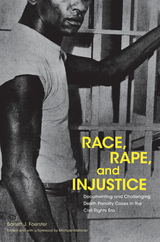
The 1965 project was organized by the NAACP Legal Defense and Educational Fund, which sought to prove statistically whether capital punishment in southern rape cases had been applied discriminatorily over the previous twenty years. If the research showed that a disproportionate number of African Americans convicted of raping white women had received the death penalty regardless of nonracial variables (such as the degree of violence used), then capital punishment in the South could be abolished as a clear violation of the Fourteenth Amendment’s Equal Protection Clause.
Targeting eleven states, the students cautiously made their way past suspicious court clerks, lawyers, and judges to secure the necessary data from dusty courthouse records. Trying to attract as little attention as possible, they managed—amazingly—to complete their task without suffering serious harm at the hands of white supremacists. Their findings then went to University of Pennsylvania criminologist Marvin Wolfgang, who compiled and analyzed the data for use in court challenges to death penalty convictions. The result was powerful evidence that thousands of jurors had voted on racial grounds in rape cases.
This book not only tells Barrett Foerster’s and his teammates story but also examines how the findings were used before a U.S. Supreme Court resistant to numbers-based arguments and reluctant to admit that the justice system had executed hundreds of men because of their skin color. Most important, it illuminates the role the project played in the landmark Furman v. Georgia case, which led to a four-year cessation of capital punishment and a more limited set of death laws aimed at constraining racial discrimination.
A Virginia native who studied law at UCLA, BARRETT J. FOERSTER (1942–2010) was a judge in the Superior Court in Imperial County, California.
MICHAEL MELTSNER is the George J. and Kathleen Waters Matthews Distinguished Professor of Law at Northeastern University. During the 1960s, he was first assistant counsel to the NAACP Legal Defense Fund. His books include The Making of a Civil Rights Lawyer and Cruel and Unusual: The Supreme Court and Capital Punishment.
Winner of the 2023 National Communication Association's American Studies Division Outstanding Book Award
News media and popular culture in the United States have produced a conventional narrative of the outcomes of sexual abuse: someone perpetrates sexual violence, goes to trial, and is then punished with prison time. Survivors recede into the background, becoming minor characters in their own stories as intrepid prosecutors, police officers, and investigators gather evidence and build a case.
Leland G. Spencer explains how the stories we tell about sexual assault serve to reinforce rape culture, privileging criminal punishment over social justice and community-based responses to sexual violence. Examining a broad range of popular media, including news coverage of the Brock Turner case, Naomi Iizuka’s popular play Good Kids, the television program Criminal Minds, and the book turned television show 13 Reasons Why, Spencer demonstrates how these representations shore up the carceral state, perpetuate rape myths, blame victims, and excuse those who harm. While increased discussion about sexual violence represents feminist progress, these narratives assume that policing and prosecution are the only means of achieving justice, sidelining other potential avenues for confronting perpetrators and supporting victims.

Marguerite de Navarre (1492–1549), the sister of the French king François I, composed the Heptaméron as a complex collection of seventy-two novellas, creating one of the first examples of realistic, psychological fiction in French literature. These novellas, framed by debates among ten storytellers, all noble lords and ladies, reveal the author’s desire to depart from the purely masculine voice of the age.
Cholakian contends that this Renaissance text is characterized by feminine writing. She reads the text as the product of the author’s personal experience. Beginning her study with the rape narrative in the autobiographical novella 4, she examines how the Heptaméron interacts with male literary traditions and narrative conventions about gender relations. She analyzes such words as rape, and honor, noting how they are defined differently by men and women and how these differences in perception affect the development of both plot and character.


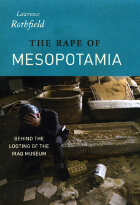
On April 10, 2003, as the world watched a statue of Saddam Hussein come crashing down in the heart of Baghdad, a mob of looters attacked the Iraq National Museum. Despite the presence of an American tank unit, the pillaging went unchecked, and more than 15,000 artifacts—some of the oldest evidence of human culture—disappeared into the shadowy worldwide market in illicit antiquities. In the five years since that day, the losses have only mounted, with gangs digging up roughly half a million artifacts that had previously been unexcavated; the loss to our shared human heritage is incalculable.
With The Rape of Mesopotamia, Lawrence Rothfield answers the complicated question of how this wholesale thievery was allowed to occur. Drawing on extensive interviews with soldiers, bureaucrats, war planners, archaeologists, and collectors, Rothfield reconstructs the planning failures—originating at the highest levels of the U.S. government—that led to the invading forces’ utter indifference to the protection of Iraq’s cultural heritage from looters. Widespread incompetence and miscommunication on the part of the Pentagon, unchecked by the disappointingly weak advocacy efforts of worldwide preservation advocates, enabled a tragedy that continues even today, despite widespread public outrage.
Bringing his story up to the present, Rothfield argues forcefully that the international community has yet to learn the lessons of Iraq—and that what happened there is liable to be repeated in future conflicts. A powerful, infuriating chronicle of the disastrous conjunction of military adventure and cultural destruction, The Rape of Mesopotamia is essential reading for all concerned with the future of our past.
Rape has never had a universally accepted definition, and the uproar over "legitimate rape" during the 2012 U.S. elections confirms that it remains a word in flux. Redefining Rape tells the story of the forces that have shaped the meaning of sexual violence in the United States, through the experiences of accusers, assailants, and advocates for change. In this ambitious new history, Estelle Freedman demonstrates that our definition of rape has depended heavily on dynamics of political power and social privilege.
The long-dominant view of rape in America envisioned a brutal attack on a chaste white woman by a male stranger, usually an African American. From the early nineteenth century, advocates for women's rights and racial justice challenged this narrow definition and the sexual and political power of white men that it sustained. Between the 1870s and the 1930s, at the height of racial segregation and lynching, and amid the campaign for woman suffrage, women's rights supporters and African American activists tried to expand understandings of rape in order to gain legal protection from coercive sexual relations, assaults by white men on black women, street harassment, and the sexual abuse of children. By redefining rape, they sought to redraw the very boundaries of citizenship.
Freedman narrates the victories, defeats, and limitations of these and other reform efforts. The modern civil rights and feminist movements, she points out, continue to grapple with both the insights and the dilemmas of these first campaigns to redefine rape in American law and culture.
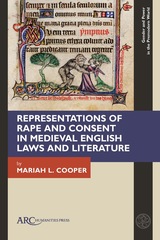
Matoesian examines the language of the courtroom, focusing on how defense lawyers interpret and classify rape in a way that makes the victim's experience appear as a normal sexual encounter. He analyzes the language that defense attorneys use in cross-examination to argue that courtroom talk can shape the victim's testimony to fit male standards of legitimate sexual practice. On this view, cross-examination is an adversarial war of words through which lawyers manipulate reality and perpetuate the patriarchal domination of women.
Reproducing Rape will interest students and professionals in law, criminology, sociology, feminist theory, linguistics, and anthropology.



Between 1880 and 1930, close to 200 women were murdered by lynch mobs in the American South. Many more were tarred and feathered, burned, whipped, or raped. In this brutal world of white supremacist politics and patriarchy, a world violently divided by race, gender, and class, black and white women defended themselves and challenged the male power brokers. Crystal Feimster breaks new ground in her story of the racial politics of the postbellum South by focusing on the volatile issue of sexual violence.
Pairing the lives of two Southern women—Ida B. Wells, who fearlessly branded lynching a white tool of political terror against southern blacks, and Rebecca Latimer Felton, who urged white men to prove their manhood by lynching black men accused of raping white women—Feimster makes visible the ways in which black and white women sought protection and political power in the New South. While Wells was black and Felton was white, both were journalists, temperance women, suffragists, and anti-rape activists. By placing their concerns at the center of southern politics, Feimster illuminates a critical and novel aspect of southern racial and sexual dynamics. Despite being on opposite sides of the lynching question, both Wells and Felton sought protection from sexual violence and political empowerment for women.
Southern Horrors provides a startling view into the Jim Crow South where the precarious and subordinate position of women linked black and white anti-rape activists together in fragile political alliances. It is a story that reveals how the complex drama of political power, race, and sex played out in the lives of Southern women.

Beginning with the attempts to abolish torture in the eighteenth century, and then sensitively examining what is suffered in torture and related transgressions, such as rape, Bernstein elaborates a powerful new conception of moral injury. Crucially, he shows, moral injury always involves an injury to the status of an individual as a person—it is a violent assault against his or her dignity. Elaborating on this critical element of moral injury, he demonstrates that the mutual recognitions of trust form the invisible substance of our moral lives, that dignity is a fragile social possession, and that the perspective of ourselves as potential victims is an ineliminable feature of everyday moral experience.

An inquiry into the phenomenology of “woman” based in the relationship between lived time and sexual violence
Feminist phenomenologists have long understood a woman’s life as inhibited, confined, and constrained by sexual violence. In this important inquiry, author Megan Burke both builds and expands on this legacy by examining the production of normative womanhood through racist tropes and colonial domination. Ultimately, Burke charts a new feminist phenomenology based in the relationship between lived time and sexual violence.
By focusing on time instead of space, When Time Warps places sexualized racism at the center of the way “woman” is lived. Burke transports questions of time and gender outside the realm of the historical, making provocative new insights into how gendered individuals live time, and how their temporal existence is changed through particular experiences.
Providing a potent reexamination of the theory of Simone de Beauvoir—while also bringing to the fore important women of color theorists and engaging in the temporal aspects of #MeToo—When Time Warps makes a necessary, lasting contribution to our understanding of gender, race, and sexual violence.
Duke University Press Scholars of Color First Book Award recipient
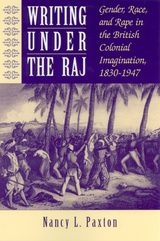
Writing Under the Raj is the first study to challenge the long-held critical assumption that the rape of colonizing women by colonized men was the first, or the only, rape script in British colonial literature. Nancy Paxton asks why rape disappears in British literature about English domestic life in the 1790s and charts its reappearance in British literature about India written between 1830 and 1947. Paxton displays the hybrid qualities of familiar novels like Kipling’s Kim and Forster’s A Passage to India by situating them in a richly detailed cultural context that reveals the dynamic relationship between metropolitan British literature and novels written by men and women who lived in the colonial contact zone of British India throughout this period.
Drawing on current feminist and gender theory as well as a wide range of historical and cultural sources, Paxton identifies four different “scripts” about interracial and intraracial rape that appear in novels about India during the period of British rule. Surveying more than thirty canonized and popular Anglo-Indian novels, Paxton shows how the treatment of rape reflects basic conflicts in the social and sexual contracts defining British and Indian women’s relationship to the nation state throughout the period. This study reveals how and why novels written after the Indian Uprising of 1857 popularized the theme of English women victimized by Indian men. Paxton demonstrates how all these novels reflect unresolved ideological and symbolic conflicts in British ideas about sex, violence, and power.
READERS
Browse our collection.
PUBLISHERS
See BiblioVault's publisher services.
STUDENT SERVICES
Files for college accessibility offices.
RECENTLY PUBLISHED




UChicago Accessibility Resources
home | accessibility | search | about | contact us
BiblioVault ® 2001 - 2024
The University of Chicago Press