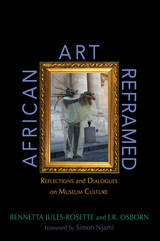
The authors take a three-pronged approach. Part One ranges from curiosity cabinets to virtual websites to offer a history of ethnographic and art museums and look at their organization and methods of reaching out to the public. In the second part, the authors examine museums as ecosystems and communities within communities, and they use semiotic methods to analyze images, signs, and symbols drawn from the experiences of curators and artists. The third part introduces innovative strategies for displaying, disseminating, and reclaiming African art. The authors also propose how to reinterpret the art inside and outside the museum and show ways of remixing the results.
Drawing on extensive conversations with curators, collectors, and artists, African Art Reframed is an essential guide to building new exchanges and connections in the dynamic worlds of African and global art.
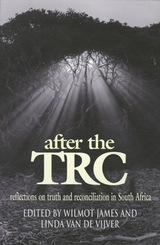
Has South Africa dealt effectively with the past, and is the country ready to face the future? What are the challenges facing both government and civil society in the years ahead? These and other questions are explored in this collection of essays by international and local commentators on the Truth and Reconciliation Commission.
A range of perspectives on whether the TRC met its objectives of truth and reconciliation is presented. The areas of particular contention-the payment of reparation, the granting of amnesty, and memorialization-are also examined.
Finally, the major challenges facing South Africa are identified, and ways of meeting these challenges and developing the assets of the nation are explored.
Contributors: Haribert Adam, Kanya Adam, Alex Boraine, Colin Bundy, Mary Burton, John de Gruchy, Richard Goldstone, Willem Heath, Wilmot James, Jeffrey Lever, Mahmood Mamdani, Gary Minkley, Njabulo Ndebele, Dumisa Ntsebeza, Kaizer Nyatsumba, Grace Naledi Pandor, Mamphela Ramphele, Ciraj Rassool, Albie Sachs, Patricia Valdez, Linda van de Vijver, Jan van Eck, Frederik Van Zyl Slabbert, Charles Villa-Vicencio, Francis Wilson, and Leslie Witz

A personal treatise from distinguished social scientist Sandro Galea on the indelible effects of being an immigrant—and what it means for the greater good.
“I am one of the lucky ones,” writes Sandro Galea. Galea left home in Malta at fourteen with his parents and sister as the island was rocked by political turmoil. The family made their way to Canada and Galea, in turn, eventually made his way to the United States. This is the story of Galea’s long, surreal journey of forging a life in a series of new and unfamiliar places.
With spare and deeply affecting prose, Alien is a poignant exploration of what it means to build a life across borders—and why it’s important for all of us. Galea’s intimate and personal story frames the experience of being an immigrant in terms of its indelible lessons on adaptation, identity, belonging, and shared generosity. Galea also captures at once the joys and the uncertainties that define the process of uprooting one life to begin another abroad. His is a reflection on empathy, on precarity, and on the effect of immigrating, in which one becomes keenly aware of how quickly life—and the world—can change.
Blending philosophical inquiry and personal story, Alien bridges the gap between storytelling and scholarship and, in doing so, gifts us an essential aperture on the world not everyone experiences—and the value of having those who do.
Artist Scholar: Reflections on Writing and Research is part history, introduction, and discussion for artists and designers entering, graduating, and employed by the contemporary art academy in the United States. The evolution of art education in the university continues to expand in the 21st century as the variables of craft, skill, technique, theory, history and criticism shift and expand as the perspective of arts-based research is introduced into this professionalized environment. Given this context: what can M.F.A. students do to improve their understanding of writing and research without sacrificing their commitment to their studio art process?
Through a series of essays, the text argues for better writing at the M.F.A. level with the purpose of becoming better artists. By contextualizing art practice in the university and providing a foundation for future artist scholarship, it serves as an invitation to artist scholars to push their work further and develop the confidence to situate their art in the university context.
READERS
Browse our collection.
PUBLISHERS
See BiblioVault's publisher services.
STUDENT SERVICES
Files for college accessibility offices.
UChicago Accessibility Resources
home | accessibility | search | about | contact us
BiblioVault ® 2001 - 2026
The University of Chicago Press