logo for Central Conference of American Rabbis
Tanu Rabbanan - Our Rabbis Taught
Joseph B. Glaser
Central Conference of American Rabbis, 1990
Essays in commemoration of the Centennial of the Central Conference of American Rabbis. Includes four discourses which together present the agenda of the American Reform Movement. Historical overviews of Conference history complete this volumen.
[more]

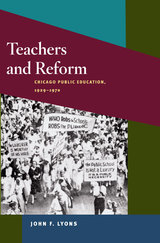
front cover of Teachers and Reform
Teachers and Reform
Chicago Public Education, 1929-70
John F. Lyons
University of Illinois Press, 2007
From the union's formation in 1937 until the 1960s, the Chicago Teachers Union (CTU) was the largest and most influential teachers' union in the country. John F. Lyons examines the role of public schoolteachers and the CTU in shaping the policies and practices of public education in Chicago.

Examining teachers' unions and public education from the bottom up, Lyons shows how the CTU and its members sought rigorous reforms. A combination of political action, public relations campaigns, and community alliances helped the CTU to achieve better salaries and benefits, increased school budgets, reformed curricula, and greater equality for women within the public education system. But its agenda was also constrained by internal divisions over race and gender and by ongoing external disputes with the school administration, politicians, and business and civic organizations.

Detailed and informed by rich interviews, Teachers and Reform: Chicago Public Education, 1929-1970 tells the story of how committed union members effected changes to public education and to local politics that still benefit Chicago teachers, students, and the city today.


[more]

front cover of These Words
These Words
Poetic Midrash on the Language of Torah
Alden Solovy
Central Conference of American Rabbis, 2023

In These Words, liturgist Alden Solovy distills the Torah into its very essence: the individual words it contains. Echoing the midrash that the Torah has seventy faces, Solovy selects seventy of its Hebrew words that are pregnant with meaning. For each word, he delves into the etymology, translation, and usage, providing deeper insights into familiar texts. Then Solovy presents a beautiful poem—what he calls “poetic midrash”—inspired by and interpreting each word. From b’reishit (“in beginning”) to shamayim (“heavens”) to zachor (“remember”), These Words will change the way you look at the language of the Torah.

[more]

front cover of This Grateful Heart
This Grateful Heart
Psalms and Prayers for a New Day
Alden Solovy
Central Conference of American Rabbis, 2017

This Grateful Heart offers an anthology of modern day psalms and prayers to lift us up, inspire our days, and mark our milestones. Written by Jewish poet and liturgist Alden Solovy, the collection provides nearly 100 readings, spanning topics from the simple delights of daily living to the complexities of grief; from the celebration of major turning points like bar and bat mitzvah to the more solemn commemoration of lost lives and ended relationships; and from the awe-filled moments of the High Holy Days to the observance of secular holidays. For clergy, this collection offers supplementary material for use in services and life cycle rituals; for the individual, this collection can serve as a way to give voice to the joys and sorrows of everyday life.

[more]

front cover of This Joyous Soul
This Joyous Soul
A New Voice for Ancient Yearnings
Alden Solovy
Central Conference of American Rabbis, 2019

Like its predecessor, This Grateful Heart, this volume of creative liturgy opens a door into the transformative power of prayer. Structured to reflect the morning service found within Mishkan T'filah, this collection invites a deeply personal prayer experience that will strengthen our connection to Judaism and to the Reform siddur.

[more]

front cover of To You I Call
To You I Call
Psalms Throughout Our Lives
Rabbi Jade Sank Ross
Central Conference of American Rabbis, 2024
Psalms have been part of Jewish ritual and liturgy for centuries, expressing praise to God, feelings of sorrow and longing, and much more. Rabbi Jade Sank Ross’s To You I Call is an invitation to make the ancient words of psalms part of our daily lives. The book pairs seventy-two psalms with a range of life moments, from giving birth to retirement to experiencing antisemitism—times of grief and gratitude, anticipation and despair, pain and relief. Rabbi Sank Ross’s original, authentic framing and Rabbi Richard N. Levy’s beautiful, contemporary translations let readers forge a deep and personal connection with the words of the Psalmist. With sensitivity and vulnerability, To You I Call brings the psalms to life for our lives, today.
[more]

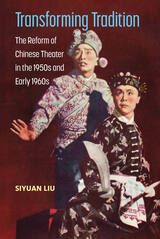
front cover of Transforming Tradition
Transforming Tradition
The Reform of Chinese Theater in the 1950s and Early 1960s
Siyuan Liu
University of Michigan Press, 2021

Shortly after the establishment of the People’s Republic of China in 1949, the PRC launched a reform campaign that targeted traditional song and dance theater encompassing more than a hundred genres, collectively known as xiqu. Reformers censored or revised xiqu plays and techniques; reorganized star-based private troupes; reassigned the power to create plays from star actors to the newly created functions of playwright, director, and composer; and eliminated market-oriented functionaries such as agents. While the repertoire censorship ended in the 1980s, major reform elements have remained: many traditional scripts (or parts of them) are no longer in performance; actors whose physical memory of repertoire and acting techniques had been the center of play creation, have been superseded by directors, playwrights, and composers. The net result is significantly diminished repertoires and performance techniques, and the absence of star actors capable of creating their own performance styles through new signature plays that had traditionally been one of the hallmarks of a performance school. Transforming Tradition offers a systematic study of the effects of the comprehensive reform of traditional theater conducted in the 1950s and ’60s, and is based on a decade’s worth of exhaustive research of official archival documents, wide-ranging interviews, and contemporaneous publications, most of which have never previously been referenced in scholarly research.

[more]


Send via email Share on Facebook Share on Twitter