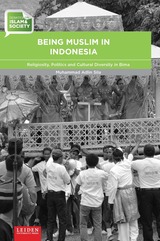
front cover of Being Muslim in Indonesia
Being Muslim in Indonesia
Religiosity, Politics and Cultural Diversity in Bima
Muhammad Adlin Sila
Leiden University Press, 2021
How Muslims in Indonesia consider their religious practices, politics and culture as Islamic is described in this volume. By examining the various ways Bima Muslims constitute their Islamic identities and agencies through rituals and festivals, this book argues that religious practice is still vigorous in present Bima. It explores the reproduction of religious meanings among various local Muslims and the differences between social groups. Islam is represented as divided between the traditionalist Muslims and the reformist Muslims, between the royal family and the ordinary Muslims, and between Muslim clerics and lay people. Consequently, there is no single picture of Islam. As Bima Muslims construe their Islam in response to their surroundings, what it means to be a Muslim is constantly being negotiated. The complexity of religious life has been a result of the duality of socio-political settings in Bima which stems from the early period of the Islamization of Bima to the present.
[more]

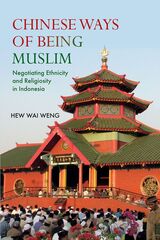
front cover of Chinese Ways of Being Muslim
Chinese Ways of Being Muslim
Negotiating Ethnicity and Religiosity in Indonesia
Hew Wai Weng
National University of Singapore Press, 2018
Many recent works on Muslim societies have pointed to a growing ‘deculturalization’ and ‘purification’ of Islamic practices. Instead, by exploring themes such as architectural designs, preaching activities, political engagement and cultural celebrations, this book describes and analyses the formation and negotiation of Chinese Muslim cultural identities in Indonesia today – a rapidly evolving environment where there are multiple ways of being or not being Chinese and Muslim. By engaging with the notions of ‘inclusive Chineseness’ and ‘cosmopolitan Islam’, this book gives insights not only into the cultural politics of Muslim and Chinese identities in Indonesia today but also into the possibilities and limitations of ethnic and religious cosmopolitanism in many other contemporary societies.
[more]

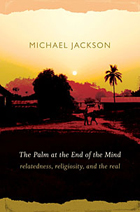
front cover of The Palm at the End of the Mind
The Palm at the End of the Mind
Relatedness, Religiosity, and the Real
Michael Jackson
Duke University Press, 2009
In many societies and for many people, religiosity is only incidentally connected with texts or theologies, church or mosque, temple or monastery. Drawing on a lifetime of ethnographic work among people for whom religion is not principally a matter of faith, doctrine, or definition, Michael Jackson turns his attention to those situations in life where we come up against the limits of language, our strength, and our knowledge, yet are sometimes thrown open to new ways of understanding our being-in-the-world, to new ways of connecting with others.

Through sixty-one beautifully crafted essays based on sojourns in Europe, West Africa, the United States, Australia, and New Zealand, and taking his cue from Wallace Stevens’s late poem, “Of Mere Being,” Jackson explores a range of experiences where “the palm at the end of the mind” stands “beyond thought,” on “the edge of space,” “a foreign song.” Moments of crisis as well as everyday experiences in cafés, airports, and offices disclose the subtle ways in which a single life shades into others, the boundaries between cultures become blurred, fate unfolds through genealogical time, elective affinities make their appearance, and different values contend.


[more]


Send via email Share on Facebook Share on Twitter