
 A SCHOLARLY BOOK REPOSITORY
The political and cultural fantasy of home as a retreat from the pressures of the world first emerged in the U.S. alongside two major nineteenth-century literary movements: Romanticism and domestic fiction. Upending accepted gendered narratives from this period, The Art of Retreat posits that these movements originated from a domestic culture already in transition, in which home was frequently a more complicated site of self-interested pleasure, coerced labor, creole social reproduction, homosocial intimacy, bachelor whimsy, petty tyranny, racial abuse, and transgender capacity. The early national periodicals, sketches, and novels examined here lend themselves to this interpretation. Hankins argues that the literary tradition emerging from these decades—one that aligned creative genius with domestic retreat—reminds us that a politics that appeals to private feeling must reckon with new interpretations of labor, kinship, and reform in exchange for the promise of consensual citizenship.
Published by Bucknell University Press. Distributed worldwide by Rutgers University Press.


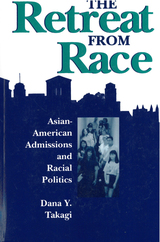
“An excellent book. Takagi takes a very complex and sensitive subject—racial politics—and shows, through a careful analysis . . . that changes in the discourse about Asian American admissions have facilitated a 'retreat from race' in the area of affirmative action. . . . This book will appeal to an audience significantly wider than a typical academic one.”— David Karen, Bryn Mawr College
Charges by Asian Americans that the top universities in the United States used quotas to limit the enrollment of Asian-American students developed into one of the most controversial public controversies in higher education since the Bakke case. In Retreat from Race, Dana Takagi follows the debates over Asian-American admissions at Berkeley, UCLA, Brown, Stanford, Harvard, and Princeton. She explains important developments in the politics of race: changes in ethnic coalitions, reconstruction of the debate over affirmative action, and the conservative challenge to the civil rights agenda of the 1960s. Takagi examines the history and significance of the Asian American admissions controversy on American race relations both inside and outside higher education.
Takagi's central argument is that the Asian-American admissions controversy facilitated a subtle but important shift in affirmative action policy away from racial preferences toward class preferences. She calls this development a retreat from race. Takagi suggests that the retreat signals not only an actual policy shift but also the increasing reluctance on the part of intellectuals, politicans, and policy analysts to identify and address social problems as explicitly racial problems.
Moving beyond the university setting, Takagi explores the political significance of the retreat from race by linking Asian-American admissions to other controversies in higher education and in American politics, including the debates over political correctness and multiculturalism. In her assessment, the retreat from race is likely to fail at its promise of easing racial tension and promoting racial equality.
READERS
Browse our collection.
PUBLISHERS
See BiblioVault's publisher services.
STUDENT SERVICES
Files for college accessibility offices.
RECENTLY PUBLISHED





UChicago Accessibility Resources
home | accessibility | search | about | contact us
BiblioVault ® 2001 - 2026
The University of Chicago Press