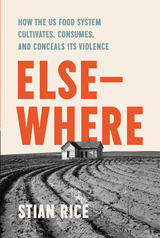
front cover of Elsewhere
Elsewhere
How the US Food System Cultivates, Consumes, and Conceals Its Violence
Stian Rice
West Virginia University Press, 2026

Elsewhere argues that you can make all of the “smart” food choices you want and follow Michael Pollan to the letter, but that won’t end the violence in the food system. Eating is an act of violence. With every life-sustaining meal and food purchase, we shorten the lives of farmers, laborers, animals, the planet, and ourselves. This isn’t a symptom of a broken food system, but a feature of a working one: our capitalist food system doesn’t cause harm accidentally, it does so because it has to. To keep generating wealth, the system moves its violence around, away from privileged producers and consumers and into forgettable elsewheres: reservations, prisons, distant islands, killing floors, inner cities, rural hinterlands, and war-torn countries. 

     This shell-game is not new. Elsewhere examines the 250-year history of the US food system to uncover how the country used abundance to enrich some and exploit others; how it captured, colonized, and reorganized territory to conceal its harms; and why decades of technological innovation, environmental awareness, and consumer consciousness haven’t staunched these self-inflicted wounds. Elsewhere invites us to ask different questions about the food system: where does its violence come from, where does it go, and how can we nurture a food system that first does no harm.


[more]

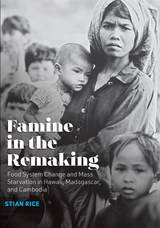
front cover of Famine in the Remaking
Famine in the Remaking
Food System Change and Mass Starvation in Hawaii, Madagascar, and Cambodia
Stian Rice
West Virginia University Press, 2020
Mass starvation’s causes may seem simple and immediate: crop failure, poverty, outbreaks of violence, and poor governance. But famines are complex, and scholars cannot fully understand what causes them unless they look at their numerous social and environmental precursors over long arcs of history and over long distances.
Famine in the Remaking examines the relationship between the reorganization of food systems and large-scale food crises through a comparative historical analysis of three famines: Hawaii in the 1820s, Madagascar in the 1920s, and Cambodia in the 1970s. This examination identifies the structural transformations—that is, changes to the relationships between producers and consumers—that make food systems more vulnerable to failure. Moving beyond the economic and political explanations for food crisis that have dominated the literature, Stian Rice emphasizes important socioecological interactions, developing a framework for crisis evolution that identifies two distinct temporal phases and five different types of causal mechanisms involved in food system failure. His framework contributes to current work in famine prevention and, animated by a commitment to social justice, offers the potential for early intervention in emerging food crises.
[more]


Send via email Share on Facebook Share on Twitter