
 A SCHOLARLY BOOK REPOSITORY
America began, we are often told, with the Founding Fathers, the men who waged a revolution and created a unique place called the United States. We may acknowledge the early Jamestown and Puritan colonists and mourn the dispossession of Native Americans, but we rarely grapple with the complexity of the nation’s pre-revolutionary past. In this pathbreaking revision, Daniel Richter shows that the United States has a much deeper history than is apparent—that far from beginning with a clean slate, it is a nation with multiple pasts that stretch back as far as the Middle Ages, pasts whose legacies continue to shape the present.
Exploring a vast range of original sources, Before the Revolution spans more than seven centuries and ranges across North America, Europe, and Africa. Richter recovers the lives of a stunning array of peoples—Indians, Spaniards, French, Dutch, Africans, English—as they struggled with one another and with their own people for control of land and resources. Their struggles occurred in a global context and built upon the remains of what came before. Gradually and unpredictably, distinctive patterns of North American culture took shape on a continent where no one yet imagined there would be nations called the United States, Canada, or Mexico.
By seeing these trajectories on their own dynamic terms, rather than merely as a prelude to independence, Richter’s epic vision reveals the deepest origins of American history.
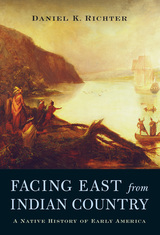
In the beginning, North America was Indian country. But only in the beginning. After the opening act of the great national drama, Native Americans yielded to the westward rush of European settlers. Or so the story usually goes. Yet, for three centuries after Columbus, Native people controlled most of eastern North America and profoundly shaped its destiny. In Facing East from Indian Country, Daniel K. Richter keeps Native people center-stage throughout the story of the origins of the United States.
Viewed from Indian country, the sixteenth century was an era in which Native people discovered Europeans and struggled to make sense of a new world. Well into the seventeenth century, the most profound challenges to Indian life came less from the arrival of a relative handful of European colonists than from the biological, economic, and environmental forces the newcomers unleashed. Drawing upon their own traditions, Indian communities reinvented themselves and carved out a place in a world dominated by transatlantic European empires. In 1776, however, when some of Britain’s colonists rebelled against that imperial world, they overturned the system that had made Euro-American and Native coexistence possible. Eastern North America only ceased to be an Indian country because the revolutionaries denied the continent’s first peoples a place in the nation they were creating.
In rediscovering early America as Indian country, Richter employs the historian’s craft to challenge cherished assumptions about times and places we thought we knew well, revealing Native American experiences at the core of the nation’s birth and identity.
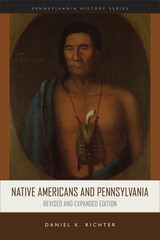
Engagingly written, deeply researched, and thoroughly revised to reflect the most recent interdisciplinary scholarship, this new edition of Native Americans and Pennsylvania focuses on Indigenous actors, voices, and landscapes, while tracing interconnections among local, continental, and global trends.
The story begins thousands of years before there was such a thing as “Pennsylvania.” William Penn did not paint his colony on a blank canvas. Colonists adapted ancient patterns of trade and cultural interaction created by the ancestors of Lenape, Conestoga, and Haudenosaunee peoples and convinced themselves they had made them their own. In the process, Pennsylvanians developed moral justifications for the expropriation of Indigenous land, pernicious doctrines about racial superiority, and brutal mechanisms of vigilante violence that profoundly influenced later United States government policies.
Those policies kept Pennsylvania in the foreground of national Native American issues long after the Commonwealth expelled the majority of its Indigenous population to far-flung diasporic homes: forced cultural assimilation at off-reservation boarding schools in the nineteenth century, cultural revitalization and political activism in the twentieth, and struggles with cultural institutions over the repatriation of human remains and controversies over who has the right to claim Indigenous identity in the twenty-first.
In the series Pennsylvania History
READERS
Browse our collection.
PUBLISHERS
See BiblioVault's publisher services.
STUDENT SERVICES
Files for college accessibility offices.
RECENTLY PUBLISHED




UChicago Accessibility Resources
home | accessibility | search | about | contact us
BiblioVault ® 2001 - 2026
The University of Chicago Press