
 A SCHOLARLY BOOK REPOSITORY
Results by Title
3 books about Rupture
3 books about Rupture

Centenary Subjects
Race, Reason, and Rupture in the Americas
Shawn McDaniel
Vanderbilt University Press, 2021
Centenary Subjects examines the ideological debates and didactic exercises in subject formation during the centenary era of independence (the decade of the 1910s)—the peak of arielismo—and proposes a new reading of the arielista archive that brings into focus the racial anxieties, epistemological and spiritual fissures, and iconoclastic agendas that structure, and at times smother, the ethos of that era.
Arielismo takes its name from José Enrique Rodó’s foundational essay Ariel (1900), a wide‑ranging gospel dedicated to Latin American youth that incited a cultural awakening under the banner of the spirit throughout the Americas at an ominous juncture—when the US co-opted the Cuban War of Independence in 1898, effectively rebranding it as the Spanish‑American War. Rodó’s optimistic message of transcendence as an antidote to the encroaching empire quickly became one of the most pervasive and malleable paradigms of regional empowerment, reverberating throughout a range of Latin Americanist projects in the twentieth and twenty‑first centuries.
Centenary Subjects recovers a series of important but understudied essays penned by arielista writers, radicals, pedagogues, prophets, and politicians of diverse stripes in the early twentieth century, and analyzes how, under the auspices of the arielista platform, young people emerged as historical subjects invested with unprecedented cultural capital, increasing political power, and an urgent mandate to break with the past and transform the sociopolitical and cultural landscape of their countries. But their respective designs harbor racial, epistemological, aesthetic, and anarchistic strains that bring into sharper relief the conflicting signals that the centenary subject had to parse with respect to race, reason, and rupture.
Arielismo takes its name from José Enrique Rodó’s foundational essay Ariel (1900), a wide‑ranging gospel dedicated to Latin American youth that incited a cultural awakening under the banner of the spirit throughout the Americas at an ominous juncture—when the US co-opted the Cuban War of Independence in 1898, effectively rebranding it as the Spanish‑American War. Rodó’s optimistic message of transcendence as an antidote to the encroaching empire quickly became one of the most pervasive and malleable paradigms of regional empowerment, reverberating throughout a range of Latin Americanist projects in the twentieth and twenty‑first centuries.
Centenary Subjects recovers a series of important but understudied essays penned by arielista writers, radicals, pedagogues, prophets, and politicians of diverse stripes in the early twentieth century, and analyzes how, under the auspices of the arielista platform, young people emerged as historical subjects invested with unprecedented cultural capital, increasing political power, and an urgent mandate to break with the past and transform the sociopolitical and cultural landscape of their countries. But their respective designs harbor racial, epistemological, aesthetic, and anarchistic strains that bring into sharper relief the conflicting signals that the centenary subject had to parse with respect to race, reason, and rupture.
[more]
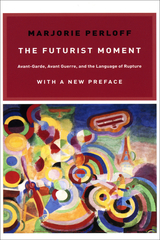
The Futurist Moment
Avant-Garde, Avant Guerre, and the Language of Rupture, with a New Preface
Marjorie Perloff
University of Chicago Press, 2004
Marjorie Perloff's stunning book was one of the first to offer a serious and far-reaching examination of the momentous flourishing of Futurist aesthetics in the European art and literature of the early twentieth century. Offering penetrating considerations of the prose, visual art, poetry, and carefully crafted manifestos of Futurists from Russia to Italy, Perloff reveals the Moment's impulses and operations, tracing its echoes through the years to the work of "postmodern" figures like Roland Barthes. This updated edition, with its new preface, reexamines the Futurist Moment in the light of a new century, in which Futurist aesthetics seem to have steadily more to say to the present.
[more]
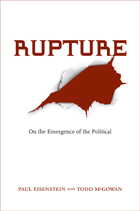
Rupture
On the Emergence of the Political
Paul Eisenstein and Todd McGowan
Northwestern University Press, 2012
In a radical reconsideration of political theory and politics, Paul Eisenstein and Todd McGowan explore the notion of rupture or radical tearing apart in both history and theory through the sweep of Western philosophy from Plato to Kierkegaard and beyond. The authors use contemporary literature and film to elucidate political theory, examining works by such writers are Dave Eggers, John Irving, and Toni Morrison, as well as films by directors from Sergei Eisenstein to David Fincher. Paul Eisenstein and Todd McGowan find that a rupture or radical break is repeatedly invoked at the beginning of every philosophical system. In this rupture, many of our most cherished political values—equality, solidarity, and the idea of freedom—emerge. But the lack of a sustained commitment to this radical tearing apart has repeatedly foreshortened, distorted, or perverted those same values. Most political philosophy may have marginalized these radical breaks with the past. But Eisenstein and McGowan demonstrate that Alain Badiou, Giorgio Agamben, and Slavoj Žižek have consistently brought rupture to the fore as an organizing principle for political thought. This insight holds great pertinence to our current world situation. Seeing the possibilities for an extended dialogue and sustained political change, Eisenstein and McGowan argue for a more systematic engagement with these theorists.
[more]
READERS
Browse our collection.
PUBLISHERS
See BiblioVault's publisher services.
STUDENT SERVICES
Files for college accessibility offices.
RECENTLY PUBLISHED



UChicago Accessibility Resources
home | accessibility | search | about | contact us
BiblioVault ® 2001 - 2025
The University of Chicago Press