
 A SCHOLARLY BOOK REPOSITORY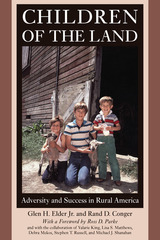
In Children of the Land, the authors ask whether traditional observations about farm families—strong intergenerational ties, productive roles for youth in work and social leadership, dedicated parents and a network of positive engagement in church, school, and community life—apply to three hundred Iowa children who have grown up with some tie to the land. The answer, as this study shows, is a resounding yes. In spite of the hardships they faced during the agricultural crisis of the 1980s, these children, whose lives we follow from the seventh grade to after high school graduation, proved to be remarkably successful, both academically and socially.
A moving testament to the distinctly positive lifestyle of Iowa families with connections to the land, this uplifting book also suggests important routes to success for youths in other high risk settings.

Strikingly, scant attention has focused on the victimization of women who want to leave their hostile partners. This groundbreaking work challenges the perception that rural communities are safe havens from the brutality of urban living. Identifying hidden crimes of economic blackmail and psychological mistreatment, and the complex relationship between patriarchy and abuse, Walter S. DeKeseredy and Martin D. Schwartz propose concrete and effective solutions, giving voice to women who have often suffered in silence.
The devastation of local news organizations has left rural areas of the US marooned in information deserts. Nick Mathews offers a boots-on-the-ground examination of the human toll of local news’s erosion by the winds of de-localization and corporate indifference.
It is no secret that ownership transfers, corporate mergers, and hedge fund takeovers have relentlessly consolidated and closed local news organizations. Mathews exposes the impact of that process on journalism, journalists, and news consumers hungry for outlets that tell their stories. A fundamental breakdown within journalism itself, the abandonment of community news has left disgruntled and disconnected locals to piece together news and information themselves. Mathews draws on the personal experiences of news gatherers and consumers to illuminate why local news cannot be scaled. Mass-produced content inevitably severs ties to communities while distant ownership is indifferent to local concerns.
Nuanced and sympathetic, <i>Deserted</i> provides a vivid portrait of the people and places forsaken by journalism’s corporate owners.
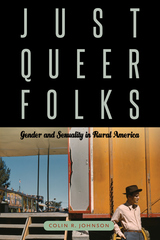
Most studies of lesbian and gay history focus on urban environments. Yet gender and sexual diversity were anything but rare in nonmetropolitan areas in the first half of the twentieth century. Just Queer Folks explores the seldom-discussed history of same-sex intimacy and gender nonconformity in rural and small-town America during a period when the now familiar concepts of heterosexuality and homosexuality were just beginning to take shape.
Eschewing the notion that identity is always the best measure of what can be known about gender and sexuality, Colin R. Johnson argues instead for a queer historicist approach. In so doing, he uncovers a startlingly unruly rural past in which small-town eccentrics, "mannish" farm women, and cross-dressing Civilian Conservation Corps enrollees were often just queer folks so far as their neighbors were concerned. Written with wit and verve, Just Queer Folks upsets a whole host of contemporary commonplaces, including the notion that queer history is always urban history.
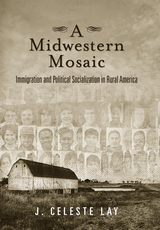
Drawn by low-skilled work and the safety and security of rural life, increasing numbers of families from Latin America and Southeast Asia have migrated to the American heartland. In the path-breaking book A Midwestern Mosaic, J. Celeste Lay examines the effects of political socialization on native white youth growing up in small towns.
Lay studies five Iowa towns to investigate how the political attitudes and inclinations of native adolescents change as a result of rapid ethnic diversification. Using surveys and interviews, she discovers that native adolescents adapt very well to foreign-born citizens, and that over time, gaps diminish between diverse populations and youth in all-white/Anglo towns in regard to tolerance, political knowledge, efficacy, and school participation.
A Midwestern Mosaic looks at the next generation to show how exposure to ethnic and cultural diversity during formative years can shape political behavior and will influence politics in the future.
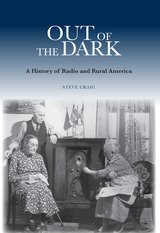
From the Grand Ole Opry to the National Barn Dance, how radio changed life in rural America
Out of the Dark: A History of Radio and Rural America shows how radio—especially clear channel network stations—brought news, markets, weather, religion, and entertainment into isolated farm homes between the 1920s and 1950s, narrowing rural–urban divides while also sustaining distinctly rural tastes (e.g., barn dance music). Craig argues that battery “farm radios,” high power stations, and national networking transformed daily life, work rhythms, consumer habits, and political participation, making radio the central domestic technology of the Depression era and beyond.
Craig blends regulatory and industry milestones, such as the Radio Act of 1927, with sociological studies, USDA extension records, FCC surveys, census tables, and rich case studies including WLS Chicago’s “National Barn Dance,” WSM Nashville’s “Grand Ole Opry,” and others. He mines audience research, diaries, program schedules, and tables that track the spread of radio. The book’s distinctive contributions include detailed charts (ownership by region; clear channel assignments) and vivid narratives of stations, formats, and personalities that connected farm families to national culture while preserving local identity.
The book is ideal for scholars and students of US social, rural, and media history; communication policy and political communication; country and bluegrass music history; agricultural extension; and American studies. It will also engage librarians, curators, and public historians seeking context for rural collections; journalists and podcasters tracing the roots of today’s information ecosystems; and general readers interested in how radio re made community life long before the internet.
This fourth Rural Sociological Society decennial volume provides advanced policy scholarship on rural North America during the 2010’s, closely reflecting upon the increasingly global nature of social, cultural, and economic forces and the impact of neoliberal ideology upon policy, politics, and power in rural areas.
The chapters in this volume represent the expertise of an influential group of scholars in rural sociology and related social sciences. Its five sections address the changing structure of North American agriculture, natural resources and the environment, demographics, diversity, and quality of life in rural communities.

When the rural poor prioritize issues such as the right to bear arms, and disapprove of welfare despite their economic concerns, they are often dismissed as uneducated and backward by academics and political analysts. In Those Who Work, Those Who Don't, Jennifer Sherman offers a much-needed sympathetic understanding of poor rural Americans, persuasively arguing that the growing cultural significance of moral values is a reasonable and inevitable response to economic collapse and political powerlessness.
Those Who Work, Those Who Don't is based on the intimate interviews and in-depth research Sherman conducted while spending a year living in "Golden Valley," a remote logging town in Northern California. Economically devastated by the 1990 ruling that listed the northern spotted owl as a threatened species, Golden Valley proved to be a rich case study for Sherman. She looks at how the members of the community coped with downward mobility caused by the loss of timber industry jobs and examines a wide range of reactions. She shows how substance abuse, domestic violence, and gender roles fluctuated under the town's economic strain.
Compellingly written, shot through with honesty and empathy, Those Who Work, Those Who Don't is a rare firsthand account that studies the rural poor. As incomes erode and the American dream becomes more and more inaccessible, Sherman reveals that moral values and practices become a way for the poor to gain status and maintain a sense of dignity in the face of economic ruin.
READERS
Browse our collection.
PUBLISHERS
See BiblioVault's publisher services.
STUDENT SERVICES
Files for college accessibility offices.
RECENTLY PUBLISHED






UChicago Accessibility Resources
home | accessibility | search | about | contact us
BiblioVault ® 2001 - 2026
The University of Chicago Press