
 A SCHOLARLY BOOK REPOSITORY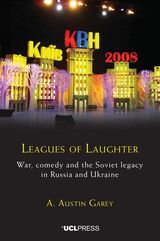
Leagues of Laughter traces the evolution of a Soviet-created youth game called KVN (Klub veselykh i nakhodchivykh or Club of the Cheerful and Clever) over sixty years as students’ nation-states collapsed, competed, and eventually went to war. Through cross-border narratives, the book shows how humor persists—and transforms—amid authoritarianism, censorship, and conflict. With insight and compassion, author A. Austin Garey reveals how laughter became a mode of resistance, identity, and cultural continuity in the long cultural context of the war in Ukraine. In addition to introducing a novel theory of “tradition as stance” to explain how traditions are reproduced and reinterpreted over time, the book offers a compelling comparative analysis of cultural production under political pressure.

From the very first weeks of Russia’s large-scale attack on Ukraine in February 2022, Russian soldiers, politicians, and proxy administrators expended considerable effort interacting with monuments on newly occupied territory. Why did the invaders care enough about war memorials to divert scarce resources to destroying, maintaining, or building them amid a massive war? Why did they remove some memorials and spare others? What was the point of commemorating past victories and defeats while bombing Ukrainian cities, and how did commemorative ceremonies in the occupied territories
change over the first year of the war? What was the broader impact of monument-related practices beyond the local settings in which they occurred? And what does the Ukrainian case teach us more generally about how memorials to past wars can be used to justify new conquests? These are some of the questions this book explores, based on fieldwork in occupied Ukraine and online research.

Aside from the near-complete devastation of a sovereign state and reversal of the global balance of power, the Russian invasion of Ukraine in 2022 is leading to a radical transformation in the Eastern European and Eurasian regions – including Russia itself.
The 13 chapters in this volume examine the main geopolitical consequences of the resurgent imperialist aspirations of the Russian Federation. They examine the ideological tools of history falsification as an integral part of hybrid warfare. Turning to the economy, the book discusses how the war and economic sanctions imposed on Russia are redrawing the geopolitical map and how economic relations would change following a regime transformation. The book discusses the reactions of members of the international community to the invasion, whether threatened or neutral parties or allies. The collection therefore offers a comprehensive picture of the main consequences of the resurgent imperialist aspirations of the Russian Federation. Equipped with the conceptual tools of the analysis with a focus on the patronal features of the political-economic system, the book considers the aftermath of the war. This collection complements the book entitled Ukraine. Patronal Democracy and the Russian Invasion.
The Russian invasion of Ukraine in 2022 jeopardizes the country's independence and its chances for Western-style development. However, the heroic attitude of the Ukrainian people, combined with a solidifying national identity, makes the domestic foundations for a western turn stronger than ever. After the invasion, building strong foundations of liberal democracy will be a top priority. In addition to alleviating immediate problems, the country must also address its post-communist legacy and address the constraints of patronalism.
The authors of this edited volume, leading Ukrainian scholars supplemented by colleagues from Hungary, examine the chances of an anti-patronal transformation after the war. The book provides an overview of the development of Ukraine's political-economic system: color revolutions in 2004 and 2014 brought democratic transformation, but no change in the patronage system The result was patronal regime cycles instead of the emergence of a Western-type liberal democracy in the country. Building on the conceptual framework of the editors' The Anatomy of Post-Communist Regimes (CEU Press, 2020), the 12 chapters examine the impact of the war on patronal democracy, the relational economy, clientelist society, and the international environment in which Ukraine operates.
This collection is complemented by the book entitled Russia. Imperial Endeavor and Geopolitical Consequences.
READERS
Browse our collection.
PUBLISHERS
See BiblioVault's publisher services.
STUDENT SERVICES
Files for college accessibility offices.
RECENTLY PUBLISHED


UChicago Accessibility Resources
home | accessibility | search | about | contact us
BiblioVault ® 2001 - 2026
The University of Chicago Press