
 A SCHOLARLY BOOK REPOSITORY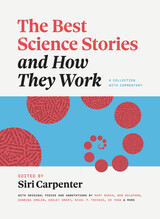
An invitation to engage with some of today’s most respected science journalists as they take readers beneath the surface to reveal the making of eleven of the best science stories.
With eleven deeply reported, artfully crafted stories and annotations by some of the most thoughtful and respected science journalists working today, The Best Science Stories and How They Work is more than the sum of its impressive parts. Experience the pleasure of reading a “Best of” anthology, attending a science writing masterclass, and meeting journalists who become more than their familiar bylines. Each piece benefits from an introduction, annotations, and a conversation between the piece’s author and annotator.
Siri Carpenter—editor of this book and cofounder of The Open Notebook, a leading source of training and educational materials for journalists who cover science—has long considered what’s behind the best writing. The pieces in this guide are drawn from a range of publications such as Scientific American, Nature, The Atlantic, and The New York Times Magazine and offer a unique perspective on how great science journalism happens: the careful structuring of a narrative, the delicate balance of skepticism and wonder, the ethical challenges of working with sources, the artistry of prose that sings. Readers will not only encounter outstanding examples of stellar storytelling, but they will also understand how these successful stories were reported and written, revealing the choices fundamental to good science journalism. Following each annotation, a Q&A with the original author provides an intimate look at the decisions and challenges that shaped their work.
Taken together, these pieces and annotations reveal the detailed, technical narrative work required to tell science stories. The book will delight, inspire, and equip readers with new tools to appreciate the stories that matter most.
Contributors: Jordana Cepelewicz, Shraddha Chakradhar, Nadia Drake, Ben Goldfarb, Sabrina Imbler, Ferris Jabr, Emily Laber-Warren, Stephanie M. Lee, Dana Mackenzie, Amy Maxmen, Emiliano Rodríguez Mega, Kendra Pierre-Louis, Debbie Ponchner, Sandeep Ravindran, Mary Roach, Paola Rosa-Aquino, Ashley Smart, Jessica Seigel, Ramin Skibba, Kamala Thiagarajan, Bijal Trivedi, and Ed Yong
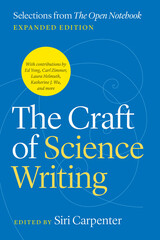
Science writing has never been so critical to our world, and the demands on writers have never been greater. On any given day, a writer might need to explain the details of AI, analyze developments in climate change research, or serve as a watchdog helping to ensure the integrity of the scientific enterprise. At the same time, writers must spin tales that hook and keep readers, despite the endless other demands on their attention. How does one do it? The Craft of Science Writing is the authoritative guide.
With pieces curated from the archives of science writers’ go-to online resource, The Open Notebook, this book explores strategies for finding and shaping story ideas, pitching editors, and building a specialty in science writing. It delves into fundamental skills that every science writer must learn, including planning their reporting; identifying, interviewing, and quoting sources; organizing interview notes; and crafting stories that engage and inform audiences. This expanded edition includes new introductory material and nine new essays focusing on such topics as how to establish a science beat, how to find and use quotes, how to critically evaluate scientific claims, how to use social media for reporting, and how to do data-driven reporting. In addition, there are essays on inclusivity in science writing, offering strategies for eradicating ableist language from stories, working with sensitivity readers, and breaking into English-language media for speakers of other languages.
Through interviews with leading journalists offering behind-the-scenes inspiration as well as in-depth essays on the craft offering practical advice, readers will learn how the best science stories get made, from conception to completion.
Contributors:
Humberto Basilio, Siri Carpenter, Jeanne Erdmann, Dan Ferber, Tina Casagrand Foss, Geoffrey Giller, Laura Helmuth, Jane C. Hu, Alla Katsnelson, Roxanne Khamsi, Betsy Ladyzhets, Jyoti Madhusoodanan, Amanda Mascarelli, Robin Meadows, Kate Morgan, Tiên Nguyễn, Michelle Nijhuis, Aneri Pattani, Rodrigo Pérez Ortega, Mallory Pickett, Kendall Powell, Tasneem Raja, Sandeep Ravindran, Marion Renault, Julia Rosen, Megha Satyanarayana, Christina Selby, Knvul Sheikh, Abdullahi Tsanni, Alexandra Witze, Katherine J. Wu, Wudan Yan, Ed Yong, Rachel Zamzow, Sarah Zhang, and Carl Zimmer
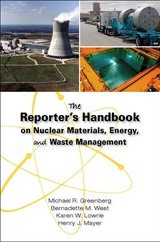
Each "brief" is based on interviews with named scientists, engineers, or administrators in a nuclear specialty, and each has been reviewed by a team of independent experts. The objective is not to make a case for or against nuclear-related technologies, but rather to provide definitive background information. (The approach is based on that of The Reporter's Environmental Handbook, published in 1988, which won a special award for journalism from the Sigma Delta Chi Society of professional journalists.)
Other features of the book include: a glossary of hundreds of terms, an introduction to risk assessment, environmental and economic impacts, and public perceptions, an article by an experienced reporter with recommendations about how to cover nuclear issues, quick guides to the history of nuclear power in the United States, important federal legislation and regulations, nuclear position statements, and key organizations, print and electronic resources.
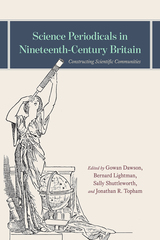
The essays in this volume set the historical exploration of the scientific and medical periodicals of the era on a new footing, examining their precise function and role in the making of nineteenth-century science and enhancing our vision of the shifting communities and practices of science in the period. This radical rethinking of the scientific journal offers a new approach to the reconfiguration of the sciences in nineteenth-century Britain and sheds instructive light on contemporary debates about the purpose, practices, and price of scientific journals.
READERS
Browse our collection.
PUBLISHERS
See BiblioVault's publisher services.
STUDENT SERVICES
Files for college accessibility offices.
RECENTLY PUBLISHED


UChicago Accessibility Resources
home | accessibility | search | about | contact us
BiblioVault ® 2001 - 2026
The University of Chicago Press