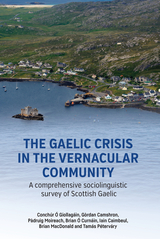
front cover of The Gaelic Crisis in the Vernacular Community
The Gaelic Crisis in the Vernacular Community
A Comprehensive Sociolinguistic Survey of Scottish Gaelic
Conchúr Ó Giollagáin, Gòrdan Camshron, Pàdruig Moireach, Brian Ó Curnáin, Iain Caimbeul, Brian MacDonald and Tamás Péterváry
Aberdeen University Press, 2020
This book emerges from the work of Soillse's Islands Gaelic Research Project (IGRP) conducted between 2015 and 2017. Soillse was a research collaboration, established between founding members – the University of the Highlands and Islands, the University of Aberdeen, the University of Edinburgh and the University of Glasgow – to provide a much enhanced research capacity to inform public policy towards the maintenance and revitalisation of Gaelic language and culture. This publication provides contemporary data and analysis of the societal and spatial extent of Gaelic speakers and Gaelic speaking in the remaining vernacular communities in Scotland. The survey modules examined: census demolinguistics; preschoolers' language practice; teenager data; three indicative communities and speaker typologies, providing qualitative and quantitative information on community, family, school and individual language acquisition and practice.
[more]


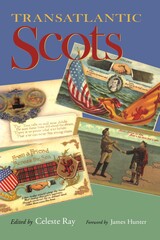
front cover of Transatlantic Scots
Transatlantic Scots
Edited by Celeste Ray, foreword by James Hunter
University of Alabama Press, 2005
Examines the impact of the Scottish legacy on North American cultures and heritage
 
During the past four decades, growing interest in North Americans' cultural and ancestral ties to Scotland has produced hundreds of new Scottish clan and heritage societies.  Well over 300 Scottish Highland games and gatherings annually take place across the U.S. and Canada. 

Transatlantic Scots is a multidisciplinary collection that studies the regional organization and varied expressions of the Scottish Heritage movement in the Canadian Maritimes, the Great Lakes, New England, and the American South. From diverse perspectives, authorities in their fields consider the modeling of a Scottish identity that distances heritage celebrants from prevalent visions of whiteness. Considering both hyphenated Scots who celebrate centuries-old transmission of Scottish traditions and those for whom claiming or re-claiming a Scottish identity is recent and voluntary, this book also examines how diaspora themes and Highland imagery repeatedly surface in regional public celebrations and how traditions are continually reinvented through the accumulation of myths. The underlying theoretical message is that ethnicity and heritage survive because of the flexibility of history and tradition. 

This work is a lasting contribution to the study of ethnicity and identity, the renegotiation of history and cultural memory into heritage, and the public performance and creation of tradition.

 
[more]


Send via email Share on Facebook Share on Twitter