front cover of Marketing for Scientists
Marketing for Scientists
How to Shine in Tough Times
Marc J. Kuchner
Island Press, 2011
It's a tough time to be a scientist: universities are shuttering science departments, federal funding agencies are facing flat budgets, and many newspapers have dropped their science sections altogether. But according to Marc Kuchner, this antiscience climate doesn't have to equal a career death knell-it just means scientists have to be savvier about promoting their work and themselves. In Marketing for Scientists, he provides clear, detailed advice about how to land a good job, win funding, and shape the public debate.
 
As an astrophysicist at NASA, Kuchner knows that "marketing" can seem like a superficial distraction, whether your daily work is searching for new planets or seeking a cure for cancer. In fact, he argues, it's a critical component of the modern scientific endeavor, not only advancing personal careers but also society's knowledge. 
 
Kuchner approaches marketing as a science in itself. He translates theories about human interaction and sense of self into methods for building relationships-one of the most critical skills in any profession. And he explains how to brand yourself effectively-how to get articles published, give compelling presentations, use social media like Facebook and Twitter, and impress potential employers and funders. 
 
Like any good scientist, Kuchner bases his conclusions on years of study and experimentation. In Marketing for Scientists, he distills the strategies needed to keep pace in a Web 2.0 world.
[more]

front cover of Shine
Shine
Joseph Millar
Carnegie Mellon University Press, 2024
Poems that arise from the currents of felt experience.

Joseph Millar’s lyrical poems explore work, love, filial connection, life, and death. This is Millar’s sixth collection, and it reaches a deeper, more sonic level than his usual narrative voice. A collection of half songs rendered in a hardscrabble lyricism, they are propelled by their shifting, irregular rhymes, half rhymes, and off rhymes. The poems’ subjects grow from moments of daily life and their deeper obsessions—love, work, death, desire—and the making of art itself. Touched with more humor than earlier work, and with an unpredictable timing that seems to listen to itself as it travels down the page, the poems are part wonder and part reflection, carried along by their music.

[more]

front cover of Shine on Me
Shine on Me
A Novel
A. G. Mojtabai
Northwestern University Press, 2016

The rules are simple enough: “Here’s the deal: Whoever keeps his hands longest on one of the dealer’s brand new pickup trucks owns it and gets to drive it away.” An actual contest hosted by an auto dealership in Texas is the prompt for this fictional exploration, which seeks to probe the depths and shallows of the American soul.

To the players vying for this shiny new prize, competition revs up as the hours wear on, positions harden, sightlines narrow, and sleep-deprivation intensifies. At the center is the reporter Trew Reade, struggling to make sense of the event and his own role in it. Early on, he muses that “surface and substance were rarely the same; transparency could be the most cunning of masks.” So, too, is the author’s transparent prose. Reviewers have sometimes found Mojtabai’s vision akin to that of Marilynne Robinson and Flannery O’Connor, but the characterization from Books & Culture—“not like anyone else”—is perhaps best, inviting readers to discover this provocative writer for themselves.
[more]

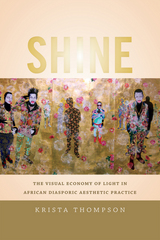
front cover of Shine
Shine
The Visual Economy of Light in African Diasporic Aesthetic Practice
Krista Thompson
Duke University Press, 2015
In Jamaican dancehalls competition for the video camera's light is stiff, so much so that dancers sometimes bleach their skin to enhance their visibility. In the Bahamas, tuxedoed students roll into prom in tricked-out sedans, staging grand red-carpet entrances that are designed to ensure they are seen being photographed. Throughout the United States and Jamaica friends pose in front of hand-painted backgrounds of Tupac, flashy cars, or brand-name products popularized in hip-hop culture in countless makeshift roadside photography studios. And visual artists such as Kehinde Wiley remix the aesthetic of Western artists with hip-hop culture in their portraiture. In Shine, Krista Thompson examines these and other photographic practices in the Caribbean and United States, arguing that performing for the camera is more important than the final image itself. For the members of these African diasporic communities, seeking out the camera's light—whether from a cell phone, Polaroid, or video camera—provides a means with which to represent themselves in the public sphere. The resulting images, Thompson argues, become their own forms of memory, modernity, value, and social status that allow for cultural formation within and between African diasporic communities.
 
[more]


Send via email Share on Facebook Share on Twitter