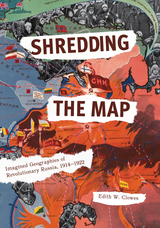
Shredding the Map
Imagined Geographies of Revolutionary Russia, 1914-1922
Edith W. Clowes
Amherst College Press, 2024
Shredding the Map investigates Russian place consciousness in the decade between the start of World War I and the end of the Russian civil war. Attachment to place is a vital aspect of human identity, and connection to homeland, whether imagined or real, can be especially powerful. Drawing from a large digital database of period literature, Shredding the Map investigates the metamorphic changes in how Russians related to places–whether abstractions like “country” or concrete spaces of borders, fronts, and edgelands–during these years.
An innovative, digitally-aided study of Russia’s “imagined geography” during the early decades of the twentieth century, Shredding the Map uncovers vying emotional patterns and responses to Russian ideas of place, some familiar and some quite new. The book includes new visualizations that connect otherwise invisible networks of shared place, feeling, and perception among dozens of writers in order to trace patterns of geospatial identity. A scholarly companion to the “Mapping Imagined Geographies of Revolutionary Russia” website and database, this book offers an innovative analysis of place and identity beyond the centers of power, enhancing our perceptions of Russia and encouraging debate about the possibilities for digital humanities and literary analysis.
[more]