
 A SCHOLARLY BOOK REPOSITORY

To the practical modern mind, the idea of divine prophecy is more ludicrous than sublime. Yet to our cultural forebears in ancient Greece and Rome, prophecy was anything but marginal; it was in fact the basic medium for recalling significant past events and expressing hopes for the future, and it offered assurance that divinities truly cared about mere mortals. Prophecy also served political ends, and it was often invoked to support or condemn an emperor's actions. In Prophets and Emperors, David Potter shows us how prophecy worked, how it could empower, and how the diverse inhabitants of the Roman Empire used it to make sense of their world.
This is a fascinating account of prophecy as a social, religious, and political phenomenon. The various systems of prophecy--including sacred books, oracles, astrological readings, interpretation of dreams, the sayings of holy men and women--come into sharp relief. Potter explores the use of prophecy as a nieans of historical analysis and political communication, and he describes it in the context of the ancient city. Finally, he traces the reformation of the prophetic tradition under the influence of Christianity in the fourth century.
Drawing on diverse evidence--from inscriptions and ancient prophetic books to Greek and Roman historians and the Bible--Potter has produced a study that will engage anyone interested in the religions of the ancient Mediterranean and in the history and politics of the Roman Empire.
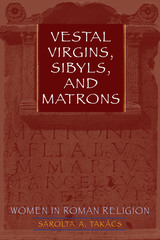
Roman women were the procreators and nurturers of life, both in the domestic world of the family and in the larger sphere of the state. Although deterred from participating in most aspects of public life, women played an essential role in public religious ceremonies, taking part in rituals designed to ensure the fecundity and success of the agricultural cycle on which Roman society depended. Thus religion is a key area for understanding the contributions of women to Roman society and their importance beyond their homes and families.
In this book, Sarolta A. Takács offers a sweeping overview of Roman women's roles and functions in religion and, by extension, in Rome's history and culture from the republic through the empire. She begins with the religious calendar and the various festivals in which women played a significant role. She then examines major female deities and cults, including the Sibyl, Mater Magna, Isis, and the Vestal Virgins, to show how conservative Roman society adopted and integrated Greek culture into its mythic history, artistic expressions, and religion. Takács's discussion of the Bona Dea Festival of 62 BCE and of the Bacchantes, female worshippers of the god Bacchus or Dionysus, reveals how women could also jeopardize Rome's existence by stepping out of their assigned roles. Takács's examination of the provincial female flaminate and the Matres/Matronae demonstrates how women served to bind imperial Rome and its provinces into a cohesive society.
READERS
Browse our collection.
PUBLISHERS
See BiblioVault's publisher services.
STUDENT SERVICES
Files for college accessibility offices.
RECENTLY PUBLISHED







UChicago Accessibility Resources
home | accessibility | search | about | contact us
BiblioVault ® 2001 - 2025
The University of Chicago Press