
 A SCHOLARLY BOOK REPOSITORY
Results by Title
2 books about Siverson, Randolph Martin
2 books about Siverson, Randolph Martin
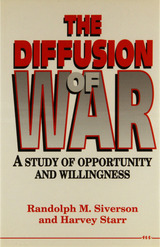
The Diffusion of War
A Study of Opportunity and Willingness
Randolph M. Siverson and Harvey Starr
University of Michigan Press, 1991
Much attention has been given in the past to the onset of war—to what causes it. The authors of this timely study argue that what war causes is just as important a question. In The Diffusion of War Randolph M. Siverson and Harvey Starr investigate the “contagion” of war — or how and under what circumstances conflicts grow once they begin.Given the great consequences of the expansion of war—economic costs, human costs, and political change, for the participants and also for the international system—it is essential to ask why some wars spread and why others do not; what states are most likely to join wars and how quickly? Viewing war as a process of conflict escalation, the authors explore these important questions through considerations of opportunity and willingness. They consider how the choice to enter war relates to the geopolitical context in which that choice must be made — demonstrating that in the war experiences of states from 1816 to 1965, the effects of geographical proximity (opportunity) and the political pressures of interstate alliances (willingness) have combined to influence the infectious diffusion of war. This distinctive approach permits a synthesis of previous theory and research on war across academic disciplines and of micro- and macrolevels of analysis. Siverson and Starr offer a valuable perspective on the changing nature and process of war; their book makes broadly accessible a subject of vital relevance to the world community.
[more]
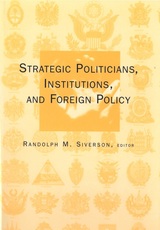
Strategic Politicians, Institutions, and Foreign Policy
Randolph M. Siverson, Editor
University of Michigan Press, 1998
Most would agree that political leaders want to stay in office. What does this mean for foreign policymaking? The essays in this book probe the way in which the desire of political leaders to stay in office shapes the choices they make in foreign policy. Moving beyond theories of international politics that emphasize the pursuit of power by the state as the goal of foreign policy, the writers look at the domestic political reasons why leaders might pursue greater power in the world for their states. In both the area of conflict policy and choices over economic policy, the essays demonstrate that leaders behave strategically, shaping their policies to satisfy key constituents whose support is necessary to keep them in power. Enhanced state power is used to satisfy constituents who will in turn be more likely to support the continued tenure of the leader. Covering topics ranging from monetary negotiations and trade agreements to decisions to go to war, increase defense spending or form alliances, the essays explore the strategic domestic political behavior of leaders in making foreign policy decisions, enhancing our understanding of how foreign policy is made. The contributors include Kurt Taylor Gaubatz, Michael J. Gilligan, W. Ben Hunt, Keisuke lida, Atsushi Ishida, Lisa Martin, Fiona McGillivray, T. Clifton Morgan, Glenn Palmer, Kenneth Shultz, Randolph Siverson, Alastair Smith, and Barry Weingast.
[more]
READERS
Browse our collection.
PUBLISHERS
See BiblioVault's publisher services.
STUDENT SERVICES
Files for college accessibility offices.
RECENTLY PUBLISHED



UChicago Accessibility Resources
home | accessibility | search | about | contact us
BiblioVault ® 2001 - 2026
The University of Chicago Press