
 A SCHOLARLY BOOK REPOSITORY
9 start with A start with A
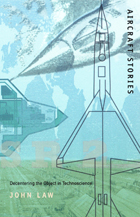
Law works to upset the binary between the modernist concept of knowledge, subjects, and objects as having centered and concrete essences and the postmodernist notion that all is fragmented and centerless. The structure and content of Aircraft Stories reflect Law’s contention that knowledge, subjects, and—particularly— objects are “fractionally coherent”: that is, they are drawn together without necessarily being centered. In studying the process of this particular aircraft’s design, construction, and eventual cancellation, Law develops a range of metaphors to describe both its fractional character and the ways its various aspects interact with each other. Offering numerous insights into the way we theorize the working of systems, he explores the overlaps between singularity and multiplicity and reveals rich new meaning in such concepts as oscillation, interference, fractionality, and rhizomatic networks.
The methodology and insights of Aircraft Stories will be invaluable to students in science and technology studies and will engage others who are interested in the ways that contemporary paradigms have limited our ability to see objects in their true complexity.
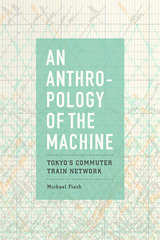
An Anthropology of the Machine is a creative ethnographic study of the culture, history, and experience of commuting in Tokyo. At the same time, it is a theoretically ambitious attempt to think through our very relationship with technology and our possible ecological futures. Fisch provides an unblinking glimpse into what it might be like to inhabit a future in which more and more of our infrastructure—and the planet itself—will have to operate beyond capacity to accommodate our ever-growing population.
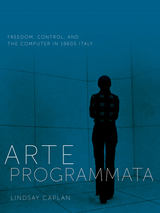
Tracing the evolution of the Italian avant-garde’s pioneering experiments with art and technology and their subversion of freedom and control
In postwar Italy, a group of visionary artists used emergent computer technologies as both tools of artistic production and a means to reconceptualize the dynamic interrelation between individual freedom and collectivity. Working contrary to assumptions that the rigid, structural nature of programming limits subjectivity, this book traces the multifaceted practices of these groundbreaking artists and their conviction that technology could provide the conditions for a liberated social life.
Situating their developments within the context of the Cold War and the ensuing crisis among the Italian left, Arte Programmata describes how Italy’s distinctive political climate fueled the group’s engagement with computers, cybernetics, and information theory. Creating a broad range of immersive environments, kinetic sculptures, domestic home goods, and other multimedia art and design works, artists such as Bruno Munari, Enzo Mari, and others looked to the conceptual frameworks provided by this new technology to envision a way out of the ideological impasses of the age.
Showcasing the ingenuity of Italy’s earliest computer-based art, this study highlights its distinguishing characteristics while also exploring concurrent developments across the globe. Centered on the relationships between art, technology, and politics, Arte Programmata considers an important antecedent to the digital age.
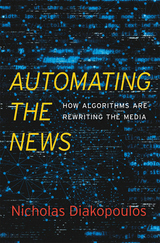
From hidden connections in big data to bots spreading fake news, journalism is increasingly computer-generated. An expert in computer science and media explains the present and future of a world in which news is created by algorithm.
Amid the push for self-driving cars and the roboticization of industrial economies, automation has proven one of the biggest news stories of our time. Yet the wide-scale automation of the news itself has largely escaped attention. In this lively exposé of that rapidly shifting terrain, Nicholas Diakopoulos focuses on the people who tell the stories—increasingly with the help of computer algorithms that are fundamentally changing the creation, dissemination, and reception of the news.
Diakopoulos reveals how machine learning and data mining have transformed investigative journalism. Newsbots converse with social media audiences, distributing stories and receiving feedback. Online media has become a platform for A/B testing of content, helping journalists to better understand what moves audiences. Algorithms can even draft certain kinds of stories. These techniques enable media organizations to take advantage of experiments and economies of scale, enhancing the sustainability of the fourth estate. But they also place pressure on editorial decision-making, because they allow journalists to produce more stories, sometimes better ones, but rarely both.
Automating the News responds to hype and fears surrounding journalistic algorithms by exploring the human influence embedded in automation. Though the effects of automation are deep, Diakopoulos shows that journalists are at little risk of being displaced. With algorithms at their fingertips, they may work differently and tell different stories than they otherwise would, but their values remain the driving force behind the news. The human–algorithm hybrid thus emerges as the latest embodiment of an age-old tension between commercial imperatives and journalistic principles.
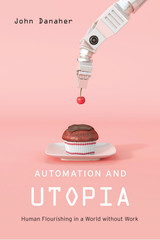
Automating technologies threaten to usher in a workless future. But this can be a good thing—if we play our cards right.
Human obsolescence is imminent. The factories of the future will be dark, staffed by armies of tireless robots. The hospitals of the future will have fewer doctors, depending instead on cloud-based AI to diagnose patients and recommend treatments. The homes of the future will anticipate our wants and needs and provide all the entertainment, food, and distraction we could ever desire.
To many, this is a depressing prognosis, an image of civilization replaced by its machines. But what if an automated future is something to be welcomed rather than feared? Work is a source of misery and oppression for most people, so shouldn’t we do what we can to hasten its demise? Automation and Utopia makes the case for a world in which, free from need or want, we can spend our time inventing and playing games and exploring virtual realities that are more deeply engaging and absorbing than any we have experienced before, allowing us to achieve idealized forms of human flourishing.
The idea that we should “give up” and retreat to the virtual may seem shocking, even distasteful. But John Danaher urges us to embrace the possibilities of this new existence. The rise of automating technologies presents a utopian moment for humankind, providing both the motive and the means to build a better future.

The written word has been a central bearer of culture since antiquity. But its position is now being challenged by the powerful media of electronic communication. In this penetrating and witty book James O'Donnell takes a reading on the promise and the threat of electronic technology for our literate future.
In Avatars of the Word O'Donnell reinterprets today's communication revolution through a series of refracted comparisons with earlier revolutionary periods: the transition from oral to written culture, from the papyrus scroll to the codex, from copied manuscript to print. His engaging portrayals of these analogous epochal moments suggest that our steps into cyberspace are not as radical as we might think. Observing how technologies of the word have affected the shaping of culture in the past, and how technological transformation has been managed, we regain models that can help us navigate the electronic transformation now underway. Concluding with a focus on the need to rethink the modern university, O'Donnell specifically addresses learning and teaching in the humanities, proposing ways to seek the greatest benefit from electronic technologies while steering clear of their potential pitfalls.
READERS
Browse our collection.
PUBLISHERS
See BiblioVault's publisher services.
STUDENT SERVICES
Files for college accessibility offices.
RECENTLY PUBLISHED





UChicago Accessibility Resources
home | accessibility | search | about | contact us
BiblioVault ® 2001 - 2024
The University of Chicago Press