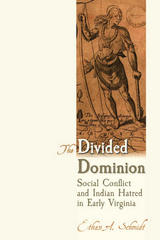
front cover of Divided Dominion
Divided Dominion
Social Conflict and Indian Hatred in Early Virginia
Ethan A. Schmidt
University Press of Colorado, 2014
In The Divided Dominion, Ethan A. Schmidt examines the social struggle that created Bacon's Rebellion, focusing on the role of class antagonism in fostering violence toward native people in seventeenth-century Virginia. This provocative volume places a dispute among Virginians over the permissibility of eradicating Native Americans for land at the forefront in understanding this pivotal event.

Myriad internal and external factors drove Virginians to interpret their disputes with one another increasingly along class lines. The decades-long tripartite struggle among elite whites, non-elite whites, and Native Americans resulted in the development of mutually beneficial economic and political relationships between elites and Native Americans. When these relationships culminated in the granting of rights—equal to those of non-elite white colonists—to Native Americans, the elites crossed a line and non-elite anger boiled over. A call for the annihilation of all Indians in Virginia united different non-elite white factions and molded them in widespread social rebellion.

The Divided Dominion places Indian policy at the heart of Bacon's Rebellion, revealing the complex mix of social, cultural, and racial forces that collided in Virginia in 1676. This new analysis will interest students and scholars of colonial and Native American history.

[more]

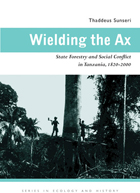
front cover of Wielding the Ax
Wielding the Ax
State Forestry and Social Conflict in Tanzania, 1820–2000
Thaddeus Sunseri
Ohio University Press, 2009

Forests have been at the fault lines of contact between African peasant communities in the Tanzanian coastal hinterland and outsiders for almost two centuries. In recent decades, a global call for biodiversity preservation has been the main challenge to Tanzanians and their forests.

Thaddeus Sunseri uses the lens of forest history to explore some of the most profound transformations in Tanzania from the nineteenth century to the present. He explores anticolonial rebellions, the world wars, the depression, the Cold War, oil shocks, and nationalism through their intersections with and impacts on Tanzania’s coastal forests and woodlands. In Wielding the Ax, forest history becomes a microcosm of the origins, nature, and demise of colonial rule in East Africa and of the first fitful decades of independence.

Wielding the Ax is a story of changing constellations of power over forests, beginning with African chiefs and forest spirits, both known as “ax–wielders,” and ending with international conservation experts who wield scientific knowledge as a means to controlling forest access. The modern international concern over tropical deforestation cannot be understood without an awareness of the long–term history of these forest struggles.


[more]


Send via email Share on Facebook Share on Twitter