
 A SCHOLARLY BOOK REPOSITORY
Results by Title
3 books about Social status in literature
3 books about Social status in literature
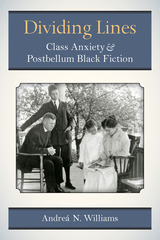
Dividing Lines
Class Anxiety and Postbellum Black Fiction
Andreá N. Williams
University of Michigan Press, 2013
One of the most extensive studies of class in nineteenth-century African American literature to date, Dividing Lines unveils how black fiction writers represented the uneasy relationship between class differences, racial solidarity, and the quest for civil rights in black communities. By portraying complex, highly stratified communities with a growing black middle class, these authors dispelled notions that black Americans were uniformly poor or uncivilized. The book argues that the signs of class anxiety are embedded in postbellum fiction: from the verbal stammer or prim speech of class-conscious characters to fissures in the fiction's form. Andreá N. Williams delves into the familiar and lesser-known works of Frances E. W. Harper, Pauline Hopkins, Charles W. Chesnutt, Sutton Griggs, and Paul Laurence Dunbar, showing how these texts mediate class through discussions of labor, moral respectability, ancestry, spatial boundaries, and skin complexion. Dividing Lines also draws on reader responses—from book reviews, editorials, and letters—to show how the class anxiety expressed in African American fiction directly sparked reader concerns over the status of black Americans in the U.S. social order. Weaving literary history with compelling textual analyses, this study yields new insights about the intersection of race and class in black novels and short stories from the 1880s to 1900s.
[more]
The Eve/Hagar Paradigm in the Fiction of Quince Duncan
Dellite Martin-Ogunsola
University of Missouri Press, 2004
Born in Costa Rica in 1940, Quince Duncan has penned an impressive body of work, including novels, short stories, essays, and literary and cultural criticism. Despite his reputation as Costa Rica’s leading novelist, Duncan remains one of the least studied writers. Dellita Martin-Ogunsola seeks to remedy this inequity with The Eve/Hagar Paradigm in the Fiction of Quince Duncan.
In this first book-length study in English devoted to Duncan’s work, Martin-Ogunsola explores the issues of race, class, and gender in five of Duncan’s major works published during the 1970s. Focusing primarily on the roles of women, Martin-Ogunsola uses the figures of Eve and the Egyptian slave Hagar to provide, through metaphor, an in-depth analysis of the female characters portrayed in Duncan’s prose. Specifically, the Eve/Hagar paradigm is employed to examine how the essential characteristics of femininity play out in the context of ethnicity and caste. The book begins with Dawn Song (1970), the story of Antillean immigrants struggling with migration, oppression, and resistance while adapting to a new environment, and continues through Dead-End Street (1979), a novel exploring the ramifications of the myth, perpetrated through history, that defines Costa Rica in terms of Euro-Hispanic culture.
Martin-Ogunsola illustrates Duncan’s use of a female presence that challenges the traditional treatment of women in literature. Spanning the period between the initial settlement of the Atlantic region of Costa Rica during the early years of the twentieth century to the 1948 Costa Rican Civil War, Martin-Ogunsola’s book invites the reader to view the world through the eyes of Duncan’s female characters.
TheEve/Hagar Paradigmin the Fiction of Quince Duncan examines some of the most compelling issues of contemporary Latin American literature and illustrates how a prominent Costa Rican writer deconstructs the stereotype of woman as wife/lover/slave. In the process, Duncan finds his own voice. Exposing aspects of Costa Rican society that have historically been kept in the shadows, this volume makes a significant contribution to our knowledge of the Latin American literary canon.
[more]

Specters, Monsters, and the Damned
Fantastic Threats to the Social Order in Nineteenth-Century Spanish Fiction
Wan Sonya Tang
Vanderbilt University Press, 2024
Specters, Monsters, and the Damned examines a rich selection of Spanish fantastic literature to illustrate how the language of the supernatural expresses the fears of complex societies beset by dizzying change and perceived decline. Throughout the nineteenth century, amid governmental upheavals and imperial losses, Spain’s dominant political, legal, and scientific voices constructed the prototypical citizen as male, middle‑class, and “ethnically pure.” The role of realist novels by canonical authors like Benito Pérez Galdós, Emilia Pardo Bazán, and Leopoldo Alas in forging this Spanish identity has been meticulously examined over the last half century, to the exclusion of many other genres. This book complements existing scholarship by demonstrating how a neglected corpus of late nineteenth‑ and turn‑of‑the‑century fantastic short fictions, many by the same canonical authors, engages with processes of national identity formation in unexpected and ambiguous ways.
Tang offers innovative readings of eleven fantastic short stories and one novella as they first appeared, some serialized and others illustrated, in Spanish periodicals from the late 1800s and early 1900s. Drawing on original archival research, she demonstrates how these stories—in which the everyday is suddenly and inexplicably disrupted by the supernatural—often employ gothic imagery (specifically that of the specter, the monster, and the curse) to depict as threatening those who deviate from cultural norms in terms of class, gender, and race. Tang argues, however, that these unsettling, open‑ended narratives likewise allow readers to question how and why certain designated groups are privileged by society. She contends that the fantastic depiction of reality as unstable in these works ultimately facilitates an interrogation of those values that are accepted as natural by the reigning social order, gesturing toward the inhumanity not of the marginalized, but of the dominant group.
Tang offers innovative readings of eleven fantastic short stories and one novella as they first appeared, some serialized and others illustrated, in Spanish periodicals from the late 1800s and early 1900s. Drawing on original archival research, she demonstrates how these stories—in which the everyday is suddenly and inexplicably disrupted by the supernatural—often employ gothic imagery (specifically that of the specter, the monster, and the curse) to depict as threatening those who deviate from cultural norms in terms of class, gender, and race. Tang argues, however, that these unsettling, open‑ended narratives likewise allow readers to question how and why certain designated groups are privileged by society. She contends that the fantastic depiction of reality as unstable in these works ultimately facilitates an interrogation of those values that are accepted as natural by the reigning social order, gesturing toward the inhumanity not of the marginalized, but of the dominant group.
[more]
READERS
Browse our collection.
PUBLISHERS
See BiblioVault's publisher services.
STUDENT SERVICES
Files for college accessibility offices.
RECENTLY PUBLISHED



UChicago Accessibility Resources
home | accessibility | search | about | contact us
BiblioVault ® 2001 - 2025
The University of Chicago Press