logo for Duke University Press
Economic Knowledge in Socialism, 1945–1989
Till Düppe and Ivan Boldyrev, issue editors
Duke University Press
This cross-disciplinary special issue focuses on economic knowledge in social countries during the second half of the twentieth century. Through a series of historical case studies, the issue embraces a wide variety of perspectives on the ways economy and society were conceptualized behind the Iron Curtain. Contributors explored the entanglement of ideology and economic discourse, the political dimensions of cybernetic technocracy, and the various faces of Cold War rationality of socialism.

Contributors. Oleg Ananyin, Johanna Bockman, Ivan Boldyrev, Till Düppe, Richard Ericson, Yakov Feygin, Olessia Kirtchik, Martha Lampland, Adam Leeds, Denis Melnik, Chris Miller, György Peteri, Eglė Rindzevičiūtė, Vítězslav Sommer, Joachim Zweynert
[more]

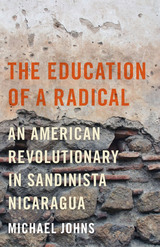
front cover of The Education of a Radical
The Education of a Radical
An American Revolutionary in Sandinista Nicaragua
By Michael Johns
University of Texas Press, 2012

“I went to Nicaragua with nothing but a tourist visa, $1,500 in cash, the name of someone at the Agrarian Reform Ministry, and the idea of being a revolutionary intellectual. . . . The idea took hold in a simple character flaw: wanting to believe that I knew better than everyone else.” —From the preface

When Michael Johns joined a Sandinista militia in 1983, a fellow revolutionary dubbed him a rábano, a radish: red on the outside but white on the inside. Now, more than twenty-five years later, Johns appreciates the wisdom of that label as he revisits the questions of identity he tried to resolve by working with the Sandinistas at that point in his life. In The Education of a Radical, Johns recounts his immersion in Marxism and the Nicaraguan sojourn it led to, with a painful maturation process along the way.

His conversion began in college, where he joined a student group called the Latin American Solidarity Association and traveled to Chiapas, Mexico, for research on his senior thesis. Overwhelmed by the poverty he witnessed (and fascinated by a new friend named Maricela who was trying to turn peasants into revolutionaries and who carried a heavily highlighted copy of Late Capitalism), he experienced an ideological transformation. When a Marxist professor later encouraged him to travel to Nicaragua, the real internal battle began for him, a battle that was intensified by the U.S. invasion of Grenada and its effect on the Sandinistas, who believed they were the next target for an imminent American invasion. Before he knew it, Johns was digging trenches and learning how to use an AK-47. His intellectual ideals came face-to-face with revolutionary facts, and the results would perplex him for years to come.

Bringing to life a vivid portrait of the sometimes painful process of reconciling reality with romanticized principles, The Education of a Radical encapsulates a trove of truths about humanity, economics, and politics in one man’s memorable journey.


[more]

logo for University of Minnesota Press
The End of the Cold War
European Unity, Socialism, and the Shift in Global Power
Bogdan Denitch
University of Minnesota Press, 1990

The End of the Cold War was first published in 1990. Minnesota Archive Editions uses digital technology to make long-unavailable books once again accessible, and are published unaltered from the original University of Minnesota Press editions.

Against the backdrop of unprecedented change in the world political and social order, Bogdan Denitch charts the unique opportunities and potential pitfalls that accompany the increased economic and political integration of the European Community. Historically, any move toward unification has had broad ramifications. This, coming as it does in the wake of recent democratic upheavals in Europe, will bring to a close an entire era -- an era of a world dominated by superpowers and the cold war that defined there confrontations.

[more]

logo for Pluto Press
Ends in Sight
Marx/Fukuyama/Hobsbawm/Anderson
Gregory Elliott
Pluto Press, 2008
Following the disappearance of the Soviet Union, scholars across the political spectrum tackled the world-historical significance of the end of communism. This book addresses the balance-sheets of modern political history offered by three writers---Francis Fukuyama, Eric Hobsbawm and Perry Anderson---comparing them with the future projected by Marx in The Communist Manifesto.


Gregory Elliott argues that Marx is central to all three accounts and that, along with the Manifesto, they form a quartet of analyses of the results and prospects of capitalism and socialism, which are of enduring significance for the Left.


Senses of an Ending provides a readable survey of key historical and political thinkers that will appeal to anyone interested in modern political thought.

[more]

front cover of Entangled Paths Toward Modernity
Entangled Paths Toward Modernity
Contextualizing Socialism and Nationalism in the Balkans
Augusta Dimou
Central European University Press, 2009
The book is a study in comparative intellectual history and discusses how socialist ideology emerged as an option of political modernity in the Balkans of the late nineteenth and early twentieth century.Focusing on how technologies of ideological transfer and adaptation work, the book examines the introduction and contextualization of international socialist paradigms in the Southeast European periphery. At its core is the presentation of three case studies (Serbia, Bulgaria and Greece), intertwined at times through similar, but also divergent paths. Each case aspires to tell a different and yet complementary story with respect to the issue of modernity and socialism. The book analyses the introduction of socialism against the background and in conjunction to other prominent options of political modernity such as nationalism, liberalism and agrarianism.
[more]


Send via email Share on Facebook Share on Twitter