
 A SCHOLARLY BOOK REPOSITORY
5 start with F start with F


"The achievement of The Fatal Conceit is that it freshly shows why socialism must be refuted rather than merely dismissed—then refutes it again."—David R. Henderson, Fortune.
"Fascinating. . . . The energy and precision with which Mr. Hayek sweeps away his opposition is impressive."—Edward H. Crane, Wall Street Journal
F. A. Hayek is considered a pioneer in monetary theory, the preeminent proponent of the libertarian philosophy, and the ideological mentor of the Reagan and Thatcher "revolutions."

The aftershocks of the Great Recession, the skyrocketing cost of living, and the titanic weight of student loan debt have made the American Dream seem to be forever retreating toward the horizon. As if that weren’t enough, millennials will face the largest federal debt in history as boomers retire and extract trillions of dollars from Social Security and Medicare—far more than they contributed.
In this concise, data-driven book, Klein begins the work of brightening the future for millennials by analyzing the problem compassionately yet objectively. There are real reasons to worry about what lies ahead if nothing changes. But the facts laid out in Klein’s book can steer the conversation to realistic solutions.

To do this, Andrew Levine examines two recent departures in Marxist thought -- Althusserian and Analytical Marxism. The former is currently defunct; the latter, very nearly so. He assesses the shortcomings of each, while emphasising their considerable, and still timely, merits. The discussion is framed against an analysis of socialism's place in the political life of the past two centuries. Levine assesses the apparent historical defeat of the Left generally since the consolidation of the Reagan-Thatcher era and speculates on current signs of renewal.
He argues that both Althusserian and analytical Marxism represent new and deeply important philosophical departures within the Marxist tradition as they force a rethinking of Marxism's scientific and political project. For all their differences in style and substance, these strains of Marxist thought share important thematic and sociological features and Levine concludes that both traditions provide a legacy upon which a revived Left can build.
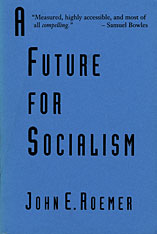
Many people point to recent events—the collapse of the Soviet Union, the electoral defeat of the Sandinistas—as proof that capitalism has triumphed over socialism once and for all. In A Future for Socialism, a noted economist argues that socialism is not dead but merely in need of modernizing. John Roemer believes that the hallmark of socialism is egalitarianism—equality of opportunity for self-realization and welfare, for political influence, and for social status—and he reminds us that capitalist societies face increasingly difficult problems of poverty and social inequality. Reenergizing a debate that began with Oskar Lange and Friedrich Hayek in the late 1930s, he brings to important questions of political economy a new level of sophistication in line with contemporary theories of justice and equality.
Roemer sees the solution of the principal-agent problem as the key to developing a decentralized market-socialist economy. This would be capable of maintaining efficiency and technological innovation while supporting a substantively more equal distribution of income than is achieved in capitalist economies. Roemer defends his views against skeptics on the right, who believe that efficiency and innovation are incompatible with egalitarianism, and skeptics on the left, who believe that socialism is incompatible with markets.
Because of its interdisciplinary approach, A Future for Socialism will appeal to a general social science audience, including economists, political scientists, sociologists, and political philosophers. It is also accessible to the interested reader.
READERS
Browse our collection.
PUBLISHERS
See BiblioVault's publisher services.
STUDENT SERVICES
Files for college accessibility offices.
RECENTLY PUBLISHED






UChicago Accessibility Resources
home | accessibility | search | about | contact us
BiblioVault ® 2001 - 2024
The University of Chicago Press