logo for Pluto Press
Naija Marxisms
Revolutionary Thought in Nigeria
Adam Mayer
Pluto Press, 2016
Since the 1940s, Marxist thought has developed considerably in Nigeria. Long gone are the days when Marxism meant imported pamphlets and a rootless foreign ideology. The history of “Naija” or Nigerian Marxism is also that of the country’s labor movement, its feminist movement, its social thought, and its political economy. Drawn from three years of research in Nigeria and elsewhere, Naija Marxisms breaks new ground in tracing the historical trajectories of leftist movements since the 1940s. Adam Mayer explores the international context of Nigerian Marxism and provides core chapters on key thinkers including Mokwugo Okoye, Ikenna Nzimiro, and Eskor Toyo, among many others.
[more]

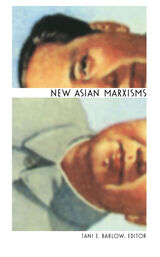
front cover of New Asian Marxisms
New Asian Marxisms
Tani E. Barlow, ed.
Duke University Press, 2002
Displaying the particular vitality of the global traditions of Marxism and neomarxism at the beginning of the twenty-first century, New AsianMarxisms collects essays by a diverse group of scholars—historians, political scientists, literary scholars, and sociologists—who offer a range of studies of the Marxist heritage focusing on Korea, Japan, India, and China.

While some of these essays take up key thinkers in Marxist history or draw attention to outstanding problematics, others focus on national literature and discourse in North and South Korea, the "Mao Zedong Fever" of the 1990s, the implications of Li Dazhao's poetry, and the Indian Naxalite movement.  Illustrating the importance of central analytical categories like exploitation, alienation, and violence to studies on the politics of knowledge, contributors confront prevailing global consumerist fantasies
with accounts of political struggle, cultural displacement, and theoretical strategies.

Contributors. Tani E. Barlow, Dai Jinhua, Michael Dutton, D. R. Howland, Marshall Johnson, Liu Kang, You-me Park, William Pietz, Claudia Pozzana, Alessandro Russo, Sanjay Seth, Gi-Wook Shin, Sugiyama Mitsunobu, Jing Wang

[more]

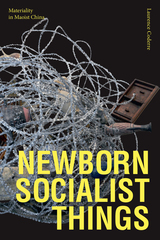
front cover of Newborn Socialist Things
Newborn Socialist Things
Materiality in Maoist China
Laurence Coderre
Duke University Press, 2021
Contemporary China is seen as a place of widespread commodification and consumerism, while the preceeding Maoist Cultural Revolution is typically understood as a time when goods were scarce and the state criticized what little consumption was possible. Indeed, with the exception of the likeness and words of Mao Zedong, both the media and material culture of the Cultural Revolution are often characterized as a void out of which the postsocialist world of commodity consumption miraculously sprang fully formed. In Newborn Socialist Things, Laurence Coderre explores the material culture of the Cultural Revolution to show how it paved the way for commodification in contemporary China. Examining objects ranging from retail counters and porcelain statuettes to textbooks and vanity mirrors, she shows how the project of building socialism in China has always been intimately bound up with consumption. By focusing on these objects—or “newborn socialist things”—along with the Cultural Revolution’s media environment, discourses of materiality, and political economy, Coderre reconfigures understandings of the origins of present-day China.
[more]

front cover of Nordic Socialism
Nordic Socialism
The Path Toward a Democratic Economy
Pelle Dragsted, Translated by William Banks
University of Wisconsin Press, 2025
In recent years, the Nordic countries have been the envy of the world for their economic success, institutional stability, and consistently high levels of social happiness. But are they socialist? Several prominent members of the American right think so. They may find a surprising ally in Pelle Dragsted, a member of the Danish parliament and the leader of the socialist political party Enhedslisten (Red-Green Alliance); contrary to most Nordic leaders, Dragsted not only accepts but embraces the charge of socialism.
 
In Dragsted’s analysis, Denmark and the rest of the Nordic countries are already socialist, but only in part. The dangers come (and here many conservative Americans will disagree) from the unhealthy encroachment of capitalism. His provocative argument is that capitalism and socialism are not in fact mutually exclusive, and already Nordic economies are hybrids, a mix of decommodified, democratically governed sectors and undemocratic, privately controlled enterprises. The relevant question is the degree to which one dominates the other. Currently, undemocratic forces are ascendant, but it need not be so. Dragsted offers both his diagnosis and his proposed solution, a comprehensive plan for a gradual (re)democratization of the economy and a move to fully and firmly embrace, and redefine, “Nordic socialism.”
[more]


Send via email Share on Facebook Share on Twitter