
 A SCHOLARLY BOOK REPOSITORY
10 start with P start with P
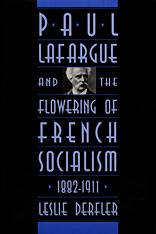
Paul Lafargue, the disciple and son-in-law of Karl Marx, helped to found the first French Marxist party in 1882. Over the next three decades, he served as the chief theoretician and propagandist for Marxism in France. During these years, which ended with the dramatic suicides of Lafargue and his wife, French socialism, and the Marxist party within it, became a significant political force.
In an earlier volume, Paul Lafargue and the Founding of French Marxism, 1842-1882, Leslie Derfler emphasized family identity and the origin of French Marxism. Here, he explores Lafargue's political strategies, specifically his break with party co-founder Jules Guesde in the Boulanger and Dreyfus episodes and over the question of socialist-syndicalist relations. Derfler shows Lafargue's importance as both political activist and theorist. He describes Lafargue's role in the formulation of such strategies as the promotion of a Second Workingmen's International, the pursuit of reform within the framework of the existent state but opposition to any socialist participation in nonsocialist governments, and the subordination of trade unionism to political action. He emphasizes Lafargue's pioneering efforts to apply Marxist methods of analysis to questions of anthropology, aesthetics, and literary criticism.
Despite the crucial part they played in the social and political changes of the past century and the heritage they left, the first French Marxists are not widely known, especially in the English-speaking world. This important critical biography of Lafargue, the most audacious of their much maligned theorists, enables us to trace the options open to Marxist socialism as well as its development during a critical period of transition.

Paul Lafargue, disciple and son-in-law of Karl Marx, was among the most important persons giving organized political expression to Marxism in France. He helped found both the first French collectivist party and the first French Marxist party. He was the first Marxist to sit in the French legislature and for three decades served as the chief theoretician and propagandist for Marxism in France. With his wife, Laura, he translated the Communist Manifesto and other works, introducing and applying Marxist thought in France.
Demonstrating an almost seamless web between intellectual and family history, Leslie Derfler relates ideas and family identity in this account of the first forty years of Paul Lafargue’s life. Lafargue, like his famous father-in-law, called for ideological purity and demanded total hostility to anarchists and reformists. He insisted on economic determinism, the primacy of the concept of the class struggle, and the theory of surplus value. But he made his own contributions as well, particularly in his insistence on rejecting the domination of bourgeois values. Lafargue’s most famous pamphlet, The Right To Be Lazy, showed the advantages that labor could derive by rejecting the bourgeois work ethic. An intellectual of power, he pioneered in the application of Marxist methods of analysis to questions of anthropology, aesthetics, and literary criticism.
Born in Cuba of mixed racial descent, Lafargue joined in demonstrations as a medical student in Paris in the 1860s and was forced into exile. Resuming his studies in London, he became a fixture in the Marx household until he married Laura Marx and moved to Paris. There he worked to expand the influence of the International Workingmen’s Association, but fled to Spain following the general repression after the fall of the Paris Commune. He continued his efforts on behalf of Marxism in Spain and then for ten years in London before returning to France, where he helped to found the new Marxist Parti Ouvrier Français, in 1882.
Powerful tech companies now own the digital infrastructure of twenty-first century social life. Masquerading as global community builders, these companies have developed sophisticated new techniques for extracting wealth from their users.
James Muldoon shows how grassroots communities and transnational social movements can take back control from Big Tech. He reframes the technology debate and proposes a host of new ideas, from the local to the international, for how we can reclaim the emancipatory possibilities of digital platforms. Drawing on sources from forgotten histories to contemporary prototypes, he proposes an alternative system and charts a roadmap for how we can get there.
Much has been written about the workings of communist governments in the USSR and the Soviet bloc, yet there is still a great deal to explore regarding their relationship to the everyday lives of the citizens living under them. This third volume builds on the editors’ Style and Socialism and Socialist Spaces, showing how the rise of consumer culture took a unique form in these countries.
Essays from top scholars address topics ranging from fashion and game shows to smoking and camping. The authors of the essays in this collection investigate the ways in which pleasurable activities, like many other facets of daily life, were both a space in which these communist governments tried to insinuate themselves and thereby further expand the reach of their authority,
and also an opportunity for people to assert their individuality.
What does the durability of political institutions have to do with how actors form knowledge about them? Andreas Glaeser investigates this question in the context of a fascinating historical case: socialist East Germany’s unexpected self-dissolution in 1989. His analysis builds on extensive in-depth interviews with former secret police officers and the dissidents they tried to control as well as research into the documents both groups produced. In particular, Glaeser analyzes how these two opposing factions’ understanding of the socialist project came to change in response to countless everyday experiences. These investigations culminate in answers to two questions: why did the officers not defend socialism by force? And how was the formation of dissident understandings possible in a state that monopolized mass communication and group formation? He also explores why the Stasi, although always well informed about dissident activities, never developed a realistic understanding of the phenomenon of dissidence.
Out of this ambitious study, Glaeser extracts two distinct lines of thought. On the one hand he offers an epistemic account of socialism’s failure that differs markedly from existing explanations. On the other hand he develops a theory—a sociology of understanding—that shows us how knowledge can appear validated while it is at the same time completely misleading.
A study of Cuban culture and media in the twenty-first century as both a global phenomenon and a local reality, at a time when the declared death of socialism coexists in tension with emerging anticapitalist movements worldwide.
Why does Cuban socialism endure as an object of international political desire, while images of capitalist markets consume Cuba’s national imagination? This bold new study argues that Cuba’s changing media cultures are key to our understanding of the global postsocialist condition and its competing political imaginaries.
Portable Postsocialisms calls on a vast multimedia archive to offer a groundbreaking cultural interpretation of Cuban postsocialism. Paloma Duong examines songs, artworks, advertisements, memes, literature, jokes, and networks that refuse exceptionalist and exoticizing visions of Cuba. Expanding postsocialist critical theory to read this complex mediascape, Duong argues that a materialist critique of Cuba’s revolutionary legacy must account for Cubans’ everyday demands for agency and self-representation. This long overdue reassessment of Cuba’s place in Latin American and post-Marxist studies shows Cuban postsocialism to be an urgent and indispensable referent for core debates on the politics of participatory cultures in new media studies. Portable Postsocialisms performs the crucial task of redefining how we envision imaginaries of social change in Latin America and the Caribbean.
Socialist doctrines had an important influence on Korean writers and intellectuals of the early twentieth century. From the 1910s through the 1940s, a veritable wave of anarchist, Marxist, nationalist, and feminist leftist groups swept the cultural scene with differing agendas as well as shared demands for equality and social justice. In The Proletarian Wave, Sunyoung Park reconstructs the complex mosaic of colonial leftist culture by focusing on literature as its most fertile and enduring expression. The book combines a general overview of the literary left with the intellectual portraits of four writers whose works exemplify the stylistic range and colonial inflection of socialist culture in a rapidly modernizing Korea. Bridging Marxist theory and postcolonial studies, Park confronts Western preconceptions about third-world socialist cultures while interrogating modern cultural history from a post–Cold War global perspective.
The Proletarian Wave provides the first historical account in English of the complex interrelations of literature and socialist ideology in colonial Korea. It details the origins, development, and influence of a movement that has shaped twentieth-century Korean politics and aesthetics alike through an analysis that simultaneously engages some of the most debated and pressing issues of literary historiography, Marxist criticism, and postcolonial cultural studies.
READERS
Browse our collection.
PUBLISHERS
See BiblioVault's publisher services.
STUDENT SERVICES
Files for college accessibility offices.
RECENTLY PUBLISHED


UChicago Accessibility Resources
home | accessibility | search | about | contact us
BiblioVault ® 2001 - 2024
The University of Chicago Press