
 A SCHOLARLY BOOK REPOSITORY
14 start with S start with S
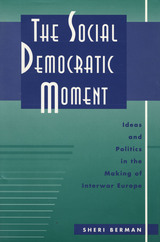
In addition to revising our view of the interwar period and the building of European democracies, this book cuts against the grain of most current theorizing in political science by explicitly discussing when and how ideas influence political behavior. Even though German and Swedish Social Democrats belonged to the same transnational political movement and faced similar political and social conditions in their respective countries before and after World War I, they responded very differently to the challenges of democratization and the Great Depression--with crucial consequences for the fates of their countries and the world at large.
Explaining why these two social democratic parties acted so differently is the primary task of this book. Berman's answer is that they had very different ideas about politics and economics--what she calls their programmatic beliefs. The Swedish Social Democrats placed themselves at the forefront of the drive for democratization; a decade later they responded to the Depression with a bold new economic program and used it to build a long period of political hegemony. The German Social Democrats, on the other hand, had democracy thrust upon them and then dithered when faced with economic crisis; their haplessness cleared the way for a bolder and more skillful political actor--Adolf Hitler.
This provocative book will be of interest to anyone concerned with twentieth-century European history, the transition to democracy problem, or the role of ideas in politics.
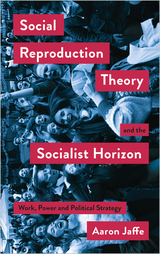

This first collection of Peter Beilharz's highly influential thought traces the themes and problems, manifestations, and trajectories of socialism and modernity as they connect and shift over a twenty-year period. Woven throughout Beilharz's analysis is the urgent question of modern utopia: how do we imagine freedom and equality in modernity?
The essays in this volume explore the relationship between socialism and modernity across the United States, Europe, and Australia from the mid-1980s to the turn of the twenty-first century, a time that witnessed the global triumph of capitalism and the dramatic turn away from Marxism and socialism to modernity as the dominant perspective. According to Beilharz, we have seen the expansion of a kind of Weberian Marxism, with the concept of revolution giving way to the idea of pluralized forms of power and the idea of rupture giving way to the postmodern sense of difference. These changes come together with the discourse of modernism, both aesthetic and technological.
Socialism and modernity, Beilharz argues, are fundamentally interrelated. In correcting the conflation of Marxism, Bolshevism, and socialism that occludes contemporary political thinking, he reopens a space for discussion of what socialist politics might look like now-in the postcommunist-postcolonial-postmodern moment.
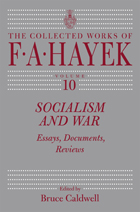
Opening with Hayek's arguments against market socialism, the volume continues with his writings on the economics of war, many in response to the proposals made in John Maynard Keynes's famous pamphlet, How to Pay for the War. The last section presents articles that anticipated The Road to Serfdom, Hayek's classic meditation on the dangers of collectivism. An appendix contains a number of topical book reviews written by Hayek during this crucial period, and a masterful introduction by the volume editor, Bruce Caldwell, sets Hayek's work in context.
Socialism and War will interest not just fans of The Road to Serfdom, but anyone concerned with the ongoing debates over the propriety of government intervention in the economy.
"When he wrote The Road to Serfdom, [Hayek's] was a voice in the wilderness. Now the fight [has] been taken up by people all over the world, by institutions and movements, and the ideas that seemed so strange to many in 1944 can be found from scholarly journals to television programs."—Thomas Sowell, Forbes
"Intellectually [Hayek] towers like a giant oak in a forest of saplings."—Chicago Tribune
"Each new addition to The Collected Works of F. A. Hayek, the University of Chicago's painstaking series of reissues and collections, is a gem."—Liberty on Volume IX of The Collected Works of F. A. Hayek

Through analysis of post-Socialist Russia and Central and Eastern Europe, as well as of the United Kingdom, China, and the United States, Socialism, Capitalism and Alternatives confronts the difficulty we face in articulating alternatives to capitalism, socialism, and threatening populist regimes. Beginning with accounts of the impact of capitalism on countries left behind by the planned economies, the book moves on to consider how China has become a beacon of dynamic economic growth, aggressively expanding its global influence. The final section of the book poses alternatives to the ideological dominance of neoliberalism in the West.
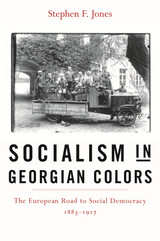
Georgian social democracy was the most successful social democratic movement in the Russian Empire. Despite its small size, it produced many of the leading revolutionary figures of 1917, including Irakli Tsereteli, Karlo Chkheidze, Noe Zhordania, and Joseph Stalin. In the first of two volumes, Stephen Jones writes the first history in English of this undeservedly neglected national movement, which represented one of the earliest examples of European social democracy at the turn of the twentieth century.
Georgian social democracy was part of the Russian social democracy from which Bolshevism and Menshevism emerged. But innovative theoretical programs and tactics led Georgian social democracy down an independent path. The powerful Georgian organization united all native classes behind it, and it set a remarkable precedent for many of the anti-colonial nationalist movements of the twentieth century. At the same time, Georgian social democracy was committed to a "European" path, a "third way" that attempted to combine grassroots democracy, private manufacturing, and private land ownership with socialist ideology.
One of the few Western historians fluent in Georgian, Jones fills major gaps in the history of revolutionary and national movements of the Russian Empire.


The primary local venues for Soviet culture were the tens of thousands of klubs where young people found entertainment, leisure, social life, and romance. Here sports, dance, film, theater, music, lectures, and political meetings became vehicles to disseminate a socialist version of modernity. The Soviet way of life was dutifully presented and perceived as the most progressive and advanced, in an attempt to stave off Western influences. In effect, socialist fun became very serious business. As Tsipursky shows, however, Western culture did infiltrate these activities, particularly at local levels, where participants and organizers deceptively cloaked their offerings to appeal to their own audiences. Thus, Soviet modernity evolved as a complex and multivalent ideological device.
Tsipursky provides a fresh and original examination of the Kremlin’s paramount effort to shape young lives, consumption, popular culture, and to build an emotional community—all against the backdrop of Cold War struggles to win hearts and minds both at home and abroad.
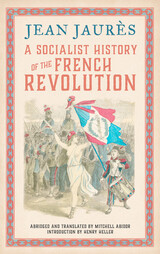
Jean Jaurès was the celebrated French Socialist Party leader, assassinated in 1914 for trying to use diplomacy and industrial action to prevent the outbreak of war. Published just a few years before his death, his magisterial A Socialist History of the French Revolution has endured for over a century.
Written in the midst of his activities as leader of the Socialist Party and editor of its newspaper, L'Humanite, Jaurès intended the book to serve as both a guide and an inspiration to political activity; even now it can serve to do just that.
Jaurès's verve, originality, and willingness to criticize all players in this epic drama make this a truly moving addition to the shelf of great books on the French Revolution. Mitchell Abidor's abridged translation of Jaurès's original six volumes makes this exceptional work truly accessible to an Anglophone audience.

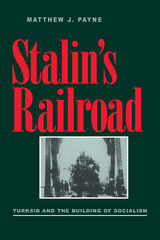
Built between December 1926 and January 1931 by nearly 50,000 workers and at a cost of more 161 million rubles, Turksib embodied the Bolsheviks’ commitment to end ethnic inequality and promote cultural revolution in one the far-flung corners of the old Tsarist Empire, Kazakhstan. Trumpeted as the "forge of the Kazakh proletariat," the railroad was to create a native working class, bringing not only trains to the steppes, but also the Revolution.
In the first in-depth study of this grand project, Matthew Payne explores the transformation of its builders in Turksib’s crucible of class war, race riots, state purges, and the brutal struggle of everyday life. In the battle for the souls of the nation’s engineers, as well as the racial and ethnic conflicts that swirled, far from Moscow, around Stalin’s vast campaign of industrialization, he finds a microcosm of the early Soviet Union.

In this bold and innovative book, Massimo Modonesi weaves together theory and political practice by relating the concepts of subalternity, antagonism and autonomy to contemporary movements in Latin America and elsewhere.
In a sophisticated account, Modonesi reconstructs the debates between Marxist authors and schools of thought in order to sketch out informed strategies of resistance. He reviews the works of Gramsci, Negri, Castoriadis and Lefort, and engages with the arguments made by E. P. Thompson, Spivak, Laclau and Mouffe.
Subalternity, Antagonism, Autonomy firmly roots key theoretical arguments from a range of critical thinkers within specific political movements in order to recover these concepts as analytical instruments which can help to guide contemporary struggles.
READERS
Browse our collection.
PUBLISHERS
See BiblioVault's publisher services.
STUDENT SERVICES
Files for college accessibility offices.
RECENTLY PUBLISHED







UChicago Accessibility Resources
home | accessibility | search | about | contact us
BiblioVault ® 2001 - 2024
The University of Chicago Press