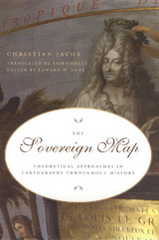
front cover of The Sovereign Map
The Sovereign Map
Theoretical Approaches in Cartography throughout History
Christian Jacob
University of Chicago Press, 2006
A novel work in the history of cartography, The Sovereign Map argues that maps are as much about thinking as seeing, as much about the art of persuasion as the science of geography. As a classicist, Christian Jacob brings a fresh eye to his subject—which includes maps from Greek Antiquity to the twentieth century—and provides a theoretical approach to investigating the power of maps to inform, persuade, and inspire the imagination.

Beginning with a historical overview of maps and their creation—from those traced in the dirt by primitive hands to the monumental Dutch atlases and ornate maps on Italian palace walls—Jacob goes on to consider the visual components of cartography: the decorative periphery, geometric grid, topographical lines, dots, details of iconographic figures, and many other aspects. Considering text on maps—titles, toponyms, legends, and keys—Jacob proposes that writing can both clarify and interfere with a map's visual presentation. Finally Jacob examines the role of the viewer in decoding a map's meaning and the role of society in defining the power of maps as authoritative depictions of space.

Innovative in its philosophical motivation and its interdisciplinary approach to looking at and writing about maps, The Sovereign Map is eagerly awaited by scholars from many different fields.

[more]

front cover of Territorial Imaginaries
Territorial Imaginaries
Beyond the Sovereign Map
Edited by Kären Wigen
University of Chicago Press, 2025
Fresh offerings on world mapping beyond Western conventions.
 
This strikingly colorful volume contends that modern mapping has never been sufficient to illustrate the complex reality of territory and political sovereignty, whether past or present. For Territorial Imaginaries, editor Kären Wigen has assembled an impressive slate of experts, spanning disciplines from political science to art history, to contribute perspectives and case studies covering three main themes: mapping before the nation-state, rethinking and critiquing mapping practices, and robust traditions of counter-cartography.
 
Each contributor proposes alternative ways to think about mapping, and the essays are supported with rich archival documentation. Among the far-reaching case studies are Barbara Mundy’s cartographic history of Indigenous dispossession in the Americas, Peter Bol’s examination of two Chinese maps created five hundred years apart, and Ali Yaycıoğlu’s exploration of tensions between top-down and bottom-up mapping of Habsburg and Ottoman border claims.


[more]


Send via email Share on Facebook Share on Twitter