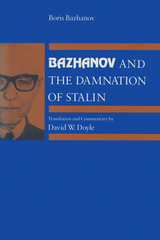
front cover of Bazhanov and the Damnation of Stalin
Bazhanov and the Damnation of Stalin
Boris Bazhanov
Ohio University Press, 1990
On January 1, 1928, Bazhanov escaped from the Soviet Union and became for many years the most important member of a new breed—the Soviet defector. At the age of 28, he had become an invaluable aid to Stalin and the Politburo, and had he stayed in Stalin’s service, Bazhanov might well have enjoyed the same meteoric careers as the man who replaced him when he left, Georgy Malenkov. However, Bazhanov came to despise the unethical and brutal regime he served. One he decided to become anti–communist, he sought to bring down the regime. Planning his departure carefully, he brought with him documentation which revealed some of the innermost secrets of the Kremlin. Despite being pursued by the OGPU (an earlier incarnation of the KGB), he arrived eventually in Paris, and Bazhanov set to work writing his message to the West. While Bazhanov did successfully escape to the West, Stalin had Bazhanov watched and several attempts were made to assassinate him. Bazhanov may have been fearful for his life much of the time, but he was a man of courage and conviction, and he damned Stalin as often and as publicly as he could. In this riveting and illuminating book, Bazhanov provides an eyewitness account of the inner workings and personalities of the Soviet Central Committee and the Politburo in the 1920s. Bazhanov clearly details how Stalin invaded the communications of his opponents, rigged votes, built up his own constituency, and maneuvered to achieve his coup d’etat despite formidable odds. he also provides a better understanding of the curiously vapid way in which he other revolutionary leaders, most notably Trotsky, failed to appreciate the threat and let Stalin override them. He reveals how those Soviets with a sense of fairness, justice, and ethics were extinguished by Stalin and his minions, and how the self–centered, protective bureaucratic machine was first built. Bazhanov’s view, at the right hand of Stalin, is unique and chilling. Bazhanov’s post–defection prediction of Stalin’s continuing and fatal danger to Trotsky shows how well Bazhanov understood the dictator. His formation, in 1940, of an armed force recruited from Soviet Army prisoners to help Mannerheim defend Finland from Stalin’s forces and his 1941 decision to decline the position of Hitler’s Gauleiter of German–occupied Russia are fascinating. But perhaps the most interesting facet to Bazhanov’s tale is the fact that almost no Soviets—even today—know the real story of the Communist party’s criminal acquiescence in Stalin’s rise to, and abuse of, power.
[more]

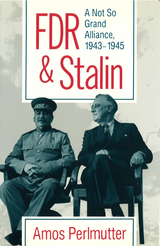
front cover of FDR & Stalin
FDR & Stalin
A Not So Grand Alliance, 1943–1945
Amos Perlmutter
University of Missouri Press, 1993

Perlmutter's hard-hitting, revisionist history of Roosevelt's foreign policy explores FDR's not-so-grand alliance with the ruthless Soviet leader. As the first Western scholar granted access to key foreign ministry documents recently declassified in the former Soviet Union, Perlmutter provides a provocative portrait of a popular leader whose failure to comprehend Stalin's long-range goals had devastating results for the postwar world.

[more]

front cover of Stalin
Stalin
An Unknown Portrait
Miklós Kun
Central European University Press, 2003
This exceptional volume contains exciting new information about Stalin's actual and political "family", the Kremlin Mafia and the clans around him. The author has interviewed key politicians who survived the Stalin era, including officials of the KGB and the Party, as well as people who had personal contact with the dictator as secretaries or interpreters. Kun's special expertise and his access to archival sources in Russia have resulted in a work revealing jealously guarded secrets. In addition to the interviews and hitherto unpublished correspondence between Stalin, Molotov, Voroshilov, Mikoyan, Zhdanov and others, the book also contains a fascinating collection of over 300 photos of Stalin, his family members, and various political actors of the period. Extensive notes, a bibliography, and an index of names add to the value of the volume.
[more]

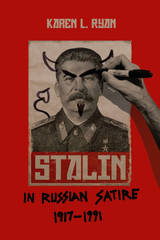
front cover of Stalin in Russian Satire, 1917–1991
Stalin in Russian Satire, 1917–1991
Karen L. Ryan
University of Wisconsin Press, 2009
During Stalin’s lifetime the crimes of his regime were literally unspeakable. More than fifty years after his death, Russia is still coming to terms with Stalinism and the people’s own role in the abuses of the era. During the decades of official silence that preceded the advent of glasnost, Russian writers raised troubling questions about guilt, responsibility, and the possibility of absolution. Through the subtle vehicle of satire, they explored the roots and legacy of Stalinism in forms ranging from humorous mockery to vitriolic diatribe.
    Examining works from the 1917 Revolution to the fall of the Soviet Union in 1991, Karen L. Ryan reveals how satirical treatments of Stalin often emphasize his otherness, distancing him from Russian culture. Some satirists portray Stalin as a madman. Others show him as feminized, animal-like, monstrous, or diabolical. Stalin has also appeared as the unquiet dead, a spirit that keeps returning to haunt the collective memory of the nation. While many writers seem anxious to exorcise Stalin from the body politic, for others he illuminates the self in disturbing ways. To what degree Stalin was and is “in us” is a central question of all these works. Although less visible than public trials, policy shifts, or statements of apology, Russian satire has subtly yet insistently participated in the protracted process of de-Stalinization.
[more]

front cover of Stalinism Revisited
Stalinism Revisited
The Establishment of Communist Regimes in East-Central Europe
Vladimir Tismaneanu
Central European University Press, 2010

Deals with the period of takeover and of ‘high Stalinism’ in Eastern Europe (1945–1955). These years are considered to be fundamentally characterized by institutional and ideological transfers based upon the premise of radical transformism and of cultural revolution. Both a balance-sheet and a politico-historical synthesis that reflects the archival and thematic novelties which came about in the field of communism studies after 1989.

Contains contributions analyzing various aspects related these topics for each country of the former Soviet bloc (with the exception of Albania). The essays are based on new archival research, some are reassessments of the author’s previous research and others are critical appraisals of the specific literature published on issues related to the main topic. A path-breaking comparative framework for interpreting the relationship between late Stalinism and the communist takeovers in former Eastern Europe. A bonus for the volume is that it also provides detailed, sectorial analyses for the Romanian case, something that the field paritcularly lacks.
[more]

front cover of Travesty Actors
Travesty Actors
Self and Theater in Stalinist Culture
Boris Wolfson, edited by Simon Morrison
Northwestern University Press, 2026
Examining theatrical performance under Stalinist cultural mandates
 
Talk of Joseph Stalin’s “show trials,” the public prosecutions in Moscow’s Hall of Columns in the late 1930s, is so familiar as to obscure the relationship between actual shows—in the Soviet Union’s major theaters—and politics. Travesty Actors: Self and Theater in Stalinist Culture examines theatrical performance within the context of the Soviet cultural establishment’s fashioning of a “genuine Soviet person.” Boris Wolfson focuses on prominent and controversial plays by artists including Aleksandr Afinogenov, Mikhail Bulgakov, Yuri Olesha, and Natalia Sats and the efforts of theater companies, like the Moscow Arts Theater, the Meyerhold Theater, and the Central Children’s Theater, to adhere to this cultural mandate while grappling with repression, censorship, and conflicting interpretations of its aims. Drawing on archival materials, diaries and memoirs and eyewitness accounts, Wolfson greatly illuminates the achievements of Soviet theater during this harsh period and the cultural significance of artistic theories and practices for articulating and enacting ideological programs.
[more]


Send via email Share on Facebook Share on Twitter