
 A SCHOLARLY BOOK REPOSITORY
Results by Title
2 books about Starr, Harvey
2 books about Starr, Harvey

Anarchy, Order and Integration
How to Manage Interdependence
Harvey Starr
University of Michigan Press, 2000
Most observers agree that the global arena is in the midst of multiple changes. The elements that create and intensify global interdependencies have been expanding rapidly, generating questions about the viability of the state and the viability of the state-centric system that has existed for over 500 years, as well as what sorts of structures and behaviors might replace them. And yet much of the analysis is not helpful in understanding the condition of the international system because it either fails to define the meaning of terms such as interdependence and order or treats these as new problems ignoring many important ideas that have developed over the years about international politics. One of our most accomplished scholars in international affairs, Harvey Starr offers a fresh and original analysis of the nature of the international system. Starr argues that the global system can best be understood as the consequence of states adapting to changing interdependencies. States do remain important in this system, but the reality they adapt to is changing. Thus the environment surrounding states is important not because it is "anarchic," as argued by structural realists such as Waltz, but because environmental conditions have changed, thereby changing the meaning and significance of such structural characteristics as "anarchy." Starr argues that we must recognize that the modes by which states adapt to change in the international system lead to changes in both the states themselves and in their environment. This book will appeal to scholars of international relations in political science and economics as well as to policy makers and analysts interested in understanding change in the international system.
[more]
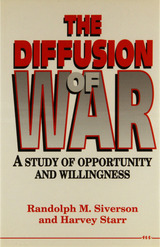
The Diffusion of War
A Study of Opportunity and Willingness
Randolph M. Siverson and Harvey Starr
University of Michigan Press, 1991
Much attention has been given in the past to the onset of war—to what causes it. The authors of this timely study argue that what war causes is just as important a question. In The Diffusion of War Randolph M. Siverson and Harvey Starr investigate the “contagion” of war — or how and under what circumstances conflicts grow once they begin.Given the great consequences of the expansion of war—economic costs, human costs, and political change, for the participants and also for the international system—it is essential to ask why some wars spread and why others do not; what states are most likely to join wars and how quickly? Viewing war as a process of conflict escalation, the authors explore these important questions through considerations of opportunity and willingness. They consider how the choice to enter war relates to the geopolitical context in which that choice must be made — demonstrating that in the war experiences of states from 1816 to 1965, the effects of geographical proximity (opportunity) and the political pressures of interstate alliances (willingness) have combined to influence the infectious diffusion of war. This distinctive approach permits a synthesis of previous theory and research on war across academic disciplines and of micro- and macrolevels of analysis. Siverson and Starr offer a valuable perspective on the changing nature and process of war; their book makes broadly accessible a subject of vital relevance to the world community.
[more]
READERS
Browse our collection.
PUBLISHERS
See BiblioVault's publisher services.
STUDENT SERVICES
Files for college accessibility offices.
RECENTLY PUBLISHED







UChicago Accessibility Resources
home | accessibility | search | about | contact us
BiblioVault ® 2001 - 2026
The University of Chicago Press