
 A SCHOLARLY BOOK REPOSITORY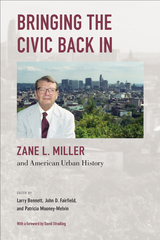
With the passing of Zane L. Miller in 2016, academia lost a renowned scholar and one of the key founders of new urban history—a branch of the discipline that placed urban life at the center of American history and treated the city as an arena for civic and political action. He was a devoted, tireless mentor who published or fostered dozens of books and articles on urban history. He also co-founded Temple University Press’ foundational series Urban Life, Landscape, and Policy.
Bringing the Civic Back In provides a critical overview, appreciation, and extension of Miller’s work as scholar, editor, mentor, colleague, and citizen. Included are three excerpts from Miller’s final, unfinished work, in which he presented cities as the source of a civic nationalism he viewed as fundamental to the development of American democracy. The editors—along with contributors Robert B. Fairbanks and Charles Lester—reflect on the life and work of their friend as well as his role in creating a Cincinnati school of urban history. These original essays by practitioners of Miller’s approach highlight the power of ideas to shape social change.
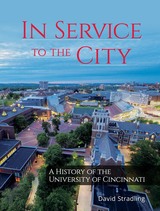
In Service to the City: A History of the University of Cincinnati, the first history of the university written in over fifty years, explores the evolving, complex relationship between UC and the city of Cincinnati. In Service to the City casts an unvarnished lens on the details of student demographics, faculty research, curricular changes, and athletic controversy to challenges associated with campus architecture and planning, neighborhood relations, regional and national consequences of urban decline, and the roles of municipal, state, and federal governments within American higher education.
Urban, environmental historian David Stradling traces UC’s story through starts and stops, growth and contraction. In the 1870s the institution began its transformation into a comprehensive, municipal university located in America’s thriving heartland. Expansion continued through mergers with Cincinnati College-Conservatory of Music and Cincinnati Medical College, among others. In 1977, University President Warren Bennis and Governor Jim Rhodes signed papers ending UC’s municipal status while securing its future as part of the state university system of Ohio.
UC maintains its strong relationship with Cincinnati, pioneering countless community and regionally oriented programs, from its expanding co-op education system, the first in the nation, to the Niehoff Urban Studio. Stradling describes the social and political activism of UC students and faculty—front and center in the civil rights and women’s rights movements, as well as the public health and environmental movements. Often they struggled to change the culture within their own institution, which at times appeared conservative or reactionary.
Drawing on archival research, Stradling recounts in lively prose and through dozens of illustrations, two-hundred years of UC history, setting the story in the context of changes within higher education in the United States.
With the cost of higher education on the minds of legislators and the public, questions first posed by Daniel Drake in 1819 upon the founding of Cincinnati College remain relevant. Who should the college serve? What and how should students learn? How can we pay for it? In Service to the City encourages readers to consider how the University of Cincinnati—with a history so entwined with its city—can balance its urban-serving tradition with its aspiration to be a leader global research university.
READERS
Browse our collection.
PUBLISHERS
See BiblioVault's publisher services.
STUDENT SERVICES
Files for college accessibility offices.
RECENTLY PUBLISHED


UChicago Accessibility Resources
home | accessibility | search | about | contact us
BiblioVault ® 2001 - 2026
The University of Chicago Press