
 A SCHOLARLY BOOK REPOSITORY
Results by Title
3 books about Summa
3 books about Summa

Aquinas's Summa and Jesuit Ethics
A Call for Ressourcement
Justin M. Anderson
Catholic University of America Press, 2026
This book explores how the great sixteenth- and early-seventeenth-century Jesuits read the secunda pars of the Summa theologiae. Their interpretation of Aquinas’s moral theology is shaped in part by their historical context, including the impact of the Protestant Reformation and the European discovery of the "New World," as well as new trade routes with Asia. The essays in this volume explore a wide variety of topics, including the natural desire to see God, infused moral virtues, freedom of conscience, faith and justification, doctrinal development, just war, slavery, the virtue of religion, Eucharistic sacrifice, sexual ethics, the theology of vocation, and natural law. The essays engage the thought of Francisco Suárez, Gabriel Vázquez, Luis de Molina, Francisco de Toledo, and various others. The underlying argument of the book is that this erudite, deeply Catholic and broadly Thomistic approach to ethics should be retrieved, given its Christian seriousness. Guided by divine revelation as taught in Scripture and Tradition, moral theologians in the Jesuit tradition ground themselves in Aquinas and in a rich understanding of natural law, universal moral norms, and the virtues, as well as in appreciation for spiritual interiority, conscience, and discernment.
[more]
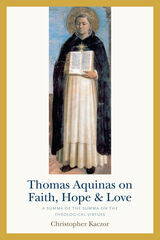
Thomas Aquinas on Faith, Hope, and Love
A Summa of the Summa on the Theological Virtues
Christopher Kaczor
Catholic University of America Press, 2020
Thomas Aquinas on Faith, Hope, and Love is designed to make as easy as possible a first reading of key passages from the Summa theologiae. This book contains selections from the Summa that are most influential, most important, or likely to be most interesting to the contemporary reader. The text of the Summa itself is edited and arranged for beginners. Each article begins with Thomas’s answers to the question at hand and then goes to the first objection, followed by the reply to the first objection, the second objection and its reply, and so on. This arrangement provides a greater accessibility and ease in following the argument. Below the text, copious footnotes illuminate the text as a professor in the classroom might. Some notes provide historical background to figures that Thomas presupposes his reader will know such as Gratian, Dionysius, and Lombard. Other notes offer doctrinal summaries of other parts of the Summa that illuminate what Thomas says about faith, hope, or love. Thomas had an enormous influence on theologians, Church councils, and popes after his time, so some footnotes examine this influence. Thomas drew heavily on sources of wisdom before him, so other footnotes summarize the teachings of earlier authors, such as Aristotle and Augustine. This book also contains introductory essays on the Summa, on faith, on hope, and on love, which provide an overview to situate the reader and place treatment of the theological virtues in its larger context of the Summa. For those who have never read Thomas Aquinas on faith, hope, and love (and for those who teach them), this book provides ready access to the wisdom of the Angelic doctor.
[more]
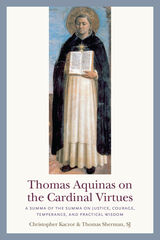
Thomas Aquinas on the Cardinal Virtues
A Summa of the Summa on Prudence, Justice, Temperance, and Courage
Christopher Kaczor
Catholic University of America Press, 2020
Thomas Aquinas on the Cardinal Virtues provides essential passages from Thomas's treatment of the cardinal virtues in the Summa theologiae, edited and explained for classroom use or the independent reader. Arranged for beginners, this book contains passages from the Summa theologiae of great historical import, contemporary relevance, or intrinsic interest combined with abundant footnotes aiding the modern reader. Each individual article is arranged so that the question, e.g. “Is capital punishment moral?” is followed directed by Thomas’s answer. Then the first objection is raised, followed immediately by Thomas’s response, the second objection is raised and then Thomas answers it, and so forth. The abundant footnotes help first time readers navigate key theological and philosophical terms which may be unfamiliar. In addition, the notes provide biographical information about key authors cited by Thomas, such as Tully, Vegetius, and Gregory the Great. The footnotes sometimes look back at the sources and philosophical roots of what Thomas teaches. Other notes note how authors after Aquinas including theologians, church councils, and popes developed, synthesized, and sometimes rejected what Thomas teaches. In sum, this book seeks to illuminate Thomas’s teaching on the cardinal virtues such as a teacher might do in the classroom.
[more]
READERS
Browse our collection.
PUBLISHERS
See BiblioVault's publisher services.
STUDENT SERVICES
Files for college accessibility offices.
RECENTLY PUBLISHED





UChicago Accessibility Resources
home | accessibility | search | about | contact us
BiblioVault ® 2001 - 2026
The University of Chicago Press