
 A SCHOLARLY BOOK REPOSITORY
5 start with A start with A
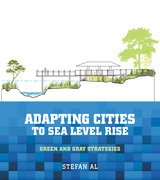
As cities build more flood-management infrastructure to adapt to the effects of a changing climate, they must go beyond short-term flood protection and consider the long-term effects on the community, its environment, economy, and relationship with the water.
Adapting Cities to Sea Level Rise, by infrastructure expert Stefan Al, introduces design responses to sea-level rise, drawing from examples around the globe. Going against standard engineering solutions, Al argues for approaches that are integrated with the public realm, nature-based, and sensitive to local conditions and the community. He features design responses to building resilience that creates new civic assets for cities. For the first time, the possible infrastructure solutions are brought together in a clear and easy-to-read format.
The first part of the book looks at the challenges for cities that have historically faced sea-level rise and flooding issues, and their response in resiliency through urban design. He presents diverse case studies from New Orleans to Ho Chi Minh to Rotterdam, and draws best practices and urban design typologies for the second part of the book.
Part two is a graphic catalogue of best-practices or resilience strategies. These strategies are organized into four categories: hard protect, soft protect, store, and retreat. The benefits and challenges of each strategy are outlined and highlighted by a case study showing where that strategy has been applied.
Any professional or policymaker in coastal areas seeking to protect their communities from the effects of climate change should start with this book. With the right solutions, Al shows, sea-level rise can become an opportunity to improve our urban areas and landscapes, rather than a threat to our communities.
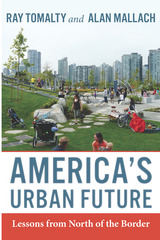
The headlines about cities celebrating their resurgence—with empty nesters and Millennials alike investing in our urban areas, moving away from car dependence, and demanding walkable, transit-oriented neighborhoods. But, in reality, these changes are taking place in a scattered and piecemeal fashion. While areas of a handful of cities are booming, most US metros continue to follow old patterns of central city decline and suburban sprawl. As demographic shifts change housing markets and climate change ushers in new ways of looking at settlement patterns, pressure for change in urban policy is growing. More and more policy makers are raising questions about the soundness of policies that squander our investment in urban housing, built environment, and infrastructure while continuing to support expansion of sprawling, auto-dependent development. Changing these policies is the central challenge facing US cities and metro regions, and those who manage them or plan their future.
In America’s Urban Future, urban experts Tomalty and Mallach examine US policy in the light of the Canadian experience, and use that experience as a starting point to generate specific policy recommendations. Their recommendations are designed to help the US further its urban revival, build more walkable, energy-efficient communities, and in particular, help land use adapt better to the needs of the aging population. Tomalty and Mallach show how Canada, a country similar to the US in many respects, has fostered healthier urban centers and more energy- and resource-efficient suburban growth. They call for a rethinking of US public policies across those areas and look closely at what may be achievable at federal, state, and local levels in light of both the constraints and opportunities inherent in today’s political systems and economic realities.
An accomplished architect and urbanist goes back to the roots of what makes cities attractive and livable, demonstrating how we can restore function and beauty to our urban spaces for the long term.
Nearly everything we treasure in the world’s most beautiful cities was built over a century ago. Cities like Prague, Paris, and Lisbon draw millions of visitors from around the world because of their exquisite architecture, walkable neighborhoods, and human scale. Yet a great deal of the knowledge and practice behind successful city planning has been abandoned over the last hundred years—not because of traffic, population growth, or other practical hurdles, but because of ill-considered theories emerging from Modernism and reactions to it.
The errors of urban design over the last century are too great not to question. The solutions being offered today—sustainability, walkability, smart and green technologies—hint at what has been lost and what may be regained, but they remain piecemeal and superficial. In The Art of Classic Planning, architect and planner Nir Haim Buras documents and extends the time-tested and holistic practices that held sway before the reign of Modernism. With hundreds of full-color illustrations and photographs that will captivate architects, planners, administrators, and developers, The Art of Classic Planning restores and revitalizes the foundations of urban planning.
Inspired by venerable cities like Kyoto, Vienna, and Venice, and by the great successes of L’Enfant’s Washington, Haussmann’s Paris, and Burnham’s Chicago, Buras combines theory and a host of examples to arrive at clear guidelines for best practices in classic planning for today’s world. The Art of Classic Planning celebrates the enduring principles of urban design and invites us to return to building beautiful cities.
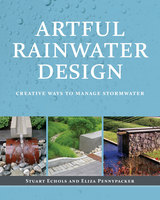
This beautifully illustrated, comprehensive guide explains how to design creative, yet practical, landscapes that treat on-site stormwater management as an opportunity to enhance site design. Artful Rainwater Design has three main parts: first, the book outlines five amenity-focused goals that might be highlighted in a project: education, recreation, safety, public relations, and aesthetic appeal. Next, it focuses on techniques for ecologically sustainable stormwater management that complement the amenity goals. Finally, it features diverse case studies that show how designers around the country are implementing principles of artful rainwater design.
Artful Rainwater Design is a must-have resource for landscape architects, urban designers, civil engineers, and architects who won't let stormwater regulations cramp their style, and who understand that for a design to truly be sustainable, people must appreciate and love it. It is a tool for creating landscapes that celebrate rain for the life-giving resource it is—and contribute to more sustainable, healthy, and even fun, built environments.
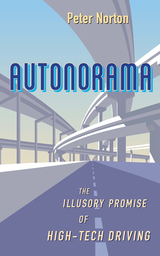
In Autonorama: The Illusory Promise of High-Tech Driving, technology historian Peter Norton argues that driverless cars cannot be the safe, sustainable, and inclusive “mobility solutions” that tech companies and automakers are promising us. The salesmanship behind the driverless future is distracting us from investing in better ways to get around that we can implement now. Unlike autonomous vehicles, these alternatives are inexpensive, safe, sustainable, and inclusive.
Norton takes the reader on an engaging ride —from the GM Futurama exhibit to “smart” highways and vehicles—to show how we are once again being sold car dependency in the guise of mobility. He argues that we cannot see what tech companies are selling us except in the light of history. With driverless cars, we’re promised that new technology will solve the problems that car dependency gave us—zero crashes! zero emissions! zero congestion! But these are the same promises that have kept us on a treadmill of car dependency for 80 years.
Autonorama is hopeful, advocating for wise, proven, humane mobility that we can invest in now, without waiting for technology that is forever just out of reach. Before intelligent systems, data, and technology can serve us, Norton suggests, we need wisdom. Rachel Carson warned us that when we seek technological solutions instead of ecological balance, we can make our problems worse. With this wisdom, Norton contends, we can meet our mobility needs with what we have right now.
READERS
Browse our collection.
PUBLISHERS
See BiblioVault's publisher services.
STUDENT SERVICES
Files for college accessibility offices.
RECENTLY PUBLISHED




UChicago Accessibility Resources
home | accessibility | search | about | contact us
BiblioVault ® 2001 - 2024
The University of Chicago Press